TEHRAN, November 29, 2026 — Iranian singer Parastoo Ahmadi and four members of her concert team have each received 74 lashes for a performance recorded nearly two years ago without a compulsory headscarf. The punishment has drawn international condemnation and renewed scrutiny of Iran’s restrictions on women, artistic expression and judicial authority.
An Iranian court’s decision to punish 29-year-old singer Parastoo Ahmadi and four male colleagues with a combined 370 lashes has exposed tensions between the country’s enforcement of public morality laws, artistic freedom and internationally recognised human rights.
The sentences were carried out on November 23, 2026, at the sentence-enforcement office of the Qom prosecutor’s office, according to defence lawyer Mostafa Nili. The decision followed a December 2024 musical performance that attracted widespread attention after being published online.
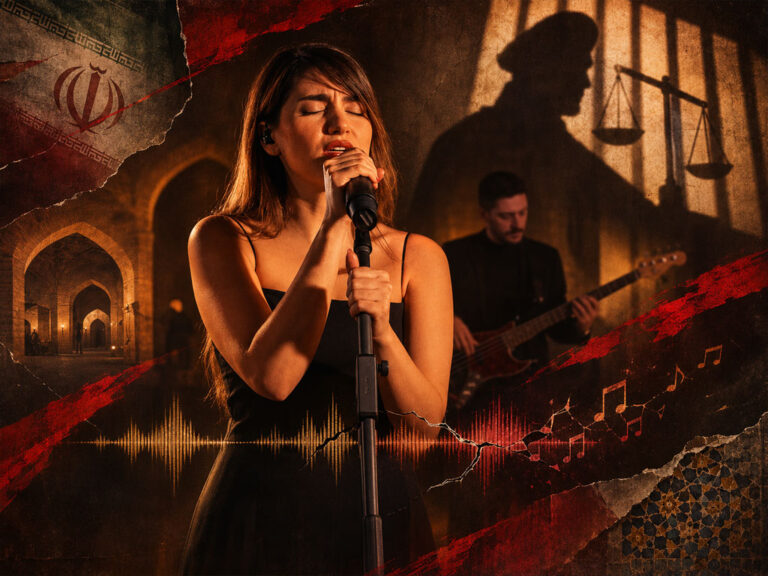
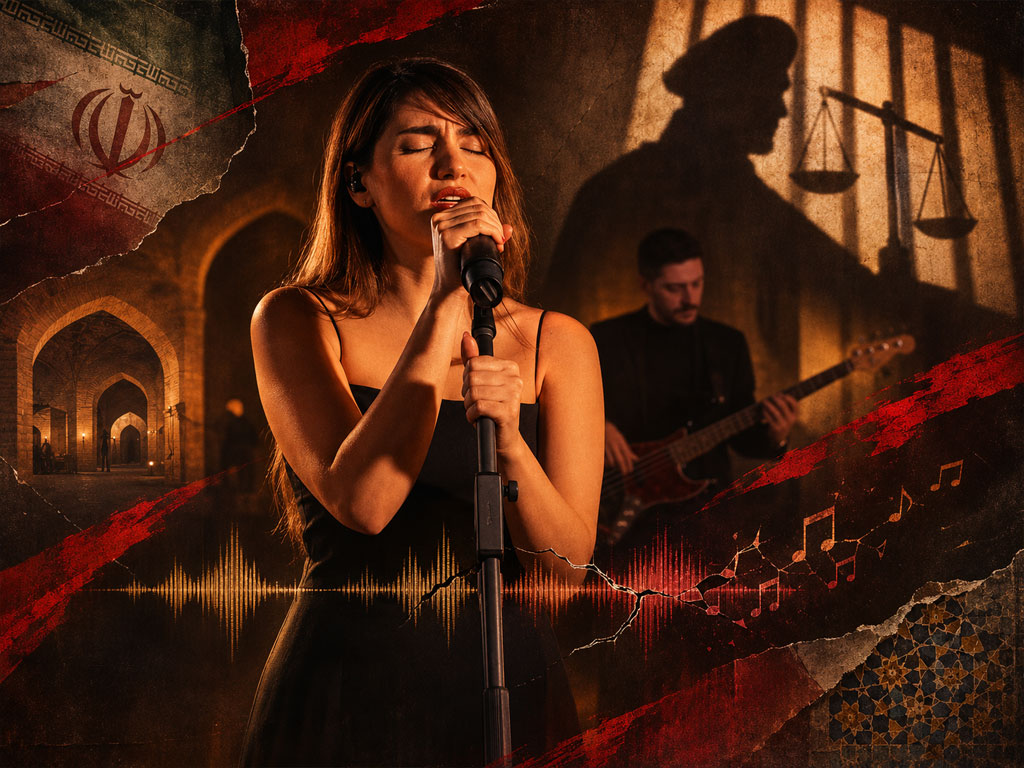
Ahmadi had appeared without the mandatory hijab, wearing a black sleeveless garment while performing alongside male musicians at the historic Deir-e Gachin caravanserai near Qom.
Her concert, recorded without a conventional audience, featured Persian songs and was presented as an opportunity to share her voice with the public.
The punishment has attracted particular scrutiny because the authorities acted almost two years after the concert was released, at a time when Iran is experiencing severe economic pressures, political unrest and the consequences of military conflict.
International human rights organisations have condemned the flogging, while Iranian lawyers, musicians and commentators have challenged both the legal basis of the convictions and their implications for artistic expression.

Five Artists Receive 370 Lashes
Ahmadi and four members of the production team were subjected to 74 lashes each on November 23.
Those punished alongside her were identified as:
- Parastoo Ahmadi, singer.
- Mohsen Lashkari, concert producer.
- Soheil Faghih-Nasiri, musician.
- Amin Taheri, musician.
- Amirali Pirnia, musician.
The cumulative punishment amounted to 370 lashes.
The proceedings followed a June 2026 ruling by a criminal court in Qom against nine individuals involved in producing the concert.
Each defendant was reportedly sentenced to 74 discretionary lashes, a two-year prohibition on artistic activities and a two-year foreign travel ban.
The convictions were subsequently upheld by the provincial appeals court.
Although five members of the group underwent the punishment on November 23, the publicly available reporting does not establish whether the remaining four, including pianist Ehsan Beyraghdar, have had their sentences enforced.
That distinction remains important because the original judgment concerned nine people, while the confirmed flogging involved five.
Lawyers had challenged the sentences, arguing that the performance did not constitute a criminal offence. Their objections did not prevent the punishment from being carried out.
A Concert That Challenged Iran’s Restrictions on Women
On December 11, 2024, Ahmadi released the performance from the ancient caravanserai near Qom.
The recording attracted considerable public attention because it challenged restrictions that have affected women’s public performances since Iran’s 1979 Islamic Revolution.
Female solo singing before mixed audiences has faced extensive official restrictions, although the precise legal and religious interpretations governing women’s voices have remained contested.
Ahmadi’s decision to perform without a headscarf added another dimension to the authorities’ objections.
Following the concert’s publication, security authorities took action against members of the production team.
The performance nevertheless continued circulating online, becoming an important cultural reference in discussions about women’s participation in Iranian public life.
It also acquired significance within the broader movement challenging compulsory dress requirements and restrictions on personal expression.
The political symbolism of Ahmadi’s performance, however, should be distinguished from the specific criminal charges brought against her.
The court’s case concerned the production and online distribution of material authorities considered contrary to public decency. It was not simply a conviction under a law expressly prohibiting women from singing.
The Legal Basis of the 74-Lash Sentence
The legal controversy centres on the interpretation of two provisions used in proceedings against Ahmadi and her colleagues.
According to legal reporting on the case, the court relied on Article 638 of Iran’s Islamic Penal Code and Article 743 of its Computer Crimes Law.
Article 638 addresses conduct classified as religiously prohibited or offensive to public decency.
Article 743 concerns the use of electronic systems to encourage or facilitate conduct that authorities classify as immoral or corrupt.
Iranian lawyer and human rights lecturer Saeed Dehghan has questioned the legal foundation of the judgment, arguing that the prosecution relied heavily on political and ideological interpretations rather than a clearly established prohibition against the artistic performance itself.
His analysis draws attention to the distinction between a general morality provision and an explicit criminal prohibition against a particular form of expression.
The fact that the concert was published online was also relevant to the authorities’ application of computer-related legislation.
Critics contend that using broad public morality provisions to prosecute artistic performances creates considerable uncertainty about what conduct may result in criminal punishment.
Iranian authorities, by contrast, have pursued the case on the basis that the performance and its online publication violated applicable morality standards.
The legality of that interpretation under Iranian domestic legislation is distinct from whether the resulting punishment complies with international human rights law.
Human rights organisations maintain that corporal punishment of this kind constitutes torture or other cruel, inhuman or degrading punishment, which is prohibited under international law.
Why the Punishment Came Almost Two Years Later
The interval between the December 2024 concert and the November 2026 flogging has prompted examination of the political circumstances surrounding the decision.
Iran has experienced substantial upheaval since the death of Mahsa Amini in police custody in September 2022, which triggered nationwide protests against compulsory hijab enforcement and wider restrictions on individual freedoms.
Although enforcement practices have fluctuated, the underlying legal framework governing women’s dress and public behaviour has not been comprehensively abolished.
The proposed Hijab and Chastity legislation, which would have strengthened enforcement mechanisms, was suspended rather than fully repealed.
That distinction has allowed disagreements over enforcement to persist within Iran’s political and judicial institutions.
The punishment also occurred against the backdrop of economic instability, protests and military conflict involving Iran, Israel and the United States during 2026.
Reuters reported on November 28 that Iranian insiders viewed the flogging as a demonstration of authority by hardline elements seeking to reinforce public compliance.
That interpretation was attributed to sources familiar with the political establishment; it is not a publicly acknowledged explanation from the Iranian judiciary.
Other analysts have similarly interpreted the punishment as a warning against dissent, particularly as authorities confront mounting domestic and external pressures.
The timing may therefore have political significance, although the available evidence does not independently establish why officials selected November 23 as the date for enforcement. Reuters+2
Women’s Rights and Divisions Within Iran
Ahmadi’s punishment has also highlighted disagreements within Iranian society over the role of women in cultural and public life.
The restrictions imposed on female singers have long been contested by musicians, cultural organisations and women’s rights advocates.
Music researcher Siavash Rokni has argued that the religious reasoning behind restrictions on women’s singing is more nuanced than a universal prohibition against hearing a female voice.
Under certain interpretations, restrictions depend on the perceived effects of singing rather than the mere fact that a woman is performing.
Critics say such interpretations can give authorities considerable discretion over women’s artistic activities while permitting comparable performances by men.
Iranian musicians and cultural figures have publicly opposed the punishment.
Veteran singer Mehdi Yarrahi, who himself received 74 lashes in March 2025 following a separate case involving a protest song against compulsory hijab, expressed solidarity with Ahmadi and her colleagues.
Other artists have also questioned the justification for corporal punishment over a musical performance.
Their objections demonstrate that criticism has not been confined to foreign governments or Western human rights organisations.
The controversy has also reached Iran’s political establishment.
President Masoud Pezeshkian published remarks on November 25 opposing violence against women, although he did not specifically name Ahmadi.
His statement should not be interpreted as confirmation that the executive branch formally opposed or attempted to overturn the court’s decision.
It nevertheless appeared at a politically sensitive moment, as public debate intensified over the punishment and the responsibilities of Iran’s governing institutions.
International Condemnation and the Question of Torture
United Nations High Commissioner for Human Rights Volker Türk publicly condemned the punishment.
He described the flogging as abhorrent and emphasised that corporal punishment involving torture or other cruel, inhuman or degrading treatment is prohibited under international law.
Türk also urged Iran to stop carrying out further flogging sentences and remove the practice from its legislation.
His intervention came as international human rights organisations raised broader concerns about the treatment of women, protesters, journalists and artists.
Amnesty International and other advocacy organisations have consistently opposed judicial corporal punishment and restrictions on freedom of expression.
The condemnation reflects a distinction between a government’s authority to enforce domestic legislation and its obligations under international human rights standards.
A punishment authorised by domestic law does not automatically satisfy those international obligations.
Iran’s judicial authorities have maintained extensive powers to prosecute conduct categorised as contrary to public morality, while rights advocates have argued that these powers are incompatible with protections for freedom of expression and bodily integrity.
For Ahmadi and her colleagues, the consequences extend beyond the physical punishment.
The two-year restrictions on travel and artistic activities may also affect their ability to work, perform and participate in cultural events.
The Danger of Misattributed Statements
The case has generated numerous social media posts, including quotations attributed to Ahmadi after the punishment.
One widely circulated statement claims that she publicly described the 74 lashes as the price she paid for freedom.
However, the available reporting does not establish that Ahmadi made that particular statement following the November 23 punishment.
Similar language has been associated with Mehdi Yarrahi, the Iranian musician previously punished in a separate case.
Attributing such remarks to Ahmadi without confirmation risks introducing misinformation into an otherwise well-documented human rights story.
Her decision to publish the 2024 concert and the circumstances surrounding the recording are independently reported.
Those events provide sufficient evidence of the artistic expression at the centre of the prosecution without requiring unverified statements to strengthen the account.
A Wider Pattern of Pressure on Iranian Artists
Ahmadi’s punishment forms part of a broader history of prosecutions and restrictions affecting Iranian artists.
Musicians including Mehdi Yarrahi, Toomaj Salehi and Shervin Hajipour have faced legal proceedings associated with politically sensitive artistic expression.
Filmmakers, including Jafar Panahi, have also encountered restrictions, imprisonment or prosecution linked to their work and public positions.
These cases differ in their legal circumstances and should not be treated as interchangeable.
Together, however, they illustrate the difficulties faced by artists operating within Iran’s restrictive political and cultural environment.
The latest case has renewed attention to the discretionary powers available to courts when interpreting public morality offences.
It has also highlighted the consequences of allowing criminal punishment to extend into artistic expression and online cultural participation.
What Happens to the Remaining Four Defendants?
Although the flogging of Ahmadi and four colleagues has been confirmed through their legal representatives and international reporting, several matters remain unresolved.
The publicly established record does not conclusively explain the enforcement status of the sentences against the other four individuals convicted in June 2026.
Nor does it establish whether any further legal remedies remain available following the appeals court’s decision.
The two-year restrictions on artistic activities and foreign travel also raise questions about the defendants’ professional futures.
For Iranian cultural organisations, the controversy continues to involve the application of morality laws to artistic expression.
For international human rights bodies, it centres on the prohibition of corporal punishment and the protection of fundamental freedoms.
The central legal issue extends beyond a single concert. It concerns whether musicians can exercise artistic freedom without facing physical punishment under broadly interpreted morality provisions.
Nearly two years after Ahmadi’s performance became available to audiences around the world, the enforcement of the court’s sentence has brought that question back into international focus.
The immediate consequences for the five artists are established. The wider implications for Iran’s treatment of women performers, freedom of expression and judicial corporal punishment remain unresolved.