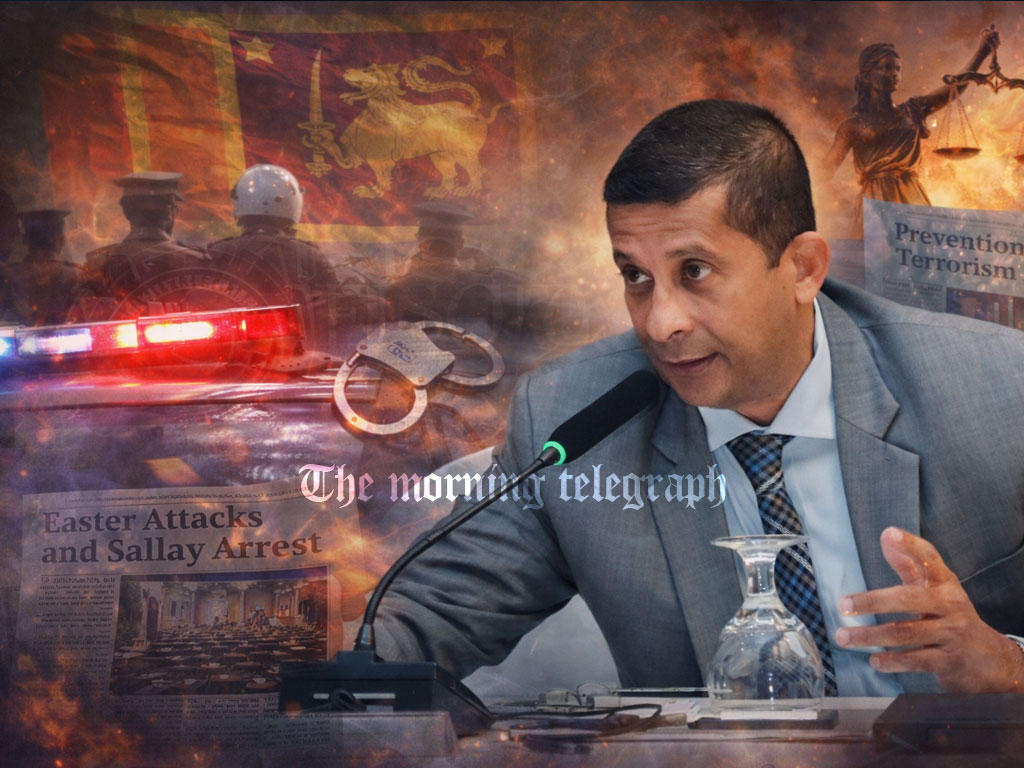
The dramatic arrest of former intelligence chief Suresh Sallay has reignited debate over the Easter Sunday investigations, raising questions about evidence, timing, and whether Sri Lanka is witnessing justice unfold or a high stakes political gamble.
The recent arrest and detention of Major General Retired Suresh Sallay, a former head of military intelligence, under the Prevention of Terrorism Act in connection with the 2019 Easter Sunday attacks has triggered intense public debate. Opinions remain sharply divided. Supporters of the move argue that investigators may have uncovered new leads, while critics claim the arrest reflects political motivations rather than solid legal evidence. As a result, the controversy surrounding Sallay’s arrest has become deeply intertwined with political narratives and public distrust surrounding the Easter Sunday investigation.

Under normal circumstances, the police cannot arrest individuals merely on suspicion, particularly under powerful laws such as the Prevention of Terrorism Act. Therefore the Criminal Investigation Department now faces the responsibility of explaining not only why Sallay was arrested but also why the arrest was conducted in such a dramatic manner. The retired officer was living openly and had not shown any sign of attempting to flee the country or evade questioning. Critics argue that investigators could have summoned him to the CID headquarters for questioning rather than arresting him publicly on the road. Such procedures are commonly followed during sensitive investigations. Instead, the authorities announced the arrest at a highly publicized media briefing that raised more questions than answers.
The timing of the arrest has also generated suspicion among analysts and observers. With the seventh anniversary of the Easter Sunday terror attacks approaching, some argue that the authorities may be attempting to demonstrate progress in a case that has remained unresolved for years. The arrests and announcements have been portrayed by some critics as an attempt to present a dramatic investigative breakthrough. However legal experts caution that dramatic arrests alone do not prove guilt. Investigators must present convincing evidence in court if the case is to stand.
One of the key claims cited in public discussions originates from statements made by Hanseer Azad Maulana, a former associate of Sivanesathurai Chandrakanthan also known as Pillayan. In a controversial interview given to an international television network, Maulana alleged that intelligence officials including Sallay had links to the Easter Sunday attacks and that a cover up followed the tragedy. These allegations quickly gained global attention. However Maulana’s credibility has been widely questioned, particularly because he is currently seeking political asylum in Switzerland and faces accusations of political motives.
A committee appointed by the Sri Lankan government to review the claims made in the documentary examined the evidence presented by Maulana. The committee, chaired by retired Supreme Court Justice S. I. Imam, concluded that the allegations lacked credible proof and rejected several of the claims made in the broadcast. Despite that finding, the narrative that elements within the intelligence community might have had knowledge of the attacks continues to circulate within political discourse.
The origins of that suspicion can be traced to a Parliamentary Select Committee formed after the attacks in 2019. The committee included members from the ruling coalition of the time and several opposition figures. Their final report highlighted serious failures within the national intelligence system. According to the committee, intelligence warnings about possible attacks were known to certain individuals but were not properly shared with relevant authorities. The report also raised concerns that some officials may have failed to act on intelligence warnings, creating an atmosphere of uncertainty and fear during a politically sensitive period ahead of the presidential election.
The report noted that such circumstances could potentially influence public opinion and calls for political change. It also pointed to leadership changes within the security apparatus that occurred during that period. These observations fueled speculation about whether the security failures were simply incompetence or something more deliberate. However the committee did not provide definitive proof of a conspiracy.
Some political figures have also raised the possibility of foreign involvement in the attacks. Several witnesses who appeared before the Presidential Commission of Inquiry investigating the Easter Sunday bombings suggested that international actors might have played a role in the tragedy. Senior police investigators and religious leaders expressed concerns about possible external influence. Nevertheless no definitive evidence has yet been publicly presented to support these theories.
At the same time, critics argue that the political context of 2019 must be considered. The Yahapalana government was already weakening at the time. Internal divisions had intensified after the Sri Lanka Freedom Party withdrew from the coalition, and political alliances were shifting rapidly. The opposition Sri Lanka Podujana Peramuna had gained significant momentum following its sweeping victory in the 2018 local government elections. Many analysts believed that a presidential election held in that environment would already favor the opposition.
The fact that Gotabaya Rajapaksa later capitalized on the public fear and insecurity created by the Easter Sunday attacks to launch his presidential campaign does not necessarily prove that intelligence officials loyal to him orchestrated the attacks. Political actors frequently use crises and tragedies to shape electoral narratives. History offers several examples where parties have gained political advantage from public outrage or fear following major events.
Another important point raised by critics concerns Sallay’s whereabouts during the attacks. Reports indicate that he was overseas at the time the bombings occurred. This raises questions about how a complex terror plot could have been coordinated by someone who was not even in the country. Skeptics argue that such an operation would have required extensive planning and coordination that would likely have been detected by a government already determined to weaken the Rajapaksa political network.
Ultimately, the debate surrounding Sallay’s arrest highlights the difference between suspicion and proof. Detaining a suspect during an investigation is one matter. Successfully prosecuting a case in court requires credible evidence that can withstand rigorous legal scrutiny. The burden now rests squarely on investigators and the government to demonstrate that the accusations are supported by solid facts rather than political speculation.
If prosecutors fail to present compelling evidence, the arrest could be remembered as a dramatic but misguided move that undermined confidence in the justice system. On the other hand, if investigators manage to prove their claims beyond reasonable doubt, the arrest could represent a major turning point in the long struggle to uncover the truth behind the Easter Sunday tragedy. Until that evidence emerges in court, the case remains a high risk political gamble for the authorities who chose to pursue it.