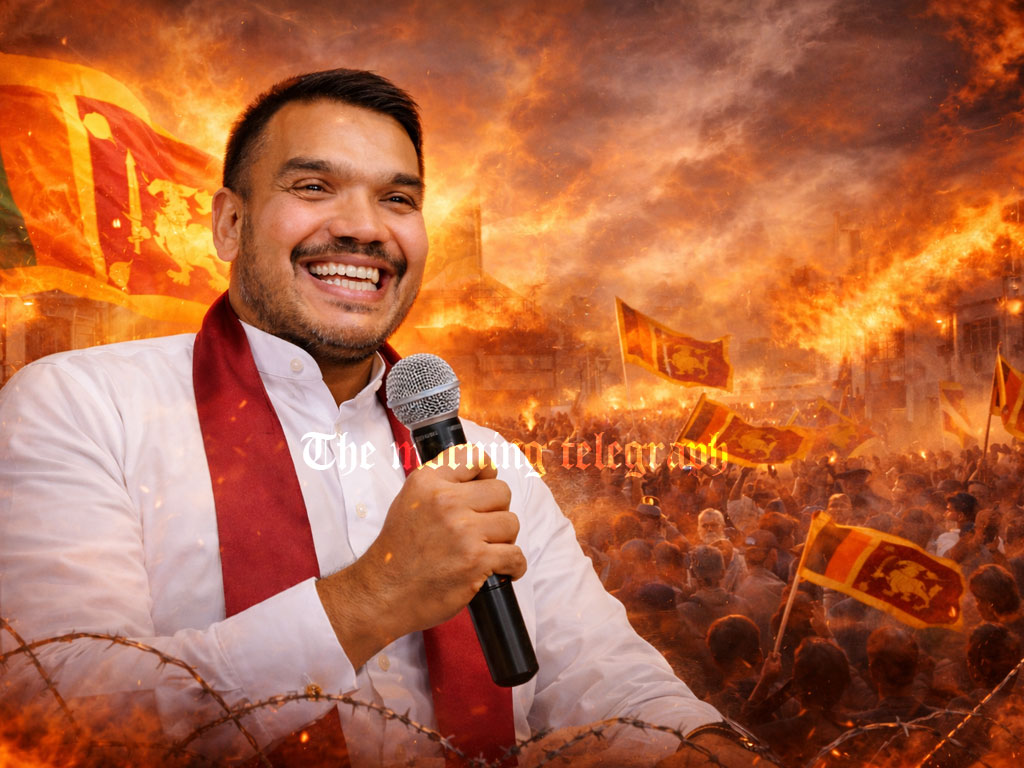
At a Women’s Day event in Matale, Namal Rajapaksa delivered a sweeping political reflection on sacrifice, leadership, and the role of women in shaping Sri Lanka’s future, arguing that difficult decisions made during moments of crisis helped protect the country and preserve democracy.
Sri Lanka Podujana Peramuna National Organizer and Parliamentarian Namal Rajapaksa delivered an emotional and politically reflective speech during the party’s International Women’s Day celebration held in Matale. Speaking before party members and supporters, he emphasized the importance of women, family values, and national unity while reflecting on several political and social crises faced by Sri Lanka in recent years.

Rajapaksa began by highlighting the cultural and emotional foundations on which Sri Lankan society is built. According to him, the nation’s strength originates from the respect given to mothers, wives, and family structures. He noted that Sri Lankans traditionally view the motherland with the same reverence they give their own mothers. In his view, a society that cannot respect parents or family relationships cannot develop into a nation that respects its country.
He stressed that love for the motherland grows naturally from these social values. Fathers, sons, brothers, and sisters, he said, carry deep respect for the country in the same way they honor their families. Without those cultural foundations, he argued, it becomes difficult to build a stable and compassionate society.
Addressing the gathering, Rajapaksa also thanked the organizers for hosting a women’s conference in Matale in connection with International Women’s Day. He acknowledged that women often carry the heaviest burdens during national crises. Whether the challenges are economic, political, or social, women tend to be the first to feel the pressure inside families and communities.
Reflecting on Sri Lanka’s civil war period, he spoke about the sacrifices made by mothers and families whose children were sent to the battlefield. According to Rajapaksa, those sacrifices allowed young people across the country to grow up in a society free from constant fear of violence and death. Mothers and daughters, he said, endured deep pain but played a crucial role in securing peace and stability.
He pointed out that even during economic hardships, the first impact is usually felt within the home, particularly by mothers and wives responsible for managing family life. Rising costs, taxation, and financial pressures directly affect households, making women central to the struggle for economic survival.
Rajapaksa also noted that political parties across Sri Lanka increasingly highlight youth and women in their policy discussions and political messaging. Election manifestos often promise opportunities and empowerment for these groups. However, he acknowledged that turning those promises into real progress at the grassroots level remains a challenge.
In his remarks, Rajapaksa stressed the importance of creating a society where women can stand on their own feet and make independent decisions. He said Sri Lanka’s cultural, religious, and social traditions should support women in building their futures with dignity and confidence. According to him, women must be empowered not only through political rhetoric but through real opportunities that strengthen their role in society.
He then reflected on several key political moments in Sri Lanka’s recent history. Rajapaksa credited former President Mahinda Rajapaksa with ending the civil war and protecting the state from collapse. In his view, the end of the war prevented the country from falling into deeper social chaos and helped save countless lives.
The discussion also turned to the period of the Covid-19 pandemic. Rajapaksa said that former President Gotabaya Rajapaksa faced extremely difficult decisions when the global health crisis struck. According to him, the government had to balance economic pressures with the need to protect human life. He argued that the leadership at the time chose to prioritize saving lives even when it meant facing severe economic consequences.
Speaking about the political unrest that followed in Sri Lanka, Rajapaksa acknowledged that there were many reasons behind the public protests and social tensions. Some concerns raised during the protest movement were legitimate, he said, while others were driven by political motives.
However, he argued that the government ultimately chose to step back in order to prevent the country from descending into a larger social disaster. By stepping aside, he said, the state institutions were protected even though the government itself collapsed.
Rajapaksa suggested that this decision preserved Sri Lanka’s democratic framework. Because the state remained intact, the country was able to change governments through political processes and continue functioning within constitutional and democratic boundaries.
He argued that if the situation had escalated into violent instability or widespread social collapse, thousands of innocent lives could have been lost across villages and communities. According to him, stepping back during the political crisis allowed the country to avoid that outcome.
The parliamentarian emphasized that throughout history the party had taken decisions aimed at protecting the nation during times of danger. Ending the war, managing the Covid-19 crisis, and responding to political unrest were all described as attempts to prevent large-scale social disasters.
Rajapaksa also spoke about the important role women have played in politics both in Sri Lanka and globally. He referred to prominent female leaders such as Sirimavo Bandaranaike, Indira Gandhi, Benazir Bhutto, and Sheikh Hasina as examples of women who led their countries during complex geopolitical challenges.
According to him, these leaders demonstrated how strong decision making by women could guide nations through difficult times. Sri Lanka, he said, has a proud history of women who stepped forward to lead the country during critical moments.
Rajapaksa also pointed to contemporary geopolitical tensions, particularly conflicts in the Middle East, which have created uncertainty for many Sri Lankan families. A large number of Sri Lankan women work in Middle Eastern countries, and their families back home anxiously follow developments in the region.
He said the government must pay close attention to the safety and wellbeing of these workers. Parents and relatives in Sri Lanka, he noted, are deeply concerned about the conditions faced by their daughters, sisters, and mothers working abroad.
Similarly, many young Sri Lankan men are employed in countries such as Israel and other parts of the Middle East. Their families also worry about their safety as regional tensions escalate.
Rajapaksa urged authorities to ensure that the state fulfills its responsibilities toward these citizens by protecting them and responding quickly to emerging risks.
Looking ahead, he noted that the challenges facing Sri Lanka and the world are rapidly changing. Global politics, economic uncertainty, and geopolitical conflict are reshaping the international environment at a pace few expected.
The world today, he said, is already very different from what it was only days earlier. Countries must prepare themselves for unexpected crises and adapt to rapidly evolving conditions.
Rajapaksa concluded by emphasizing the importance of building a new generation of political leadership that includes strong female voices. He praised the Sri Lanka Podujana Peramuna Women’s Organization and said it has become one of the most active and influential wings of the party.
He noted that several young women speakers and leaders are emerging within the party and contributing meaningfully to political debate. Encouraging this leadership, he said, is essential for creating a modern political force capable of guiding the next generation.
According to Rajapaksa, women must play a decisive role not only in community life but also in national decision making. He expressed hope that future elections would bring greater female representation to Parliament.
He ended his speech by returning to the values of family, respect, and cultural unity. The strength of a nation, he said, ultimately depends on the respect people show toward mothers, wives, sisters, and families.
A society built on respect, compassion, and shared values, he concluded, is the foundation upon which Sri Lanka’s future must be constructed.