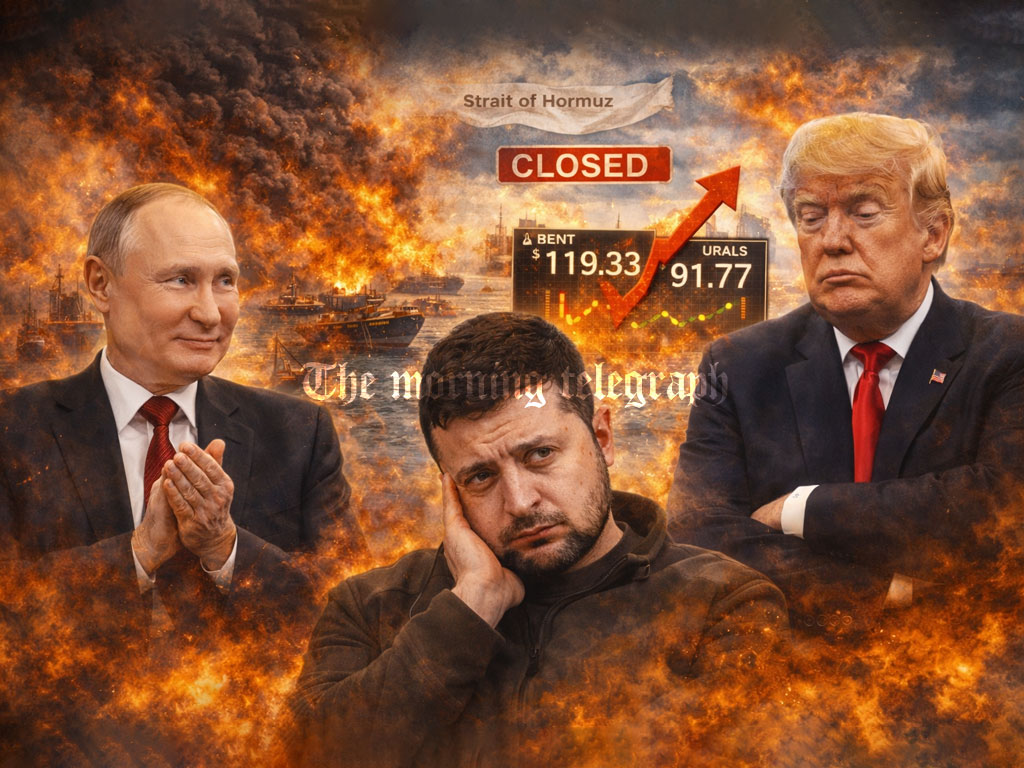
A deepening US Israeli and Iranian conflict has shaken the global energy market, pushing Russian Urals crude above the Brent benchmark for the first time and raising fears of a worldwide economic slowdown.
The escalating conflict involving the United States, Israel and Iran has triggered major disruptions in the global oil market, creating what analysts describe as the early stages of a global energy crisis. One of the most striking developments is that Russia’s Urals crude oil has reportedly surpassed the international Brent crude benchmark for the first time in history.

This unusual price shift reflects the instability in the Middle East energy supply chain. Military tensions in the Persian Gulf region have severely affected oil production and shipping routes. As the conflict continues, the energy market is facing unprecedented volatility that could reshape global oil trade.
A key factor behind the disruption is the situation in the Strait of Hormuz, one of the world’s most critical maritime energy corridors. Nearly one third of global seaborne crude oil shipments normally pass through this narrow passage. However, Iranian military activity and growing security risks have significantly reduced shipping operations in the area. Insurance companies have also become reluctant to cover vessels moving through the region.
As a result, major Gulf producers such as Kuwait, Iraq and the United Arab Emirates have taken steps to limit their oil production and exports.
Russia, which controls roughly 11 percent of global oil output, now finds itself in a strategic advantage. Unlike many Middle Eastern exporters, Russia does not rely on the Strait of Hormuz for its oil shipments and is not directly involved in the current Persian Gulf conflict.
Brent crude briefly surged to around 119 dollars per barrel before settling near 91 dollars. At the same time Russian Urals crude is reportedly being sold to major buyers including India at prices exceeding that level.
The surge in Russian oil revenues has raised alarm in both the United States and the European Union. European officials warn that the additional income could help Moscow finance its ongoing war in Ukraine.
In an effort to stabilize global oil prices, US President Donald Trump has temporarily relaxed restrictions on India’s purchases of Russian crude, granting a 30 day exemption.
A Global Energy Shock
Oil market analysts warn that Brent crude could climb to 130 dollars per barrel if the conflict continues to disrupt global supply routes. Such a surge could trigger a severe slowdown in the world economy.
The war in the Middle East is already transforming global energy dynamics and geopolitical calculations.
Power Politics and the Future
Ukraine’s President Volodymyr Zelensky has also expressed concern about the situation. Kyiv fears that US military resources may shift toward the Middle East conflict, potentially reducing support for Ukraine.
Observers note that Washington’s current strategy signals a new geopolitical era where raw power may increasingly shape global decisions.