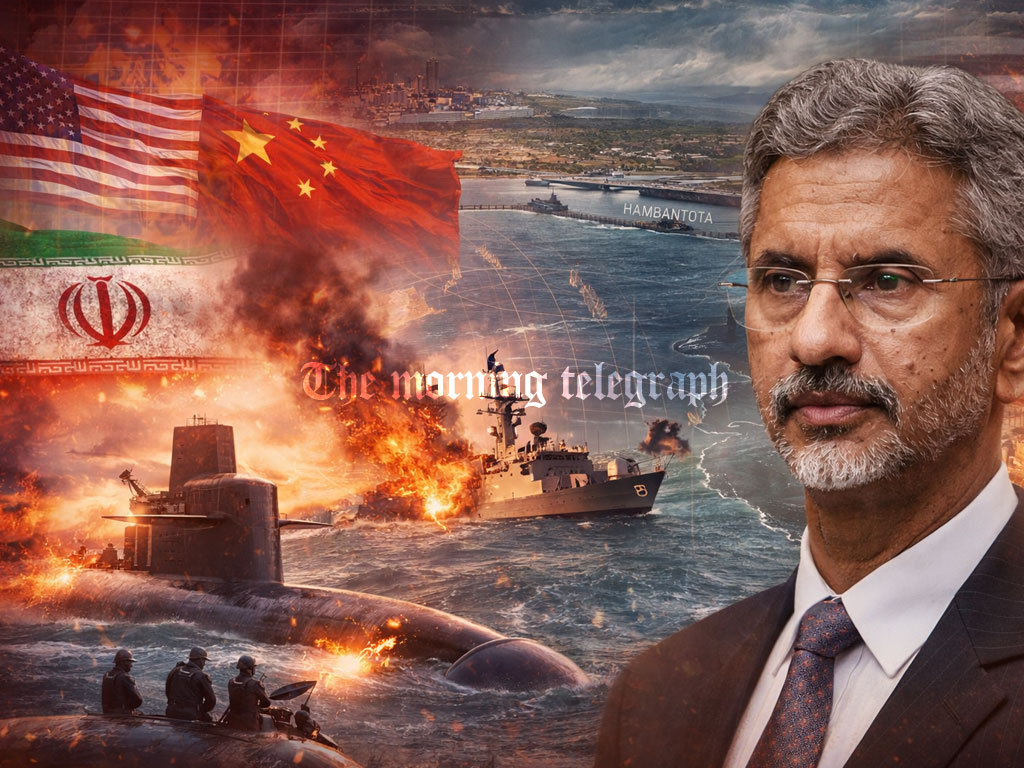
The sinking of an Iranian frigate in Sri Lankan waters by a United States submarine has ignited a diplomatic firestorm, with India’s Foreign Minister linking the incident to Chinese military presence in the region and exposing the delicate power dynamics playing out across the Indian Ocean.
The destruction of the Iranian Moudge-class frigate IRIS Dena, which was attached to Tehran’s southern fleet operating in the Gulf of Oman and the Strait of Hormuz, appears to have been strategically calculated to create widespread chaos across the Indian Ocean region. The vessel met its end not in the familiar waters of the Persian Gulf, but thousands of kilometres away, off the southern coast of Galle, lying deep within Sri Lanka’s Exclusive Economic Zone.
Indian External Affairs Minister Dr. S. Jaishankar used the ensuing controversy to spotlight what he described as an intimidating foreign military buildup in the Indian Ocean, specifically identifying the Hambantota harbour as a Chinese military facility. His remarks came during the Raisina Dialogue 2026, held in New Delhi from March 5 to 7, in response to pointed questions about India’s self-proclaimed role as the region’s premier net security provider.

The annual conference, launched in 2016 shortly after Narendra Modi first assumed the prime ministership, became the stage for a revealing exchange about the nature of great power competition in South Asian waters. When pressed about the US submarine attack on the Iranian vessel, Jaishankar appeared visibly unsettled. He urged the moderator, Pakki Sharma Ipadhyay, to grasp what he termed the ground realities of the Indian Ocean.
The Foreign Minister pointed to the longstanding joint US-British military presence at Diego Garcia, which has now operated for five decades. He then drew attention to China’s expanding military footprint, including its base in Djibouti established in 2017, and the controversial Chinese takeover of Hambantota port during the same period. Beijing secured this strategically positioned harbour on a 99-year lease for 1.2 billion US dollars, successfully overcoming Indian attempts to block Chinese infrastructure projects in Sri Lanka, including the Colombo port city development.
The submarine responsible for the attack is widely believed to be the Virginia-class USS Minnesota, though some sources identify it as the USS Charlotte. International news agencies report that three Australian Navy personnel were aboard the vessel at the time of the incident. Diego Garcia serves as a critical hub for military operations across the Middle East, Africa and the wider Indo-Pacific region.
Notably, Jaishankar omitted mentioning that India, as a key US ally and Quad member, operated P8A maritime patrol and reconnaissance flights from Diego Garcia as recently as the previous October. The growing strategic alignment between Washington, New Delhi and Tel Aviv continues to strengthen, paralleling enhanced US engagement with Colombo.
The Foreign Minister emphasized the deployment of the US Fifth Fleet in Bahrain, a nation which had been targeted by Iranian retaliation following the joint US-Israeli assassination of Iran’s Supreme Leader and senior government officials. This massive surprise attack was clearly designed to trigger regime change in Tehran. Jaishankar briefly explained how India and Sri Lanka managed the threat to three Indian naval vessels following these unprovoked attacks.
Sri Lankan Foreign Minister Vijitha Herath, who appeared before the same forum, struggled to articulate his government’s position effectively. Jaishankar drew laughter from the audience at Herath’s expense as the Sri Lankan official repeatedly insisted that Colombo would address the situation according to the UN Convention on the Law of the Sea and established international legal frameworks. Critics suggested Herath should have clarified that Hambantota does not function as a military base and cannot reasonably be compared to China’s Djibouti facility.
The incident reflects typical Western power dynamics, with the United States showing little regard for international legal constraints. President Donald Trump has made Washington’s position abundantly clear on multiple occasions.
Israel has acknowledged that the decision to attack Iran was made months in advance. The sinking of the Iranian vessel, which was entirely domestically constructed and launched in 2021, must therefore be understood within the broader context of US-Israeli strategy aimed at dismantling the Islamic revolutionary government and installing a Western-friendly administration. This echoes the 1953 coup that removed democratically elected Prime Minister Mossadegh.
US Defence Secretary Pete Hegseth offered a chilling assessment, stating that IRIS Dena thought it was safe in international waters but died a quiet death. The submarine launched its torpedo on the morning of March 4, striking the vessel 19 nautical miles off Galle, within Sri Lanka’s exclusive economic zone. The decision to attack was likely finalized before IRIS Dena participated in the International Fleet Review and Exercise Milan 2026 at Visakhapatnam, held from February 15 to 25.
Iran appears to have fatally misjudged US intentions, having been previously deceived during negotiations when Washington and Tel Aviv jointly attacked its nuclear research facilities last June while discussions were ongoing. Had Tehran comprehended the strategic threat, it might have withdrawn from the Indian-hosted naval exercises. Iranian officials possibly believed their vessels would be safe as guests of the Indian Navy. The US Navy withdrew from the exercise, though the US Air Force participated.
The American action inadvertently elevated the profile of the Raisina Dialogue 2026, though at India’s expense. Prime Minister Modi’s two-day visit to Tel Aviv, occurring just before the US-Israel campaign to effect regime change in Tehran commenced, compounded the diplomatic damage. The BJP has clearly signalled its alignment, but Washington’s actions have undeniably humiliated New Delhi.
The Indian Navy had warmly welcomed the Iranian warship on February 17, the day before President Droupadi Murmu presided over the International Fleet Review off Visakhapatnam. “Welcome!” the Navy posted on social media, greeting IRIS Dena as it steamed into port. Photographs showed Iranian sailors aboard the grey frigate gliding into the Indian harbour on a clear day. Hashtags celebrated Bridges of Friendship and United Through Oceans.
American Submarine Struck Iranian Vessel in Sri Lankan Waters
Three Iranian vessels participated in the International Fleet Review. Besides the ill-fated IRIS Dena, the frigate IRIS Lavan and auxiliary ship IRIS Bushehr completed the contingent. Jaishankar revealed at the Raisina Dialogue that Tehran requested permission for IRIS Lavan to enter Indian waters, which New Delhi granted, accommodating the vessel at Cochin Port on the Arabian Sea in Kerala.
When the US torpedo struck IRIS Dena within Sri Lanka’s Exclusive Economic Zone, IRIS Lavan was docked safely at Cochin. Sri Lankan territorial waters extend 12 nautical miles from the coastline, approximately 22 kilometres. The attack occurred 19 nautical miles off the southern coast, placing it clearly within international norms for EEZ jurisdiction but raising significant sovereignty questions.
Sri Lanka also participated in the International Fleet Review and Milan 2026. The SLN Sagara, a Vikram-class offshore patrol vessel formerly operated by the Indian Coast Guard, and SLN Nandimithra, a fast missile vessel acquired from Israel, joined the exercises before returning to Colombo on February 27, the day before IRIS Lavan sought refuge in Indian waters.
Contrary to widespread belief that Sri Lanka responded to a distress call from the Iranian ship, the Indo-Pacific Command actually alerted the Maritime Rescue Coordination Centre after delivering the single torpedo strike. The Sri Lanka Navy’s Southern Command deployed three Fast Attack Craft, with a tug from the Sri Lanka Ports Authority joining subsequently.
The Indo-Pacific Command rejected Iranian claims that IRIS Dena was unarmed, stating that US forces planned for and Sri Lanka provided life-saving support to survivors in accordance with the Law of Armed Conflict. In explicit social media posts, Washington confirmed that the rescue operation proceeded according to their planning, executed by the Sri Lanka Navy.
IRIS Lavan and IRIS Bushehr will likely remain berthed at Cochin and Trincomalee ports respectively for an extended period, with their crews accommodated ashore. Given the US-Israel determination to pursue their campaign fully, neither India nor Sri Lanka is likely to permit these vessels to depart in the foreseeable future.
India Faces Diplomatic Embarrassment Following Attack on Iranian Naval Guests
Former Indian Foreign Secretary Kanwal Sibal expressed deep embarrassment for the Modi administration, asserting that IRIS Dena would not have been targeted had Iran not been invited to participate in the International Fleet Review and Milan exercises. We were the hosts, he posted on social media. As per protocol for this exercise, ships cannot carry any ammunition. It was defenceless. The Iranian naval personnel had paraded before our president.
Sibal characterized the attack as premeditated, noting that the US Navy withdrew from the exercise at the last minute, presumably with this operation in mind. He emphasized that Washington disregarded India’s sensitivities, given that the Iranian ship was present in the waters due to New Delhi’s invitation.
While stressing that India bears no political or military responsibility for the American attack, Sibal acknowledged a moral and humanitarian obligation. He suggested that the Indian Navy, after appropriate political clearance, should offer condolences for the lives lost among those who were India’s invitees and had saluted the Indian president.
Both Iran and India apparently missed the significance of the US Navy’s eleventh-hour withdrawal from the exercises. New Delhi and Colombo, now entangled in US-Israeli strategic calculations, face uncomfortable questions from domestic political opposition. The Congress party in India, along with Sri Lanka’s Samagi Jana Balwegaya and Sri Lanka Podujana Peramuna, have exploited the situation to target their respective governments. Both nations now find themselves playing unprecedented roles in post-Milan 2026 developments that could permanently affect their relationships with Tehran.
India and Sri Lanka also notably failed to condemn the February 28 assassination of Iranian Supreme Leader Ayatollah Ali Khamenei, which occurred while Tehran was engaged in US-mediated talks through Oman. Leader of the Opposition Rahul Gandhi questioned New Delhi’s silence on March 3, posting on social media that Prime Minister Modi must speak up. He asked whether Modi supports the assassination of a Head of State as a way to define the world order, warning that silence now diminishes India’s standing in the world.
Under mounting opposition pressure, India finally offered condolences on March 5, nearly a week after the killing. Foreign Secretary Vikram Misri visited the Iranian Ambassador in Delhi to sign the condolence book, though the gesture appeared belated and somewhat reluctant.
Sri Lanka’s Opposition Questions Naval Capabilities Following Attack
The opposition has also scrutinized Sri Lanka’s National People’s Power government handling of the IRIS Dena incident, though critics conveniently ignore that any administration would face similar constraints in defying US demands. Under President Trump, Washington has behaved recklessly even toward longstanding allies, demanding Canada become the 51st state and insisting Denmark surrender Greenland immediately.
Opposition leader Sajith Premadasa cut a diminished figure demanding parliamentary answers about Sri Lanka’s submarine detection capabilities. Colombo should rather appreciate that its Southern Command rapidly deployed three Fast Attack Craft and a port authority tug, saving 32 Iranian lives and recovering 84 bodies. Of the 180 crew members aboard IRIS Dena, 116 have been accounted for, with 64 personnel missing and presumed dead.
Sri Lanka could not have intervened without the US signal authorizing the humanitarian rescue operation. India similarly must have coordinated with Washington regarding Tehran’s request for IRIS Lavan to re-enter Indian waters. Colombo could not have hosted the Iranian auxiliary vessel without American consent. President Trump shows no interest in diplomatic conventions, consistently demonstrating reckless disregard for European allies. The uncomfortable truth remains that Washington could have destroyed the entire Iranian flotilla even within Sri Lankan or Indian waters, given that Exclusive Economic Zones extend 200 nautical miles from coastlines.
Historical Defence Agreements Reveal Depth of US-Sri Lanka Security Ties
Despite repeated assertions of neutrality, successive Sri Lankan governments have yielded to American pressure. In March 2007, the Mahinda Rajapaksa administration signed the Acquisition and Cross-Servicing Agreement with Washington, establishing a high-profile bilateral mechanism ensuring uninterrupted logistical support. The Rajapaksas proceeded despite opposition from some partners, with then Defence Secretary Gotabaya Rajapaksa, then a US citizen, and Ambassador Robert O. Blake signing without cabinet consultation.
Following this agreement, the US provided critical intelligence enabling the Sri Lanka Navy to destroy four floating LTTE arsenals. Whatever criticisms may be levelled, this American intervention disrupted the rebel supply line and destroyed their conventional fighting capability by March 2009. The US responded favourably to Vice Admiral Wasantha Karannagoda’s assistance request, though the intelligence sharing exceeded ACSA provisions.
The agreement covered 2007 to 2017 and was extended by the Yahapalana government without formal discussion among SLFP and UNP partners, despite President Maithripala Sirisena’s attempts to distance himself from the arrangement.
The US had previously pushed for ACSA during Ranil Wickremesinghe’s 2001-2003 premiership, though he lacked sufficient political strength to finalize it amid opposition resistance. During the Yahapalana extension, Washington also sought a Status of Forces Agreement, a legally binding instrument governing US force deployment. While SOFA never materialized, the possibility of renewed American pressure cannot be dismissed.
Gotabaya Rajapaksa, victorious in the 2019 presidential election, incurred Washington’s displeasure by declining to finalize the Millennium Challenge Corporation Compact based on Professor Gunaruwan Committee findings that the agreement threatened national security, sovereignty and the legal system. During the election campaign, UNP leader Ranil Wickremesinghe declared he would sign if Sajith Premadasa won.
Post-Aragalaya Government Deepens Military Cooperation with Washington
Since the September 2024 presidential election, four-star Admiral Steve Koehler, Commander of the US Pacific Fleet, has visited Colombo twice, in October 2024 and February 2026. These represent the highest-level American military engagements with Sri Lanka since 2021.
Between Koehler’s visits, Washington and Colombo signed a Memorandum of Understanding formalizing defence partnership between the Montana National Guard, US Coast Guard District 13, and Sri Lankan armed forces under the State Partnership Programme. The JVP-led NPP government appears confident in its policy direction, having delayed decisions on extending the one-year moratorium on foreign research vessels, though the ban was designed to exclude Chinese ships. The government has yet to announce its position despite the ban expiring on December 31, 2024.
Former President Ranil Wickremesinghe imposed the ban under intense US-Indian pressure. The current administration’s relationships with Washington and New Delhi should be examined against allegations that both facilitated the Aragalaya uprising that forced Gotabaya Rajapaksa from office.
The Trump administration demonstrated its commitment to Sri Lanka relations by transferring the former US Coast Guard Cutter Decisive to the Sri Lanka Navy. The vessel, commanded by Captain Gayan Wickramasooriya, departed Baltimore’s US Coast Guard Yard East Wall Jetty on February 23 and should reach Trincomalee in mid-May.
Last year, Sri Lanka signed seven Memorandums of Understanding, including defence cooperation, and sold controlling shares of Colombo Dockyard Limited to a Defence Ministry-affiliated company as New Delhi strengthened its regional influence.
Strategic Realignments Reshape Indian Ocean Geopolitics
Sri Lanka-US relations appear firmly on track, with the IRIS Dena incident unlikely to disrupt bilateral ties. Washington continues taking extraordinary measures to facilitate its Iranian campaign, temporarily easing sanctions to permit Indian purchases of Russian oil, overcoming Tehran’s blockade on crude carriers.
Treasury Secretary Scott Bessent characterized the 30-day waiver as a deliberate short-term measure to maintain global oil flows. American sanctions on Russian oil following the Ukraine invasion had forced buyers to seek alternatives.
Washington shows little concern for Kyiv’s likely distress over this development. India, compelled to halt Russian oil purchases, now finds opportunity to resume trading with Moscow, though this benefits Tehran’s adversaries as Iran faces unprecedented military assault.
The intricate web of alliances, historical agreements and strategic interests revealed by the IRIS Dena sinking demonstrates how small nations like Sri Lanka can become unintended battlegrounds for great power competition. For India, the incident exposes the uncomfortable reality of managing relationships with both Washington and Tehran while maintaining credibility as a regional security provider. The coming months will determine whether diplomatic efforts can repair damaged relationships or if the Indian Ocean is entering a new era of intensified great power confrontation.