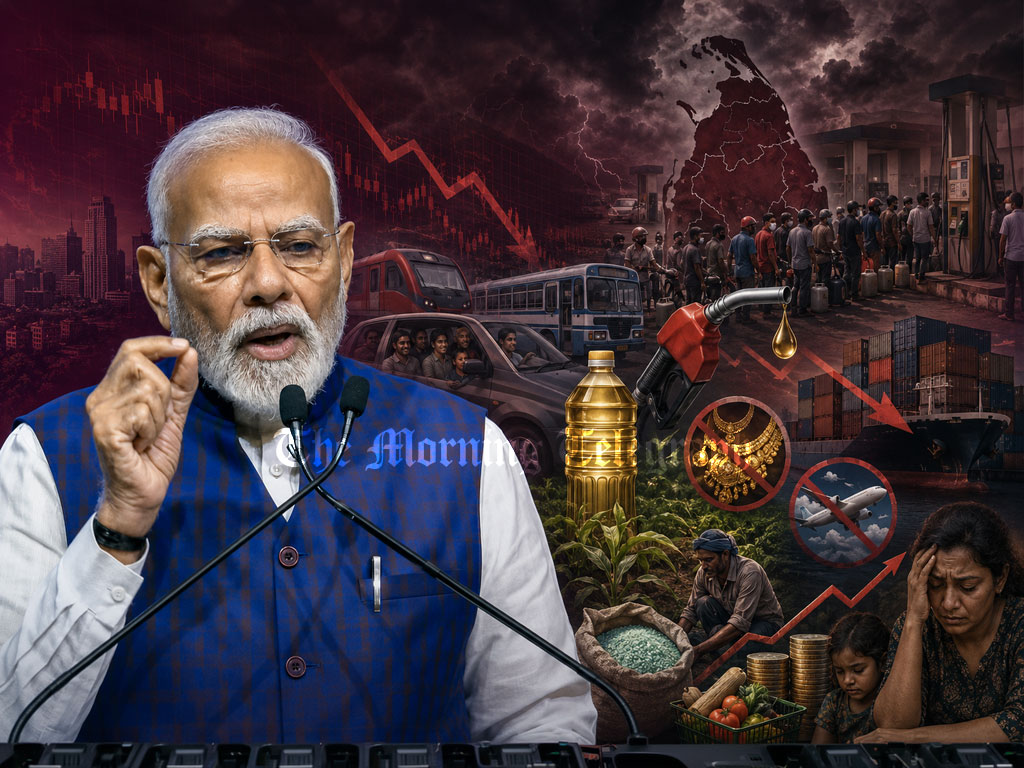
Modi’s 7 warnings to India reveal a darker global economic threat, forcing Sri Lanka to rethink fuel, imports, food security and spending.
Modi’s 7 warnings to India cannot be dismissed by Sri Lanka as ordinary news, especially as the extremely difficult month of June approaches.
When Indian Prime Minister Narendra Modi issued the same severe appeals twice within 24 hours to his country’s 1.4 billion people, it carried a message far beyond India’s borders. For Sri Lanka, still struggling to rebuild foreign reserves and economic confidence, those warnings should be treated as a serious signal of what may be coming.
First, we must understand how dangerous the threat is for a small country like ours, which struggles even to maintain reserves of a few billion dollars. If India, the world’s fifth-largest economy, with foreign reserves approaching $700 billion, is asking its citizens to make painful sacrifices, Sri Lanka has every reason to be deeply concerned.

Prime Minister Modi’s first appeal was for people to work from home whenever possible. This is not merely a request made for comfort or convenience. It is, in effect, a military-style economic strategy to reduce fuel consumption and protect the country’s foreign exchange.
If a country like India, with its vast highway network, metro rail systems, and stronger transport infrastructure, is worried about its fuel bill, what should Sri Lanka think? In our country, where public transport remains crippled and imported fuel is essential to daily life, the fear of fuel queues returning cannot be ignored.
As India moves to reduce its oil import bill, what will happen to us, who have depended on borrowed oil and external support? Modi’s second appeal, urging people to use public transport and adopt carpooling, suggests that global crude oil prices may be preparing to rise uncontrollably.
Even with metro systems in several major Indian cities, India is now asking citizens to limit the use of private vehicles in order to protect the Indian rupee from collapsing against the dollar.
Anyone who remembers the terrible pressure faced by the Sri Lankan rupee recently must understand the warning clearly. If a country with a stronger currency like India is this fearful, does it not reveal the scale of the black clouds gathering over the global economy?
As his third and fourth appeals, Prime Minister Modi urged citizens to limit the use of cooking oil and move away from chemical fertilisers toward natural farming. This is an extremely sensitive topic for Sri Lankans because we are still suffering the damage caused to agriculture by the overnight ban on chemical fertilisers.
However, India is attempting to do this in a systematic manner to stop the outflow of dollars. If India, with billions of dollars in reserves, is worried even about the oil bottle in the kitchen, then the anxiety Sri Lanka should feel about food security is almost like a fear of death.
The appeal to limit the purchase of foreign goods and embrace local brands highlights self-reliance and economic patriotism. India is a country with enormous manufacturing capacity. It produces a large share of what it needs.
Yet, despite that strength, if India is rejecting foreign goods, the message to Sri Lanka is painfully clear. Our economic foundation is fragile because we import almost everything, from food to clothing. The absence of a strong productive economy of our own will place us in even greater danger when global crises deepen.
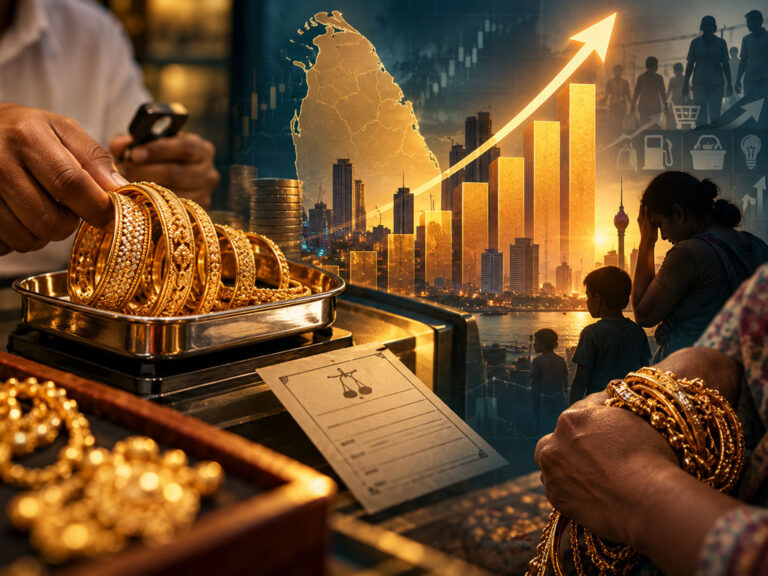
The sixth and seventh appeals were even more striking. Modi asked citizens to stop buying gold jewellery for one year and avoid foreign travel. India is the world’s second-largest consumer of gold and spends more than $70 billion a year importing it.
Sri Lanka, by comparison, has had to look to the International Monetary Fund even to secure a billion dollars. Against that background, if India is asking its people to sacrifice luxuries such as gold and foreign travel to protect its foreign reserves, we must honestly examine the unnecessary consumption patterns still visible in our own country.
Even though India’s foreign reserves remain at a very high level, the Indian Prime Minister is adopting strict measures to prepare for a possible global economic depression ahead.
Sri Lankans must now ask themselves a simple question. If a man stronger than oneself is being careful, how careful must the weaker man be?
India is doing this to place the country’s stability above personal convenience. These are economic measures similar to those taken during wartime. If Sri Lanka is still living under the illusion that everything has returned to normal, Modi’s appeals should be seen as an extremely frightening warning.
Finally, India is sending a “Nation First” message to its 1.4 billion people in order to protect the value of the dollar and the stability of its currency. Sri Lanka’s main problem is also the shortage of foreign exchange.
If a giant like India cannot tolerate its rupee depreciating to 95 against the dollar, it is natural for Sri Lankans to fear that the cost of living could rise to unbearable levels again. After all, we live with a currency that has already crossed 300 rupees to the dollar.
Therefore, these seven Indian appeals are not merely lessons for Sri Lanka. They are a final warning to prepare before a severe economic cyclone possibly arrives in the future.
Throughout history, the fiercest storms have often come when the world appears most silent. Today, the seven sacrifices Modi is asking from Indian citizens sound less like political rhetoric and more like the teachings of Stoic philosophers who lived two thousand years ago.
When the world approaches a war economy, how does the wise person prepare? The Roman philosopher Seneca once said that true freedom comes from training oneself, even in abundance, not to fear scarcity.
Seneca wore coarse clothing, ate simple food, and asked himself whether this was the condition he had feared. Today, Modi is asking Indians to stop buying gold, stop foreign travel, and become accustomed to simple, local things.
This is not only about saving money. It is also a mental rehearsal to remain steady when a great economic storm arrives. The same lesson applies to Sri Lanka. Instead of crying over what we lack, the wisdom of Seneca teaches us to manage what we already have.
The Greek philosopher Diogenes lived in an old barrel. One day, the great Emperor Alexander came before him and said, “Ask for any help you wish from me.” Diogenes gave an answer that remains powerful even today: “Yes, please step aside a little. You are blocking the sunlight falling on me.”
That dialogue speaks of true self-sufficiency. Today, India is asking its citizens to see the sunlight of the local economy that has been blocked by foreign luxuries. If Sri Lanka can also reduce its dependence on imported goods, we may gain the spiritual strength of Diogenes to remain steady even before great powers.
A Zen story from Japan also offers a lesson for this moment. A learned man once went to meet a master. The master poured tea into his cup. Even after the cup became full and began overflowing, the master continued pouring.
“Master, stop! The cup is full, you cannot pour any more,” the man said.
The master replied: “Your mind is like this cup. To learn something new, you must first empty your cup.”
Today, our consumerist minds are filled with foreign brands, modern gadgets, and unnecessary ornaments. Modi’s appeals are, in another way, asking people to empty this cup. To strengthen the rupee and protect the country, desires must be reduced so that space can be created to think nationally.
The real fear should not only be the crisis itself. The greater fear is knowing that a crisis is coming, yet refusing to prepare like Diogenes in his barrel.
Sri Lanka must treat these philosophical warnings, delivered by a strong leader backed by some of the world’s most powerful intelligence networks and geopolitical connections, as a serious message for national security.
So, how is your preparation? Are you ready to empty your tea cup a little before the storm arrives?