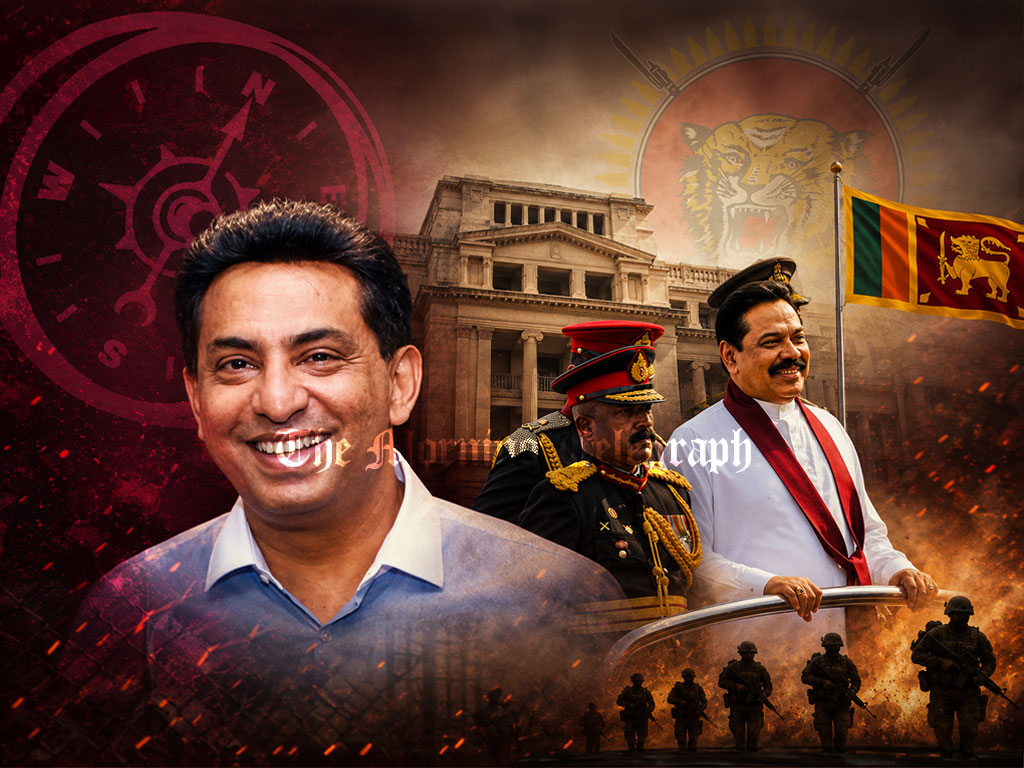
Sri Lanka’s LTTE victory remains central to national memory as political turmoil, NPP choices and war commemoration debates return.
Sri Lanka’s LTTE victory remains one of the country’s defining national moments, even as fresh political turmoil, Treasury scandal allegations, and public controversies dominate the present.
Sri Lanka is facing rising political turbulence after the alleged theft of USD 2.5 million from the Treasury, a scandal that has embarrassed the ruling NPP while the government is also under pressure over red-flagged containers, narcotics-linked shipments, and a coal procurement dispute.
The suspicious deaths of a Finance Ministry official linked to the Treasury scandal and former SriLankan Airlines CEO Kapila Chandrasena have further deepened public concern. Yet amid these crises, many argue that the country must not lose sight of commemorating the military victory over the LTTE and preserving Sri Lanka’s unitary status.

Next week, Sri Lanka marks the eradication of the Liberation Tigers of Tamil Eelam as a conventional threat to the survival of the nation, even if the authorities choose to dampen public celebrations. The armed forces brought the war to a successful conclusion on 18 May, 2009. The body of LTTE leader Velupillai Prabhakaran was found on the banks of the Nanthikadal lagoon on the morning of 19 May, less than 24 hours after ground forces declared the end of operations in the Vanni theatre.
The destruction of the LTTE’s conventional military capacity remains Sri Lanka’s greatest post-independence achievement. Whatever various interested parties with different agendas may say, the vast majority of people accept that achievement as the highest battlefield success of the armed forces.
Sri Lanka’s triumph cannot be discussed without remembering how the Indian-trained LTTE later fought the Indian Army deployed here under the Indo-Lanka Peace Accord signed in July 1987. That intervention cost India nearly 1,500 officers and men. Just over a year after the Indian pullout in March 1990, the LTTE assassinated Rajiv Gandhi, who as Prime Minister had sent the Indian Army to Sri Lanka. But India’s destabilisation project in Sri Lanka began during Indira Gandhi’s premiership.
Western powers, the now weakened United National Party, the Janatha Vimukthi Peramuna, and an influential section of the media promoted the claim that the LTTE could not be defeated. Yet the United People’s Freedom Party, under President Mahinda Rajapaksa’s resolute leadership, sustained a nearly three-year offensive that brought the entire Northern and Eastern regions back under government control.
The UNP relentlessly obstructed the war against the LTTE. UNP leader Ranil Wickremesinghe, determined to undermine the military campaign, openly questioned the military strategy. The former Prime Minister even mocked the culmination of the Eastern campaign with the capture of Thoppigala, also known as Baron’s Cap, in the second week of July 2007, describing it as a rock outcrop with no significance.
Believing the military lacked the strength to continue the campaign, Wickremesinghe publicly ridiculed the Thoppigala success. The then Brigadier Chagie Gallage, a pint-sized human dynamo, provided critical leadership to the highly successful Eastern campaign. That victory deprived the LTTE of the ability to force the armed forces to commit far greater strength to the region.
It is still recalled how Gallage went to announce the prized capture from his forward base that afternoon, driving his own jeep, dressed as a soldier wearing a cap, with his second-in-command seated beside him, clearly aware of the danger of snipers hiding in the surrounding jungle.
Figures such as Ravi Karunanayaka, Lakshman Kiriella, Dr. Rajitha Senaratna, and the late Mangala Samaraweera demeaned those successes by contributing to a harsh political campaign that weakened public confidence in the armed forces.
Then Lt. General Sarath Fonseka’s Army needed a major boost, not only to sustain the relentless advance into enemy territory, but also to hold and stabilise areas brought under government control. But the attacks from critics were so fierce that Samaraweera even said Fonseka was not fit to lead the Salvation Army.
The Opposition campaign was intended to discourage the recruitment drive that enabled the Army to increase its strength from 116,000 to more than 205,000 by the end of the campaign. Despite attempts to create doubts among the public about the military campaign, and despite backing from Western forces sympathetic to the LTTE, the Rajapaksa government maintained momentum.
President Rajapaksa had a strong team that helped the government meet the challenge. That team included Defence Secretary Gotabaya Rajapaksa, Vice Admiral Wasantha Karannagoda, Lt. General Sarath Fonseka, Air Marshal Roshan Goonetileke, and then Chief of National Intelligence Maj. General Kapila Hendawitharana.
There were also figures such as Rear Admiral Sarath Weerasekera, who returned from retirement to transform the once ragtag Home Guards into the Civil Defence Force, a worthy back-up to the military at critical locations and moments.
The then Governor of the Central Bank, Ajith Nivard Cabraal, also played a significant role in the overall government response. Then presidential adviser MP Basil Rajapaksa’s role should also be recognised, while Prof. Rajiva Wijesinghe and Minister Mahinda Samarasinghe contributed to countering false propaganda campaigns directed at the country.
Whatever shortcomings the Mahinda Rajapaksa-led UPFA may have had, the armed forces could not have succeeded if the political leadership he provided, supported by his team of brothers, had failed both inside and outside Parliament. That remains the undeniable truth.
During the 2006-2009 campaign, the UNP twice attempted to defeat the UPFA Budget, hoping to bring the war to an abrupt end. That contemptible effort ultimately caused a split in the JVP, with a section of the party switching allegiance to President Rajapaksa to save the day.
Amid political turmoil and both open and covert Western interventions, the armed forces continued the offensive. It is important to remember that the Vanni campaign began in March 2007, a few months before the armed forces completed the Eastern campaign.
Vanni Campaign
The Army launched the Vanni campaign in March 2007. The 57 Division, tasked with taking Madhu and then advancing toward Kilinochchi, faced fierce resistance. The principal fighting division suffered significant casualties, and progress was slow. An angry Fonseka brought in Maj. Gen. Jagath Dias as General Officer Commanding of the 57 Division to advance and consolidate captured areas.
The Army expanded the Vanni campaign in September 2007. Task Force 1, later the 58 Division, launched operations from the Mannar rice bowl. Fonseka placed Gallage in command of that fighting formation, but he was replaced by then Brigadier Shavendra Silva due to a medical emergency.
The Army gradually gained the upper hand in the Vanni west, while the LTTE faced a new threat in the Vanni east from the newly created 59 Division under Brigadier Nandana Udawatta. That division launched offensive operations in January 2008. After its first major action in the Weli Oya region, it fought its way toward Mullaitivu, an LTTE stronghold since 1996.
The 53 Division under Maj. Gen. Kamal Gunaratne and the 55 Division under Brig. Prasanna Silva, deployed in the Jaffna peninsula, joined the Vanni offensive in late 2008. Task Force 1 fought its way to Pooneryn, turned right toward Paranthan, captured the area, struck Elephant Pass, and advanced rapidly toward Kilinochchi. Task Force 1 and the 57 Division met in Kilinochchi, and the rest is history.
Once the Army brought Kilinochchi under its control in January 2009, the LTTE had lost the war. The raising of the Lion flag over Kilinochchi meant the entire area west of the Kandy-Jaffna A9 road had come under government control.
By then, the LTTE had lost the sea supply route between Tamil Nadu and the Mannar region. The LTTE was surrounded by several fighting formations in the Vanni east, while the Navy made an unprecedented achievement by cordoning off the Mullaitivu coast, effectively cutting the group off on all sides.
During the final phase of naval action, the Navy captured Sea Tiger leader Soosai’s wife, Sathyadevi, and her children Sivanesan Mani Arasu and Sivanesan Sindhu. Spearheaded by the elite Fourth Fast Attack Flotilla, the Navy conducted a sustained campaign with spectacular success in the high seas. By late 2008, the Navy dominated waters around the country.
The sinking of floating LTTE warehouses, based on intelligence from the Directorate of Military Intelligence and the U.S. Pacific Command, weakened the LTTE after the Americans decided to speed up the inevitable. The campaign across the Palk Strait also damaged the LTTE’s supply capacity. By early January 2009, the LTTE had lost its ability to carry out mid-sea transfers and use Tamil Nadu fishing trawlers to bring supplies. It was only a matter of time before the group surrendered or faced the consequences.
Although the Tamil Diaspora still believed the LTTE could launch a major counterattack on the Vanni east front, and although the Tamil National Alliance under the late R. Sampanthan worked hard to halt the offensive, President Rajapaksa declared that the campaign would not be stopped. He had the strength to resist combined pressure from the West and the UN until the armed forces delivered the final blow.
The efforts made by U.S. Secretary of State Hillary Clinton to block IMF funding for Sri Lanka are in the public domain. Clinton was clearly trying to please the Tamil Diaspora. The U.S. made that attempt when the ground offensive was in its final phase, against the backdrop of the international community suspending relief supply ships to Puthumathalan.
The IMF eventually provided the much-needed funding to Sri Lanka despite Clinton’s intervention.
A Targeted Assassination
The Air Force conducted a strategic campaign against the LTTE while supporting both the Army and the Navy. Despite limited resources, the Air Force severely weakened the enemy. The high-profile targeted assassination of S.P. Thamilselvan at his Kilinochchi hideout in early November 2007 shook the LTTE leadership.
The deployment of a pair of jets, Kafir and MiG 27, based on intelligence provided by the DMI and backed by UAV footage, carried out a precise strike on Thamilselvan’s Kilinochchi hideout. That attack created unprecedented fear among the LTTE.
Current Defence Secretary Sampath Thuyakontha, then Commanding Officer of No. 09 Squadron, played a vital role in action against the LTTE. Thuyakontha earned respect for landing behind enemy lines in support of the LRRP, or Long Range Reconnaissance Patrol.
As the Army advanced on the Vanni east front, thousands of LTTE cadres gave up their weapons, threw away their trademark cyanide capsules, and surrendered. Their defences collapsed, and even hardcore cadres surrendered despite warnings issued by Prabhakaran.
By the time the armed forces concluded clearing operations, more than 12,000 LTTE cadres were in government custody. Although those unable to accept Sri Lanka’s victory over the LTTE spread allegations about the rehabilitation programme, ordinary Tamil people appreciated the project.
C.V. Wigneswaran, as Chief Minister of the Northern Province, called for a U.S. investigation into the death of ex-LTTE cadres in government custody. The retired Supreme Court judge sought to consolidate political power by alleging that the Army executed surrendered men by injecting them with poison. The then Yahapalana government failed to take action against Wigneswaran, who claimed more than 100 deaths among ex-combatants.
Instead of initiating legal action, the war-winning Rajapaksa government rehabilitated them. Even after the change of government in 2015, the rehabilitation project continued. Almost all of them were released, and since the end of the war, members of the defeated LTTE never tried to reorganise, though some Diaspora elements attempted to do so.
The LTTE’s defeat also brought an end to the use of child soldiers. Those demanding justice for Tamils killed during the war conveniently forget that the LTTE’s forcible recruitment of children also ended in May 2009. Struggling to overcome severe manpower shortages amid mounting battlefield losses, the LTTE abducted Tamil children from the early 1990s to force them into its ranks.
Although the UN and ICRC sought an agreement with the LTTE during Chandrika Bandaranaike Kumaratunga’s presidency to stop the forced recruitment of children, they failed to achieve the desired result. The much-publicised UN-ICRC projects failed. The LTTE continued abducting children and never stopped child recruitment. Depending on the battlefield situation, it carried out forced recruitment drives. Even the Norwegian-arranged Ceasefire Agreement failed to halt forced child recruitment.
The Darusman report, which accused the military of killing more than 40,000 civilians during the final phase of the war, revealed that the LTTE tried to recruit children as it was about to collapse.
The TNA, or any other like-minded group here or abroad, never urged the LTTE to give up civilian shields and stop recruiting children, though they realised Prabhakaran could no longer change the outcome of the war. Norway and others who still believed in a negotiated settlement desperately tried to convince Prabhakaran to release civilian shields.
A note dated February 16, 2009, sent to Basil Rajapaksa by Norwegian Ambassador Tore Hattrem, expressed concern over the fate of those trapped in the Vanni east. Hattrem’s note revealed Norway’s serious concern over the LTTE’s refusal to release civilians.
The Norwegian note, headlined “Offer/Proposal to the LTTE” and personally signed by Ambassador Hattrem, stated: “I refer to our telephone conversation today. The proposal to the LTTE on how to release the civilian population, now trapped in the LTTE controlled area, has been transmitted to the LTTE through several channels. So far, there has been, regrettably, no response from the LTTE and it doesn’t seem to be likely that the LTTE will agree with this in the near future.”
After the Anandapuram debacle in the first week of April 2009, the LTTE lost much of its fighting capacity. The loss of more than 600 cadres marked the collapse of the organisation’s conventional military strength.
The LTTE sought an arrangement that would allow it to retain its remaining weapons and begin rebuilding the group. President Rajapaksa emphasised that only unconditional surrender could save the remaining cadres. He refused to recognise any area under LTTE control.
The CFA, signed by Wickremesinghe and Prabhakaran in February 2002, recognised a vast area under LTTE control. The CFA gave the terrorist group unparalleled recognition, and the LTTE exploited that position fully.
NPP’s Dilemma
During his controversial May Day address this year, President Anura Kumara Dissanayake declared that only the armed forces and police could carry arms. Dissanayake warned that no one else could retain weapons.
His declaration is of pivotal importance, as the armed forces and police twice crushed JVP-led insurgencies in 1971 and 1987-1990. Dissanayake is the leader of both the JVP and the NPP, two political parties recognised by the Election Commission.
Dissanayake, who is also Minister of Defence and Commander-in-Chief of the armed forces, triggered controversy last year when the government announced that the President would not attend the 16th annual war heroes’ commemoration ceremony at the War Heroes’ Memorial in Sri Jayawardenepura Kotte.
That announcement caused a major backlash. The government later reversed its decision. Having received unprecedented support from the northern and eastern electorates in the September and November 2024 presidential and parliamentary elections, President Dissanayake appeared somewhat reluctant to join the national celebration.
Yahapalana leaders President Maithripala Sirisena and Prime Minister Ranil Wickremesinghe yielded to Tamil Diaspora and Western pressure to abandon the 2016 annual armed forces Victory Day parade. That move followed their betrayal of the war-winning armed forces at the Geneva-based United Nations Human Rights Council in October 2015.
They co-sponsored an accountability resolution introduced by the U.S. in terms of an understanding with the LTTE’s sidekick. Sirisena and Wickremesinghe forgot that the TNA had recognised the LTTE as the sole representative of the Tamil-speaking people in 2001, thereby setting the stage for Eelam War IV.
Sampanthan’s Illankai Tamil Arasu Kadchi-led TNA showed its true colours when it joined the UNP-JVP-led initiative to defeat Mahinda Rajapaksa. Having accused war-winning Army Commander Sarath Fonseka of serious war crimes, the TNA, along with the UNP-JVP combine, backed Fonseka at the 2010 presidential election.
The South rejected Fonseka, and he lost by a staggering 1.8 million votes. The late JVP leader Somawansa Amarasinghe foolishly called it a computer “jilmart”, a newly coined phrase of the fake Marxists. Fonseka’s indefensible declaration in the run-up to the 2010 presidential election, alleging that the celebrated 58 Division executed surrendered LTTE cadres, did not help him.
President Rajapaksa never explained why the U.S.’ unofficial contradiction of Fonseka’s claim was not used cleverly to counter unsubstantiated war crimes allegations, along with Lord Naseby’s disclosures made in October 2017.
Sri Lanka’s failure to properly defend the armed forces is nothing but an insult to them. They saved the country from the JVP twice, defeated more than half a dozen Indian-trained terrorist groups, and finally brought the largest and deadliest of them, the LTTE, to its knees on the banks of the Nanthikadal lagoon.
The armed forces should not hesitate to remember their victory over terrorism. Since the change of government in September 2024, the armed forces have refrained from even mentioning their battlefield achievements. At the last Independence Day, the armed forces shockingly referred to their role in Ditwah cyclone recovery efforts as their main achievement, apparently to please political masters who themselves had been lackeys of the West while outwardly professing to be Marxists, a line they have now conveniently dropped for all purposes.
The armed forces should not play NPP politics. They should explain the situation to the current dispensation. The failure of the armed forces to preserve their proud achievements against terrorism in their press releases and narratives appears rather foolish.
SOURCE :- SRI LANKA GUARDIAN