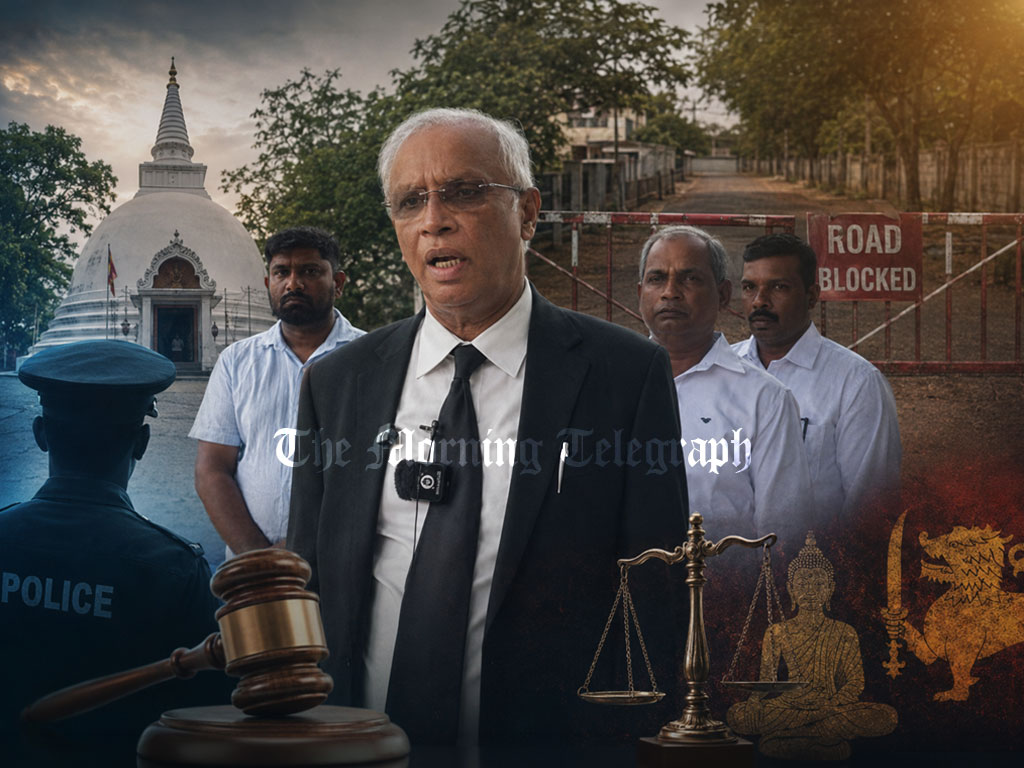
Sumanthiran alleges Sri Lankan police acted with Sinhala-Buddhist bias over the Thaiyiddy Tissa Vihara road dispute in Jaffna.
Sumanthiran has accused Sri Lankan police of acting with a “Sinhala-Buddhist supremacist mindset” over the disputed Thaiyiddy Tissa Vihara road issue in Jaffna.
Former parliamentarian M. A. Sumanthiran alleged that police were attempting to prevent the implementation of the law because of fear of Sinhala Buddhist clergy. His remarks came in connection with the controversial Thaiyiddy Tissa Vihara matter and the blocked road belonging to the Valikamam North Pradeshiya Sabha.
The comments were made after proceedings at the Mallakam Magistrate’s Court, where a case had been filed by the Sri Lankan Police seeking an order to prevent the Valikamam North Pradeshiya Sabha from reclaiming a road belonging to the local council within the premises of the Thaiyiddy Tissa Vihara.

Sumanthiran appeared in court on behalf of the Chairman and Secretary of the Valikamam North Pradeshiya Sabha during the hearing.
Speaking to the media afterwards, he said police had informed court that reclaiming the road could lead to a breach of peace.
The road in question, known as Bhavani Road, belongs to the local council. However, Sumanthiran said it had been blocked off with fencing erected illegally by the temple administration.
He said the Pradeshiya Sabha had taken steps according to the law to remove the obstruction and restore public access to the road.
Sumanthiran argued that police should act against those obstructing the implementation of the law, rather than against those trying to enforce it.
Referring to complaints reportedly made by the chief incumbent of the vihara, Sumanthiran questioned who was actually threatening public peace.
“The vihara’s chief priest has complained that enforcing the law would create unrest. Who is creating that unrest? It is as if he is saying, ‘I myself will create the disturbance if the law is implemented’,” he said.
Sumanthiran further alleged that police officers were attempting to commit legal violations by obstructing those carrying out lawful duties.
“This is a Sinhala-Buddhist supremacist mindset. Because the police officers are Buddhists, they are afraid of Buddhist prelates and are trying to engage in unlawful conduct,” he charged.
He added that legal action would be pursued against those attempting to obstruct the enforcement of the law.
The dispute has drawn wider attention because it touches on issues of local authority, public access, religious influence, policing, and the rule of law in the North.
The original report also carried an appeal for support for journalism, stating that Sri Lanka remains one of the most dangerous places in the world for journalists. It further noted that Tamil journalists face particular threats, with at least 41 media workers said to have been killed by the Sri Lankan state or paramilitaries during and after the armed conflict.
Despite those risks, the report said journalists on the ground remain committed to detailed and accurate coverage of developments in the Tamil homeland, across the island, and around the world, while also providing analysis and insight from the Tamil point of view.
Source: Tamil Guardian