Sri Lanka’s most revered ceremonial elephant, Nedungamuwe Vijaya Raja, has been scientifically reconstructed and preserved to survive for centuries, allowing future generations to witness the majestic giant that once carried the Sacred Tooth Relic in the Dalada Perahera.
Asia’s tallest ceremonial elephant reborn for public viewing
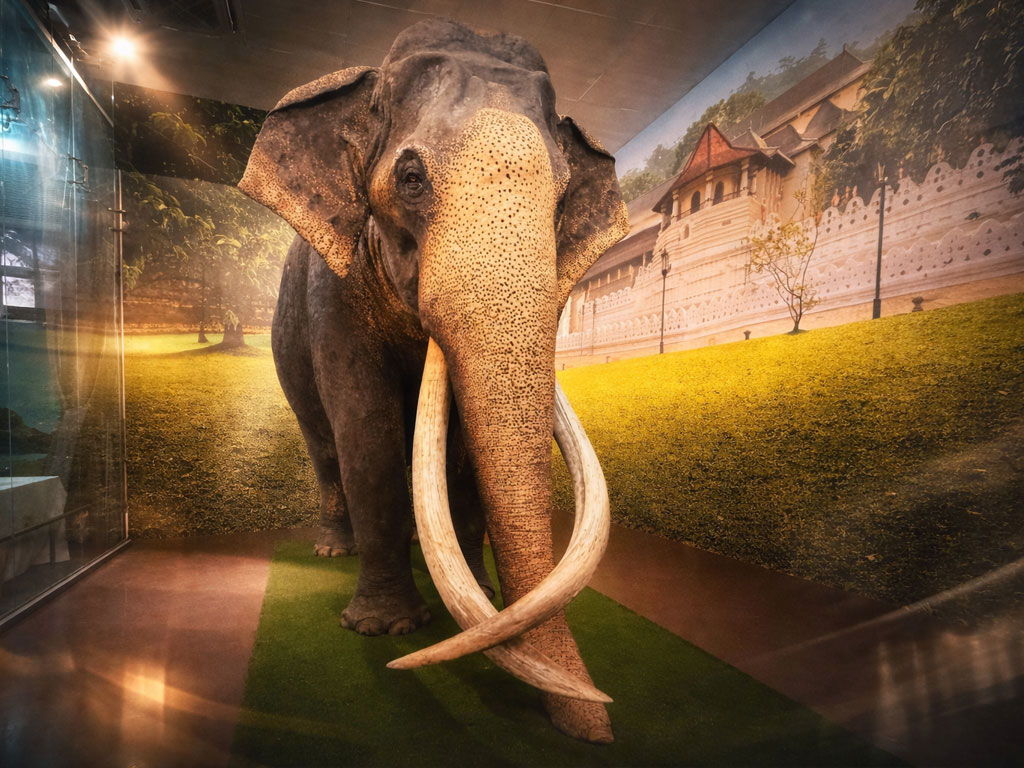
Nedungamuwe Vijaya Raja, the legendary elephant famous for carrying the Sacred Tooth Relic during the Kandy Esala Perahera, has been carefully preserved and recreated for public exhibition. The reconstructed elephant is now displayed at the Natural Science Museum of the National Museum from March 11 onward.
The conservation and reconstruction project was carried out by the Department of National Museums following the death of the iconic elephant on March 7, 2022. Vijaya Raja was officially declared a national treasure because of his historical and religious significance to Sri Lankan Buddhists.

Recreating the elephant posed a major challenge
Director General of the Department of National Museums, Sanuja Kastuarachchi, explained that preserving cultural heritage and presenting it for future generations is one of the most important responsibilities of the institution.
She said the body of Nedungamuwe Vijaya Raja was obtained for preservation on the same day the elephant died. This was done according to the wishes of the Diyawadana Nilame of the Dalada Maligawa and Dr. Harsha Dharmawijaya, who had been responsible for the elephant’s care.
According to the Director General, recreating such a well known elephant was extremely difficult because the public was deeply familiar with its appearance.
Teams behind the conservation effort
The reconstruction project was carried out by the Zoology Division and the Exhibition Planning Division of the Department of National Museums.
Under the supervision of Deputy Director Lankani Somaratne, a dedicated team including leather technician Chamalka Kothalawala, experts Ravindra Wickramanayake, L. R. Wijepala, L. P. Mahinda, and several other specialists contributed to the process.
Designed to last for centuries
Leather technician Chamalka Kothalawala explained that preserving the skin of a large animal requires both scientific expertise and artistic skill.
The process of removing and preserving the elephant’s skin took about ten days. After preservation, the skin was transported to the Natural Science Museum where the reconstruction work began.
According to Kothalawala, the elephant has been preserved using specialized conservation techniques so that the structure can survive for nearly five hundred years.
How the elephant’s skin was carefully removed
Deputy Director Lankani Somaratne described the complex method used during the initial stage of preservation.
The first step involved taking detailed measurements of the elephant’s body. These measurements were crucial for creating an accurate replica. At the same time, extensive photographic documentation was carried out to record every feature of the animal.
During the skin removal process, large cuts were made carefully and the skin was separated piece by piece. Only the skin was preserved, as the meat and fat components decay quickly.
Special chemical preservatives were applied immediately to protect the skin and ensure long term durability.
Building the lifelike replica
Model artists L. R. Wijepala and L. P. Mahinda from the Department of National Art explained the technical work involved in reconstructing the elephant.
After the preserved skin was delivered to them, the artists measured the animal once again and created the structural model that would support the preserved skin. The model was carefully shaped to match the original proportions of the famous elephant.
Because Vijaya Raja was widely recognized and admired, the team studied photographs and video recordings extensively to recreate his posture, facial expressions, and body features accurately.
Restoring the original skin color
Wijepala also explained that the natural color of the elephant’s skin changes slightly during preservation. Because of this, the team had to carefully restore the original tones through artistic adjustments.
Mahinda added that the team conducted continuous visual studies using video footage and photographs to ensure that the recreated elephant captured the distinctive presence of Vijaya Raja without damaging the authenticity of the preserved skin.
Cost of conservation and exhibition
Deputy Director Lankani Somaratne revealed that the cost of preserving the elephant was approximately seven million rupees.
Additional funds were used to construct a special display chamber with climate control. The exhibition enclosure includes a glass chamber with regulated humidity and air conditioning to protect the preserved structure.
Altogether, the entire conservation and exhibition project cost approximately twenty five to twenty six million rupees.
The legendary elephant’s journey to Sri Lanka
Nedungamuwe Vijaya Raja was born in 1953 in Manipur, India. Historical accounts say the elephant was gifted to a Sri Lankan monk who had successfully treated an Indian royal for an illness.
The elephant later came under the care of Dr. Harsha Dharma Vijaya in Gampaha and was raised within the traditional Nedungamuwa Dharma Vijaya Veda lineage.
Belonging to the subspecies Elephas maximus indicus, Vijaya Raja stood nearly eleven and a half feet tall and possessed magnificent tusks measuring around five feet.
From 2006 to 2021, he carried the Sacred Tooth Relic in the final Randoli Perahera of the Kandy Esala Perahera on eleven occasions. He was also protected by a special army unit due to his cultural importance.
Among the elephants that carried the Sacred Tooth Relic, Nedungamuwe Vijaya Raja remains the animal that performed the sacred duty the greatest number of times after the temple’s own elephants.