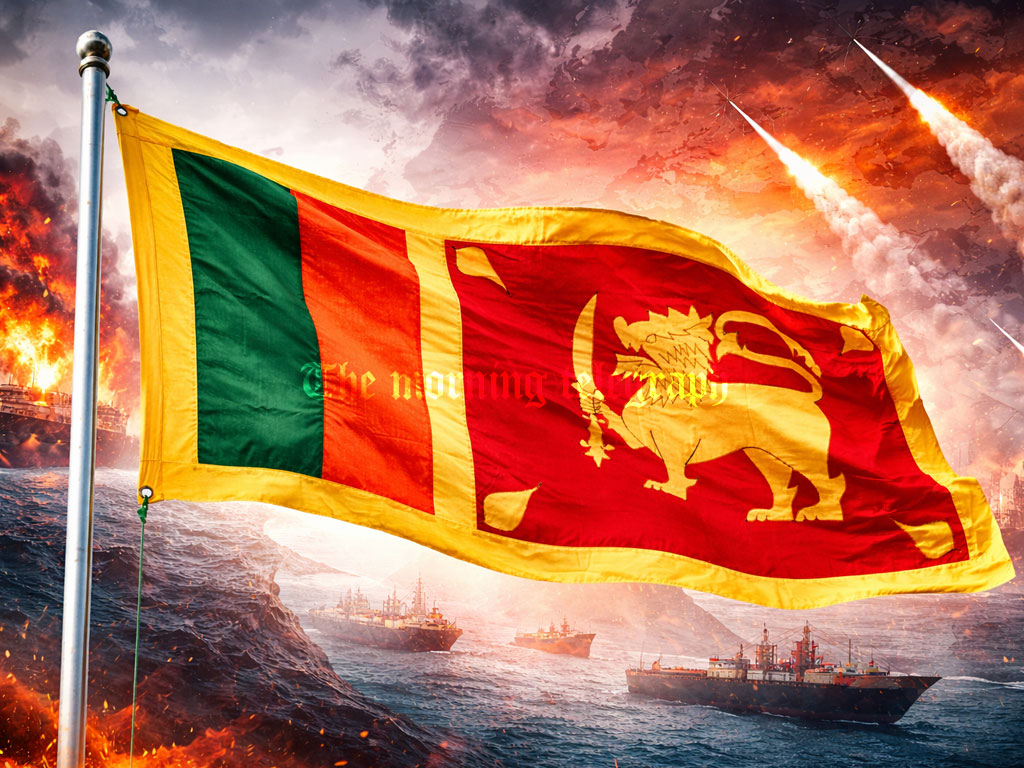
As the Israel Iran conflict intensifies across the Middle East, Sri Lanka finds itself navigating a delicate path between humanitarian obligations, energy security fears, and growing economic risks linked to disrupted global supply chains and Indian Ocean security.
Sri Lanka continues to grapple with the economic, diplomatic and humanitarian consequences of the widening Middle East conflict, nearly two weeks after an Iranian naval vessel was sunk near the island’s Exclusive Economic Zone.
While rescue operations and humanitarian assistance to Iranian sailors remain central to developments, authorities are increasingly focused on the broader economic and energy consequences. Officials are closely monitoring disruptions to global fuel supplies, maritime shipping routes, and Sri Lanka’s export markets as the Israel Iran conflict reshapes international trade patterns and Indian Ocean security dynamics.
The government says its response strategy remains centred on maintaining neutrality, delivering humanitarian assistance, and protecting national economic stability as the conflict continues to influence global supply chains and maritime transport corridors.
Here are the latest developments on how Sri Lanka is responding.
Explainer: What is the Strait of Hormuz? How will its closure impact oil prices? Click here to read more

Repatriation of Iranian Sailors Bodies Begins
Sri Lanka has begun the process of repatriating the bodies of Iranian sailors killed when the naval frigate IRIS Dena was torpedoed earlier this month in waters south of the island.
Officials confirmed that 84 bodies recovered from the sea are being returned to Iran after receiving judicial clearance from the Galle Chief Magistrate’s Court.
As part of the operation:
45 bodies stored in specialized freezers at Galle National Hospital were transported to Mattala Rajapaksa International Airport
The remains are being formally handed over to the Iranian Embassy in Sri Lanka
Airlift arrangements are currently underway to return the bodies to Tehran
Authorities say the repatriation process is being conducted in close coordination with Iranian diplomatic representatives and Sri Lankan government authorities.
The incident attracted major international attention after reports confirmed that the Iranian warship had been struck by a United States submarine while sailing near Sri Lanka’s Exclusive Economic Zone.
Sri Lanka Seeking Multiple Fuel Supply Options
As global energy market uncertainty intensifies, Sri Lanka has accelerated diplomatic discussions to secure alternative fuel supply arrangements.
Foreign Minister Vijitha Herath held discussions with Russian Ambassador Levan S. Dzhagaryan regarding the possibility of importing Russian fuel to stabilize domestic fuel supply and prevent potential shortages.
These discussions come at a time when global oil markets are experiencing volatility due to tensions and disruptions linked to the Middle East conflict.
The Russian envoy stated that Sri Lanka’s request would be conveyed to Moscow and that Russian institutions would examine the feasibility of facilitating fuel exports to the island nation.
India Responds Positively to Fuel Supply Request
Sri Lanka is also engaging regional partners to ensure emergency fuel supply support if global disruptions worsen.
The Ministry of Foreign Affairs confirmed that India has responded positively to Sri Lanka’s request for assistance in maintaining fuel supplies during the crisis.
Foreign Minister Herath raised the issue during discussions with Indian External Affairs Minister S. Jaishankar during his visit to India earlier this month.
India’s Ministry of External Affairs confirmed that it has received fuel supply requests from Sri Lanka, Bangladesh and the Maldives. These requests are currently under review.
Officials say any decision will depend on India’s domestic fuel availability and refining capacity. India remains one of the largest exporters of refined petroleum products in the region.
Export Sector Mobilises Amid Middle East Trade Disruptions
Sri Lanka’s export sector has also begun to experience the ripple effects of the conflict, particularly through disruptions to shipping routes and trade flows with Middle Eastern markets.
In response to the emerging risks, the Export Development Board convened a high level meeting with major export sector associations to assess the evolving situation.
Participants included representatives from:
Tea, spice and coconut export industries
Food processing and beverage exporters
Fruit and vegetable exporters
Fisheries sector stakeholders
Shipping and freight forwarding associations
The meeting focused on identifying strategies to minimize supply chain disruptions and ensure that export operations can continue during the volatile geopolitical environment.
Officials stated that the discussions aim to develop coordinated policy recommendations that will be presented to the Export Development Council of Ministers.
Energy Security Remains a Growing Concern
The government has already warned that prolonged global supply disruptions could eventually threaten Sri Lanka’s energy security.
President Anura Kumara Dissanayake previously stated that while Sri Lanka currently has sufficient financial reserves to purchase fuel, the country could only reliably guarantee continuous energy supply for approximately two months if the conflict continues to escalate.
Authorities say the current strategy focuses on diversifying supply sources and establishing emergency purchasing agreements with multiple international partners.
Calls for Stronger Indian Ocean Cooperation
Political leaders across Sri Lanka’s political spectrum have also emphasized the importance of strengthening regional cooperation across the Indian Ocean.
Former President Ranil Wickremesinghe stated that countries in the region should deepen cooperation in economic, political and security spheres to respond effectively to emerging geopolitical risks.
He noted that existing regional initiatives such as:
the Indian Ocean Naval Symposium
the Colombo Security Conclave
could serve as key platforms for stronger cooperation among Indian Ocean nations.
Opposition Proposes Global Peace Initiative
Opposition Leader Sajith Premadasa has also proposed a new international initiative aimed at promoting global peace and stability amid the escalating conflict.
Speaking to international media, Premadasa said he intends to promote a diplomatic framework titled Peace Stability Order and Prosperity.
He emphasized that regional cooperation and diplomatic engagement are essential to protect critical global regions and prevent further escalation of the Israel Iran conflict.
Sri Lanka Balancing Humanitarian Role and Strategic Risks
Although Sri Lanka is not directly involved in the Middle East conflict, the island’s strategic location along vital Indian Ocean maritime routes has placed it at the center of major geopolitical developments.
From maritime rescue operations and humanitarian assistance to Iranian sailors to managing potential economic shocks and fuel supply risks, Sri Lanka is attempting to navigate the crisis carefully while maintaining its traditional non aligned foreign policy stance.
Authorities say the coming weeks will be critical as the government continues to monitor the evolving impact of the conflict on global energy markets, maritime security and international trade routes.
Further developments are expected as the Israel Iran conflict and its global economic consequences continue to unfold.