Russia unleashes an unprecedented 948-drone assault across Ukraine within 24 hours, striking cities, damaging historic landmarks and civilian infrastructure, and signaling a dangerous escalation in the ongoing war.
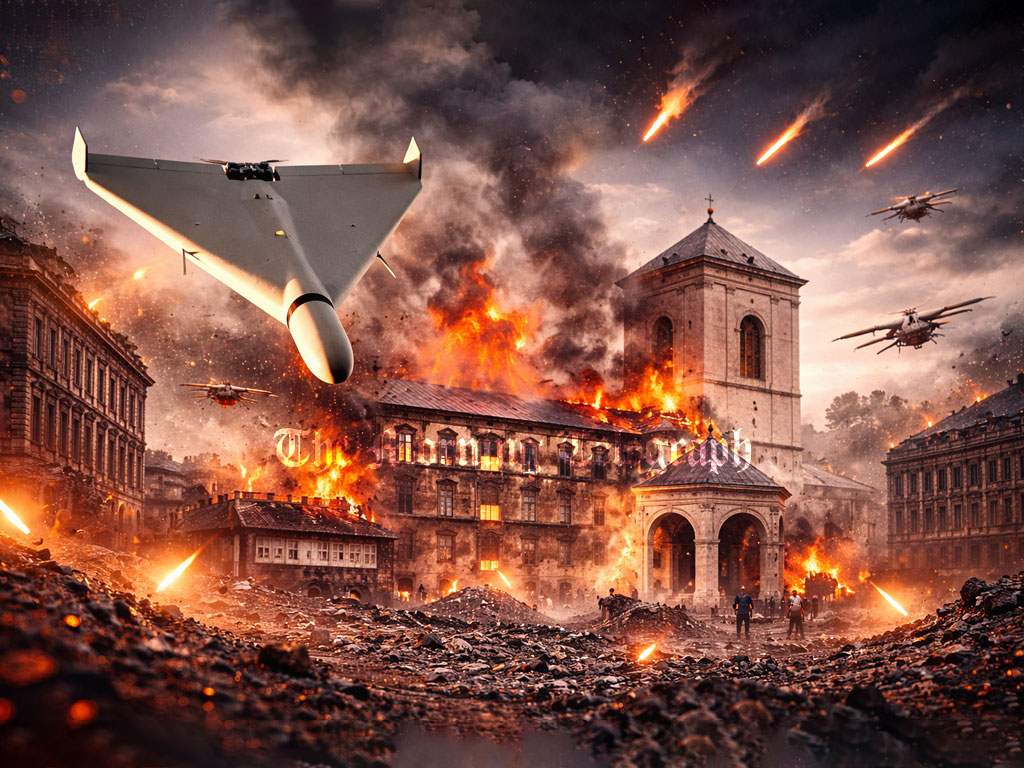
Russia has carried out its largest aerial assault on Ukraine within a 24 hour period since the war began, targeting multiple cities across the country with a staggering 948 drones, marking a significant escalation in the Russia Ukraine war.
Ukraine’s Air Force reported that 556 drones were launched from 09:00 local time on Tuesday, in what officials described as an unusual daytime drone attack. The strikes resulted in at least three deaths and left dozens injured across several regions, highlighting the growing intensity of the conflict.

In the western city of Lviv, local authorities confirmed that the historic Bernardine monastery, a 16th century structure recognized as part of a UNESCO World Heritage site, sustained damage during the attacks. The incident underscores the widening impact of Russian strikes on cultural heritage sites and civilian areas.
Meanwhile, in the neighboring Ivano Frankivsk region, a maternity hospital was struck, raising serious concerns about the targeting of civilian infrastructure. Officials reported that two people were killed in the region and four others, including a six year old child, were injured.
These daytime strikes followed an earlier overnight wave of attacks, during which Ukraine reported that Russia launched 392 drones along with 34 missiles. That barrage left five people dead and caused widespread destruction across 11 Ukrainian regions, demonstrating the scale and coordination of the offensive.
Ukrainian President Volodymyr Zelensky addressed the nation on Tuesday evening, stating that the magnitude of the latest attacks clearly indicates that Russia has no intention of ending the war. His remarks reflect growing frustration in Kyiv over the continued escalation and lack of progress in peace negotiations.
Russia’s military has not issued any official statement regarding the attacks, maintaining its pattern of limited public commentary on large scale operations.
Footage released by Lviv authorities showed flames engulfing the roof of a residential building near the Bernardine monastery. Additional videos circulating on social media appeared to capture a low flying drone striking the same building, emphasizing the direct threat to civilian life.
Lviv regional governor Maksym Kozytskyi reported that at least 32 people were injured in the attack on the city. Emergency services were deployed across multiple sites to manage fires and assist victims.
In Ivano Frankivsk, officials confirmed fatalities and injuries, while also noting damage to several buildings including critical healthcare facilities. The targeting of a maternity hospital has drawn particular concern from observers monitoring the humanitarian impact of the war.
Ternopil, another city in western Ukraine, was also targeted during the strikes. Regional authorities reported multiple direct hits, although no casualties were recorded in that area, offering a rare moment of relief amid widespread destruction.
Further east in the central city of Vinnytsia, one person was killed and 13 others were injured, according to regional head Nataliya Zabolotna. The attacks there added to the growing list of affected regions, demonstrating the broad geographic spread of the offensive.
During the overnight phase of the assault, five people lost their lives as Russian forces targeted 11 different regions, reinforcing the scale of the coordinated strikes.
Ukraine’s Air Force stated that it successfully intercepted a majority of the incoming drones and missiles. However, officials acknowledged that multiple direct hits still occurred, causing damage to infrastructure and residential areas.
Air Force spokesman Yurii Ihnat explained that a large number of drones entered Ukrainian airspace from the northern direction, moving in organized formations. He noted that the geography of the daytime strikes was even broader than the nighttime attacks, describing the event as one of the most extensive within a single 24 hour period.
Although the war has impacted nearly every part of Ukraine over more than four years of conflict, western regions such as Lviv have historically experienced fewer and less frequent attacks compared to frontline areas in the east. The latest strikes suggest a shift in targeting strategy.
Russia’s full scale invasion of Ukraine began in February 2022 and has since evolved into a prolonged conflict characterized by frequent missile strikes, drone warfare, and heavy casualties on both sides.
On the same day, Russia reported that a Ukrainian drone attack struck an agricultural facility in the western Kursk region. Local authorities stated that one person was killed and 13 others were injured in that incident.
Efforts to broker peace, led by the United States, have stalled in recent months. Diplomatic momentum has been further complicated by global tensions, including the US Israel Iran conflict, which has diverted international attention and resources.
Ukraine’s First Lady Olena Zelenska took to social media to express concern that the suffering of Ukrainians risks being overlooked amid the volume of global crises. She emphasized that Ukrainian grief must not be reduced to statistics or headlines that are easily ignored.
The latest escalation in drone warfare, combined with continued missile attacks and stalled negotiations, highlights the ongoing instability in the region and raises serious concerns about the future trajectory of the Russia Ukraine conflict.