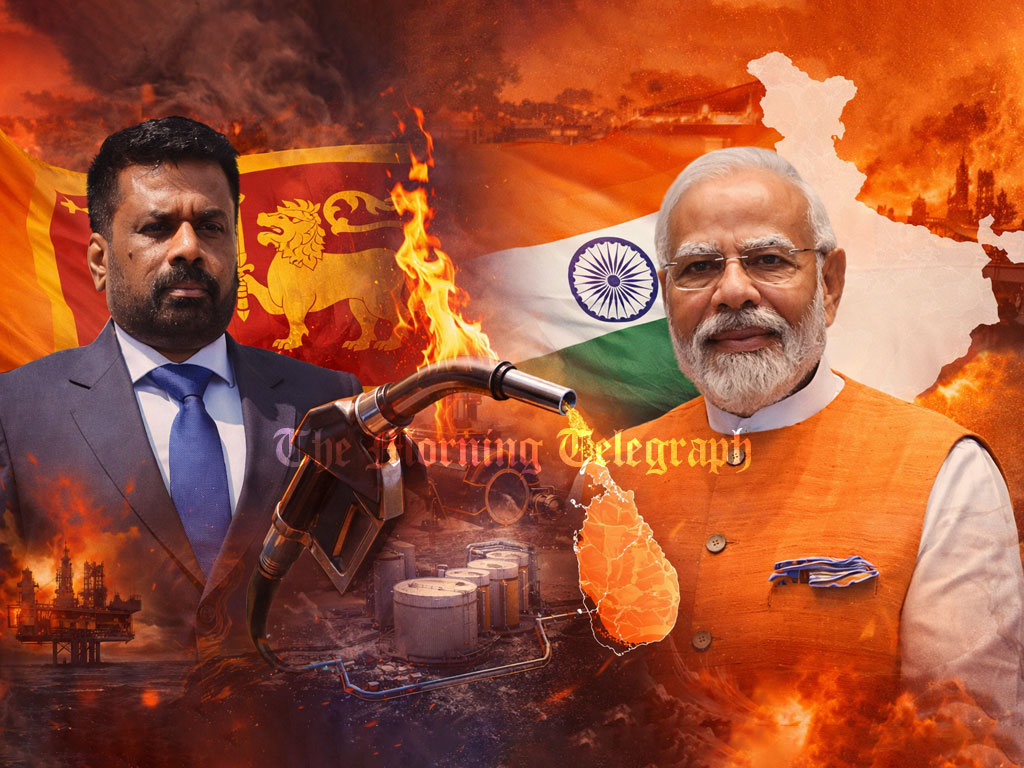
A dramatic reversal unfolds as Sri Lanka’s leadership, once fiercely opposed to Indian energy deals, now turns to New Delhi for survival amid a worsening fuel crisis triggered by global conflict.
Amid an escalating oil crisis driven by the Middle East war, President Anura Kumara Dissanayake held urgent discussions with Indian Prime Minister Narendra Modi as Sri Lanka once again grapples with fuel shortages and energy insecurity.

The situation echoes the economic collapse under Gotabaya Rajapaksa’s administration, when then Finance Minister Basil Rajapaksa travelled to India to secure a vital credit line that enabled Sri Lanka to import fuel and essential goods, ultimately bringing an end to crippling fuel queues across the country.
This pattern reinforces a consistent reality in Sri Lanka’s energy crisis narrative. Whenever fuel shortages intensify, Colombo turns to India for immediate assistance. Recognizing this dependency, the Ranil Wickremesinghe government in 2003 moved to lease 15 oil tanks in Trincomalee to India under the framework of the Indo Sri Lanka Agreement of 1987. However, the decision triggered fierce political backlash, with the SLFP and JVP leading nationwide protests, accusing the government of compromising national assets. The resulting political pressure derailed the agreement and stalled progress.
By 2004, political upheaval further disrupted continuity when President Chandrika Kumaratunga aligned with the JVP and dissolved Ranil Wickremesinghe’s government, effectively halting any advancement of the Trincomalee oil tank development project.
A decade later, in 2015, the Sirisena Ranil administration attempted to revive the initiative by proposing a joint venture between India and Sri Lanka to develop 85 unused oil tanks in Trincomalee. Once again, strong resistance emerged, led by the JVP, which organized protests claiming that strategic national resources were being handed over to India. Anura Kumara Dissanayake himself publicly opposed the move, raising concerns over sovereignty and control.
In a parliamentary statement in 2018, Anura Kumara Dissanayake criticized the decision to involve the Indian Oil Company, arguing that the Ceylon Petroleum Corporation possessed the financial capacity and strategic advantage to independently develop the tank farm. He emphasized that such development could have strengthened Sri Lanka’s access to international oil markets while generating valuable foreign exchange revenue.
Opposition to Indian involvement was not limited to the JVP. Figures aligned with Mahinda Rajapaksa, including Udaya Gammanpila, also strongly resisted the leasing of oil infrastructure, framing it as a threat to national control over critical energy assets.
Despite these earlier objections, a significant policy shift occurred in 2019 when President Gotabaya Rajapaksa and Energy Minister Udaya Gammanpila finalized an agreement to lease the Trincomalee oil tanks to India for a period of 50 years. The move reignited protests, with Anura Kumara Dissanayake and trade unions staging demonstrations and strikes, demanding the cancellation of the agreement.
Following the 2022 political transition, President Ranil Wickremesinghe deepened economic ties with India by signing the Economic Partnership Vision agreement with Prime Minister Modi. A central proposal included the construction of an energy pipeline connecting South India and Sri Lanka. Once again, the JVP opposed the initiative, warning that such integration could compromise national sovereignty and effectively bind Sri Lanka to Indian influence.
Today, as fuel shortages resurface due to geopolitical tensions in the Middle East, the narrative has shifted dramatically. The current JVP led administration now attributes the crisis to the failure of previous governments to invest in adequate storage and energy infrastructure, even though India had offered support for such development as early as 2002. With India now advancing proposals for deeper energy connectivity, including pipeline integration, Sri Lanka finds itself with limited alternatives.
The evolving situation highlights a striking political contradiction. A leadership that once resisted Indian involvement in Sri Lanka’s energy sector is now compelled to rely on it. As the country navigates its latest fuel crisis, aligning with India’s energy initiatives appears less like a choice and more like an unavoidable necessity shaped by years of missed opportunities and shifting geopolitical realities.