By Roshan Jayasinghe
The life between two unknowns
A reflection on birth, death, uncertainty, contentment, and the quiet responsibility of learning to live clearly within the only life we can actually touch.
As the Sinhala and Tamil New Year is observed, I find myself thinking not only about custom, celebration, and tradition, but about what such moments quietly ask of us as human beings. Across generations, this occasion has been marked through rituals, rhythms, relationships, and shared observances that remind us of time, renewal, and the movement of life itself. Beyond the beauty of culture and the warmth of gathering, I also feel there is something more intimate being offered in a moment like this: a pause, a return, a gentle invitation to look again at how we are living. Much of my writing returns to this same inquiry. I find myself observing life, human behavior, thought, fear, nature, and the many ways we drift from what is simple and real. So on an occasion such as this, when time itself is being noticed and honored, I feel drawn again to one quiet question: what are we doing with the life that is actually being given to us?

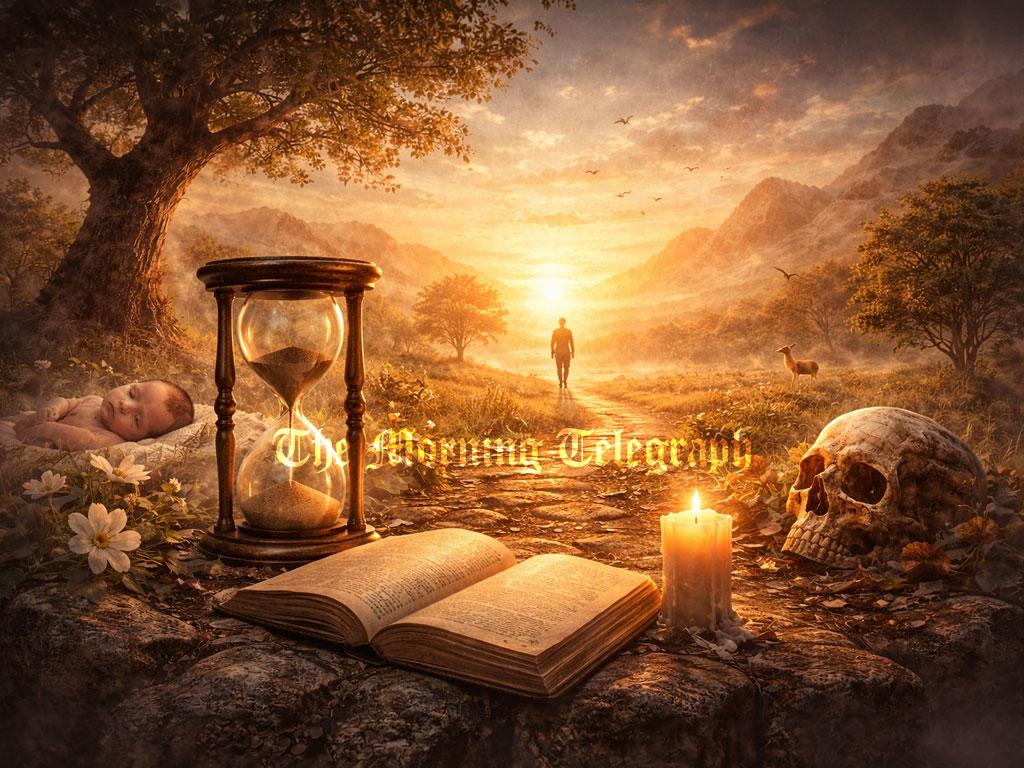
I keep coming back to one simple observation. We enter life without knowing where we came from, and we leave it without any final certainty about where we go. Before birth, we do not know. Beyond death, we do not know. Between those two immense unknowns, we are given this brief interval of living existence, a moving current of moments in which life appears, unfolds, changes, and passes. The more I sit with that, the more I feel that this interval, however long or short it may be, is the only time we ever truly have. Yet it is also the time we seem least willing to understand.
As I observe human life, I keep seeing how often we live as though life were elsewhere. We live as though what matters most is not here now, but hidden in some imagined future, in some perfected identity, in some spiritual reward, social position, intellectual superiority, or personal accumulation yet to be reached. Even while standing inside life, we keep leaning away from it. We keep searching beyond it, building mental worlds around what we hope to become, what we fear losing, what we wish to prove, and what we want to believe will finally make us enough.
What I find deeply sorrowful in human living is not simply that we do not know, but that we are so uneasy with not knowing. Instead of allowing mystery to humble us, we often let it drive us into invention, division, and psychological noise. We create systems of thought that place one person above another, one belief above another, one path above another, and in doing so we lose sight of the plain fact that the breath we are taking now may be the most real thing we will ever know. While we argue over what lies beyond life, life itself continues to pass through our hands.
When I look at religion through this lens, I do not only see belief. I also see a human response to mystery. Faced with birth, death, loss, love, suffering, beauty, and the vastness of existence itself, human beings reached for story, symbol, explanation, and order. That is understandable to me. In the face of what cannot be fully known, the mind longs for ground beneath its feet. It wants meaning. It wants reassurance. It wants to feel that life is held within some knowable design. And so across civilizations, in different lands and different ages, human beings created systems through which to interpret what lay beyond them.
But what I also see is that what begins as an attempt to approach truth can, over time, become a substitute for truth. What begins as humility before mystery can harden into certainty. What begins as guidance can become authority. What begins as a symbolic language for life can become a barrier between the mind and direct living. Once that happens, distortion enters. The structure becomes more important than the reality it was meant to illuminate. The belief becomes more important than the living human being. The defense of an idea becomes more urgent than the clear observation of life itself.
To me, this pattern is not confined to religion alone. I see it across civilizations. Human beings repeatedly create systems, identities, loyalties, ambitions, and institutions that may begin by serving life but gradually come to dominate it. Distortion replaces clarity. Falsehood takes the place of truth, not always because truth has disappeared, but because falsehood is often easier to sell to the fearful mind. It offers certainty where life offers mystery. It offers image where life asks for substance. It offers performance where life asks for sincerity. It offers artificial forms of fulfillment while drawing us further from the natural intelligence of direct existence.
What keeps becoming clearer to me is this: much of civilization may be the story of human beings trying to escape uncertainty, then slowly becoming trapped in what they created.
When I look at the present age, this feels especially visible. We are surrounded by more information than ever, yet not necessarily by more clarity. We are increasingly drawn toward what is artificial, manufactured, exaggerated, and strategically presented, while nature, stillness, simplicity, and inward honesty are treated as secondary. The false can be made to appear more desirable than the true. The distorted can appear more convincing than the clear. The artificial can be made more seductive than the natural. And the result, as I see it, is that human beings, though more connected in appearance, may be living further from themselves than ever before.
Another thing I keep noticing is that human beings do not suffer only from ignorance. We also suffer from the feeling of not enough. Even in the midst of existence, even with the miracle of life already in motion, we often carry a restless sense of insufficiency. Not enough success. Not enough certainty. Not enough recognition. Not enough pleasure. Not enough holiness. Not enough control. This sense of lack follows us through our days and shapes the way we think, work, compete, desire, and compare. We overlook what has already been given because thought keeps telling us that fulfillment is elsewhere.
This is where the living moment becomes so important to me. Not as a slogan, but as the only place where life is ever actually taking place. Happiness cannot be lived yesterday. Contentment cannot be experienced tomorrow. Peace does not happen in theory. It happens, if it happens at all, in the conscious meeting of what is here now. And yet the present moment is rarely met directly. It is filtered through memory, fear, ambition, regret, identity, and projection. We are here, but not fully here. Alive, but not fully living.
What I have come to see is that happiness is not what we have made it. It is not excitement, possession, or the achievement of a superior position. It is far quieter than that. It is the natural state of a human being who is no longer in constant argument with life. A human being who sees clearly, receives consciously, and lives without the endless torment of comparison. Contentment is not passivity. It is not indifference. It is not the refusal to grow. It is the absence of psychological starvation in the midst of life. It is the ability to participate without constantly insisting that the present must be something other than what it is before one can feel whole.
When I look at a baby, an animal, and a tree, I see forms of life that do not seem burdened in the way human beings are. A baby does not begin with ideology. An animal does not appear burdened by status. A tree does not seem occupied with proving its worth. Each exists in a more direct relationship with life. Human beings seem to move away from that simplicity as thought, conditioning, and identity accumulate. Over time, these additions become so familiar that they are taken to be reality itself.
When I look at nature, I do not see the measurements that consume the human mind. Nature does not pause to rank itself. It does not divide itself into superior and inferior forms of worth. It moves according to relationship, rhythm, adaptation, and participation. There is a lesson in this for me. The more human beings move away from nature, the more easily distortion begins to look like truth. Where clarity is lost, distortion becomes normal. Once distortion becomes normal, human beings can mistake noise for wisdom, excess for progress, and artificiality for advancement.
I am not saying thought has no place. Thought can clarify, build, discern, and protect. But I also see how thought can become a trap when it loses touch with direct living. Knowledge itself is not wisdom. Knowledge that is not consciously applied becomes decoration. It becomes identity. It becomes something worn rather than lived. Nature gives intelligence everywhere. Creativeness is woven through existence itself. But what matters, as I understand it, is not how much a human being can collect mentally. What matters is whether that intelligence becomes action, relationship, right living, and inward clarity. If awareness does not enter conduct, then knowledge remains unfinished.
I also find myself questioning the many measurements human beings live by. Wealth, status, titles, followers, achievements, influence, moral certainty, religious standing, even intellectual brilliance. All such measures shift. They rise and fall. They can disappear in a day. Even the body changes, memory changes, power changes, and the praise of the world changes. So I keep asking myself what really remains as measure. What becomes true to me is this: it may be only whether one has lived consciously, responsibly, and contentedly within the life one has been given. Whether one has paid attention. Whether one has turned knowledge into conduct. Whether one has participated in life in a way that did not deepen unnecessary confusion, suffering, and waste.
Fear, too, seems to sit quietly beneath much of human movement. Fear of death. Fear of insignificance. Fear of loss. Fear of being ordinary. Fear of not knowing. Fear of not mattering. I see how fear often disguises itself as ambition, certainty, righteousness, and control. We call it purpose, conviction, success, destiny, even faith, when sometimes beneath it lies the trembling need to protect ourselves from the fact that life is uncertain and passing. Yet the more I observe, the more I feel that fear begins to loosen when we stop demanding guarantees from existence. Courage, to me, is not certainty at all. Courage is the willingness to live deeply within uncertainty, without abandoning the moment that is actually here.
And this moment is not solitary. This is another thing I keep returning to. Life is not occurring in isolation. Everything contributes to everything. The air enters us. The earth feeds us. Relationship shapes us. Time alters us. What I call my life is not mine alone. It is interwoven with countless visible and invisible forces, with the labor of others, with the presence of nature, and with the movement of existence itself. We are contributing constantly to the whole, whether consciously or unconsciously. Everything around us enters our life, and we enter the life of everything around us. To see this clearly is to realize that living is not ownership. It is participation.
Once I see that, responsibility changes its meaning. It is no longer merely about obeying rules or maintaining image. It becomes a living question. If this is the only time we ever have, how shall I live? Shall I waste it in comparison, division, resentment, and endless dissatisfaction? Shall I spend it defending borrowed ideas while neglecting the miracle of direct existence? Shall I fill it with thought and leave no room for awareness? Or shall I begin, however imperfectly, to live consciously enough that this brief interval between not knowing and not knowing again is not entirely lost?
Even what I am saying now may itself seem like another thought among thoughts. And it is. But I also see that some thoughts darken life, while others clear a little space within it. If a thought brings me back to honesty, humility, attention, and the living fact that this moment matters, then it has served its purpose. Not as doctrine. Not as authority. Not as final truth. Only as a clearing through which life may be seen with less distortion.
I do not know what came before birth. I do not know what lies beyond death. But here we are. Breathing, perceiving, affecting, receiving, moving through a living moment that never holds still. If there is wisdom available to us, I feel it begins here: not in claiming more than we know, but in living more deeply within what we have been given. Not in reaching beyond life while neglecting life, but in meeting this passing moment with enough clarity to see that it is all we ever truly hold.
This is the only time we ever have.
And the deepest measure of a human life may simply be whether we were awake enough to live it.
Author’s Note:
I write not as one claiming final answers, but as one trying to look more honestly at the conditions of being human. Much of my work returns to this same effort: to observe where thought distorts, where fear divides, where artificiality overtakes the natural order of life, and where clarity may still be recovered through conscious living. If these reflections offer anything, I hope it is not conclusion, but a small clearing, a pause in which the reader may look again at life, at self, and at the moment now passing through their hands.
About the Author
Roshan Jayasinghe is a writer and observer of human systems. His work explores the gap between man made constructs and lived humanity, with a focus on how economics, trade and everyday choices intersect with questions of fairness, responsibility and inner alignment. Through essays for publications in The Morning Telegraph, he aims to remind readers that they are not passengers in a fixed machine, but active custodians of a shared world.