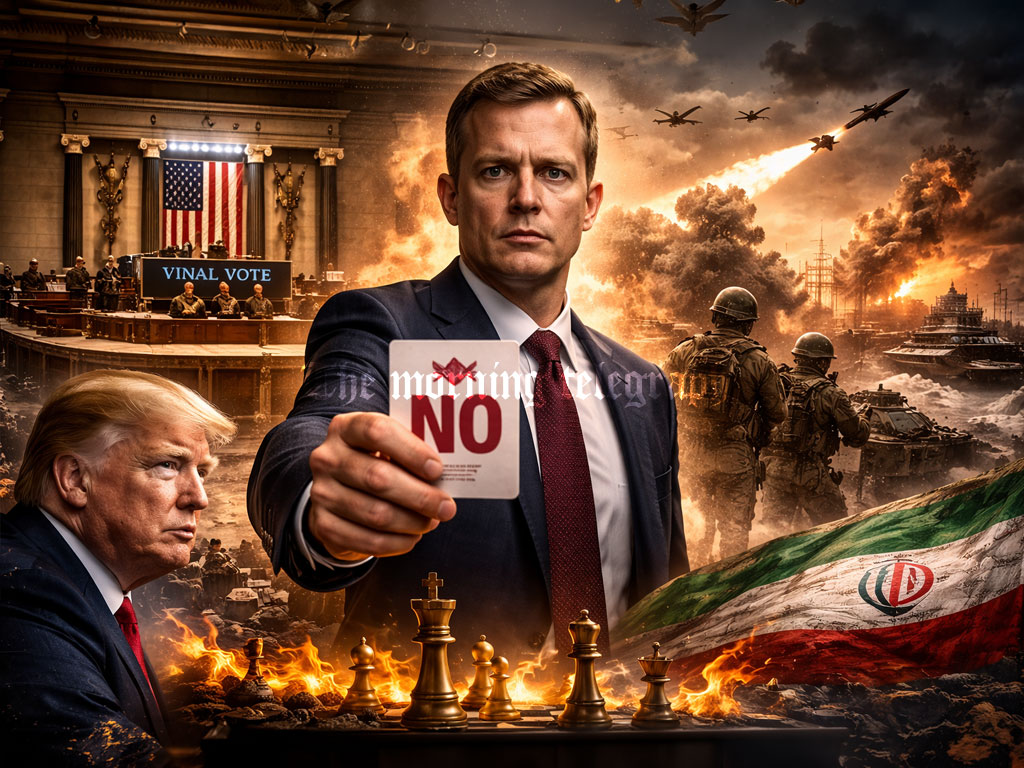
A razor-thin U.S. Congress vote on Iran war powers reveals how one decision can shift global security, escalate geopolitical tensions, and redefine the balance between peace and conflict.
This extraordinary moment from the United States Congress sent shockwaves across global politics and international relations. A crucial war powers resolution aimed at preventing escalation with Iran, closely tied to former President Donald Trump’s foreign policy strategy, was defeated by just one vote. The final tally stood at 213 to 214. This narrow margin has now become a defining case study in U.S. politics, demonstrating how a single vote can influence global security, economic stability, and the future of international diplomacy.

For many, the idea that one vote can change history may seem exaggerated. However, political history and geopolitical analysis repeatedly prove that major world events often hinge on the smallest decisions. This U.S. Congress vote is a powerful example of democratic power, where individual lawmakers hold the ability to impact war, peace, and global stability.
Under the U.S. political system, war powers are divided between the Executive branch led by the President and the Legislative branch represented by Congress. In this situation, concerns grew as Donald Trump appeared willing to initiate military action against Iran without full congressional approval. To counter this, lawmakers introduced a war powers resolution designed to limit unilateral military decisions and enforce congressional oversight. The goal was clear: prevent a potential U.S.-Iran conflict and ensure democratic accountability in decisions of war.
When the vote was held, the resolution received 213 votes in favor and 214 against. This meant the resolution failed, allowing the President to retain authority to pursue military action against Iran. Such a close vote is extremely rare in U.S. congressional history. Most legislative outcomes are decided by wider margins, but here, the fate of a potential war scenario was determined by a single vote.
Attention quickly turned to Democratic Congressman Jared Golden, whose decision became the defining factor in this geopolitical moment. In U.S. party politics, Democrats generally oppose aggressive war strategies, while Republicans often align more closely with Trump’s policies. As a Democrat, Golden was expected to support the resolution to prevent war. However, in a surprising political move, he voted against it, effectively siding with the opposing camp.
Had Golden voted in line with his party, the result would have flipped to 214 in favor and 213 against, allowing the resolution to pass. This would have significantly reduced the risk of military escalation between the United States and Iran. This moment highlights the immense influence of individual representatives within a democratic system, where a single vote can alter the course of global politics and international conflict.
For historians and political analysts, this development is deeply concerning. Both World War I and World War II were triggered by decisions that initially seemed minor or isolated. These historical parallels provide a stark warning about the consequences of political miscalculations.
In June 1914, Archduke Franz Ferdinand of Austria was assassinated in Sarajevo after a series of unexpected events, including a wrong turn by his driver. This single moment triggered World War I, resulting in over 20 million deaths. Similarly, before World War II, British Prime Minister Neville Chamberlain attempted to maintain peace through the Munich Agreement with Adolf Hitler in 1938. His decision allowed Germany to grow stronger, ultimately leading to a war that killed over 70 million people.
Today, Jared Golden’s vote in the U.S. Congress draws uncomfortable comparisons to those historical turning points. It illustrates how a single political decision can create conditions that may escalate into large-scale conflict if not carefully managed.
Philosopher George Santayana once warned that those who fail to learn from history are destined to repeat it. In both 1914 and 1939, people believed the conflicts were distant issues that would not affect them. However, once war began, it spread rapidly across borders, affecting millions regardless of nationality or belief.
This is why the one-vote decision in the U.S. Congress must be viewed with caution, strategic awareness, and geopolitical insight. Behind that single vote lies the potential to influence global peace, military strategy, and international relations.
The words of renowned writer Mario Benedetti remain relevant in this context. War often becomes a situation where individuals who do not know each other are forced into conflict, while leaders who make the decisions never experience the battlefield themselves.
Those casting critical votes or shaping foreign policy rarely face the consequences of war directly. However, for soldiers, civilians, and entire nations, the impact is devastating. This reality reinforces the significance of democratic responsibility and the power of each vote in shaping the future.
The reflection of poet Sekera also resonates strongly. Knowing what is right does not always translate into action. When a decision prevents the opportunity to avoid war, even by a single vote, it delays peace and increases uncertainty for millions around the world.