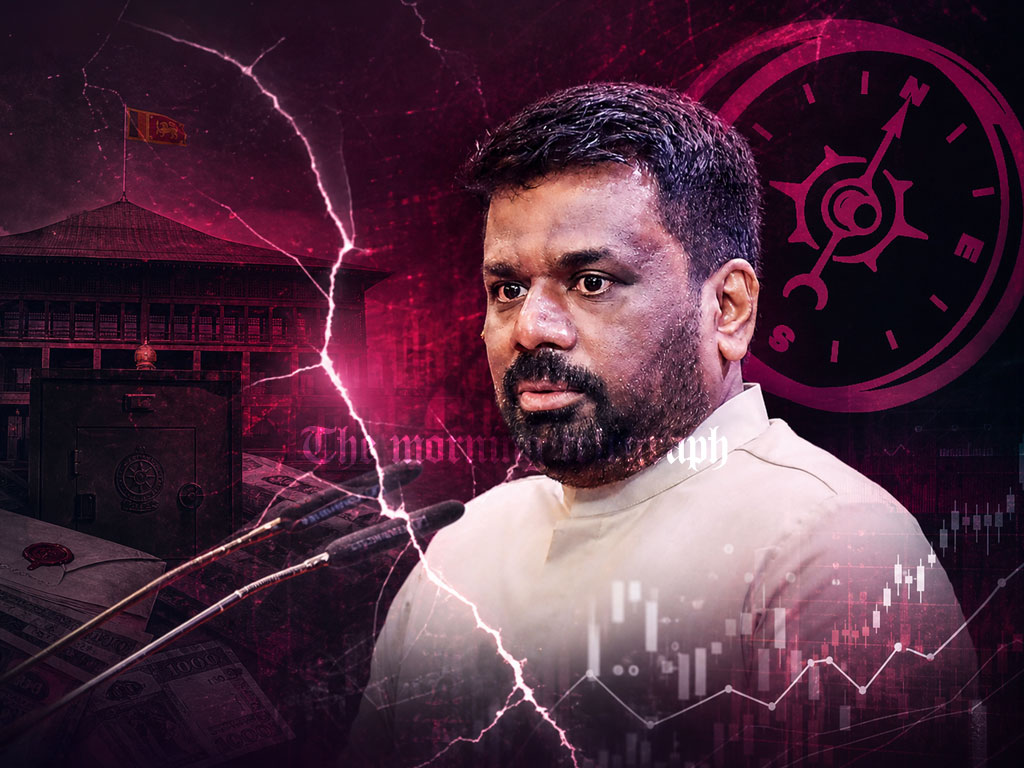
Treasury theft scandal over USD 2.5 million intensifies as Opposition demands debate, exposing NPP pressure over coal, ports and banking crises.
Opposition pushes for debate as government faces mounting pressure
Treasury theft scandal allegations involving USD 2.5 million have thrown the NPP government into one of its most damaging political crises since taking office.
The Opposition is demanding a one-day parliamentary debate on the alleged Treasury theft, which critics describe as a daylight robbery exposed only after the “Free Lawyers” movement went public.

The government opposes the move, while the Opposition is attempting to build unity around the issue and escalate pressure at a time when the NPP is already battling several controversies.
Already under pressure from the coal tender debate, the ruling party appears unwilling to face another major confrontation in Parliament over the Treasury scandal.
The alleged USD 2.5 million heist at the Treasury, which reportedly took place several months ago, has become politically explosive because senior officials are accused by critics of dragging their feet until the matter was brought to public attention.
The controversy, first highlighted by the Free Lawyers movement, has dampened the NPP’s enthusiasm ahead of May Day and placed the government’s anti-corruption credentials under severe scrutiny.
The Treasury fiasco has come against the backdrop of a damaging report issued by the National Audit Office, which found fault with the government for awarding the coal tender for the 2025/2026 period to Trident Champhar Limited of India in violation of tender procedures.
The NAO emphasized that the Indian company should not even have been considered for the tender.
Even after the exposure of the controversial handling of the coal tender, the NPP, despite internal rumblings, appeared confident that it could overcome the growing accusations regarding governance failures.
However, the sudden revelation of the loss suffered by the Treasury, and the government’s attempts to manage the fallout, have caused serious damage to the ruling party.
Instead of using May Day platforms only to attack corruption allegations against previous administrations, the NPP now faces the difficult task of explaining serious failures under its own watch, particularly the loss of USD 2.5 million.
There had not been a previous instance of such an incident at the Treasury. That makes the controversy even more serious for a government elected on a strong anti-corruption platform.
The NPP will have to answer questions raised by “Free Lawyers,” the civil society group that first brought the Treasury issue into public focus.
On behalf of “Free Lawyers,” its President Maithri Gunaratne, PC, former Governor of several provinces Rajith Keerthi Tennakoon, and Attorney-at-Law Shiral Lakthilaka have strongly questioned the government over the unprecedented Treasury incident.
The Opposition has also censured the NPP, with SJB leader Sajith Premadasa, MP, Chairman of the Committee on Public Finance Dr. Harsha de Silva, MP, and the United Republican Front taking the lead.
The NPP’s explanation, based on alleged cyber intrusions by hacker or hackers targeting the Treasury, has not convinced critics.
The ruling party’s position is now under growing public pressure as the coal scam and Treasury fiasco dominate social media and political debate.
The Opposition, along with ordinary citizens, has seized the moment to attack the NPP, a political movement that previously accused its rivals of waste, corruption, irregularities, and mismanagement.
The NPP’s successful propaganda campaigns during the presidential and parliamentary elections in September and November 2024 were centered on fighting corruption.
That anti-corruption platform appealed to the public for clear reasons. After Sri Lanka declared bankruptcy in May 2022, having failed to meet debt commitments, voters rallied around the NPP’s promise to end waste, corruption, irregularities, and mismanagement associated with previous governments.
Having won the executive presidency in September 2024, the NPP assured voters that Parliament would be cleansed of evils at the general election.
President Anura Kumara Dissanayake declared that the people had been vested with the responsibility of cleansing Parliament.
Dissanayake went further when he addressed a public gathering at the 18th mile post on the Negombo-Colombo road.
The NPP leader, who also leads the JVP, asserted that there was no need for an Opposition in Parliament and that the House should be filled with NPPers.
Dissanayake based that assertion mainly on two failed No-Confidence Motions moved against Ravi Karunanayake and Keheliya Rambukwella in 2016 and 2023, respectively.
The NPP/JVP leader faulted the Yahapalana government and the Wickremesinghe-Rajapaksa government for protecting the two wrongdoers, hence the call to cleanse Parliament.
The parliamentary election results showed that the electorate responded strongly to Dissanayake’s appeal.
Of the 225-seat Parliament, the NPP secured 159 seats, including 18 National List slots.
Having accused previous governments of shielding wrongdoers, Dissanayake then directed the NPP’s overwhelming parliamentary group to defeat the No-Confidence Motion moved against Energy Minister Punyakumara Dissanayake, National List MP, on 10 April.
That vote came just a few days after the NAO report exposed the coal tender controversy.
First Ex-MP as Treasury Secretary
If its own hands are clean, there is little doubt that the NPP now faces hard questions over the appointment of ex-NPP National List MP Harshana Suriyapperuma as Secretary to the Treasury and the Finance Ministry.
That appointment was made in June 2025 to fill the vacancy created by the retirement of Mahinda Siriwardana.
Siriwardana, together with Governor of the Central Bank Dr. Nandalal Weerasinghe, played a significant role in the country’s post-Aragalaya recovery programme.
Suriyapperuma had served as Deputy Minister of Finance and Planning for just seven months before being appointed Treasury Secretary and Finance Ministry Secretary.
He is now under heavy criticism over the handling of the Treasury crisis.
No less a figure than CoPF Chairman Dr. Harsha de Silva publicly accused Suriyapperuma of trying to undermine his committee.
The SJB has demanded Suriyapperuma’s immediate resignation. Dr. Anil Jayantha succeeded as Deputy Minister of Finance and Planning.
Those who inquired into the crisis-hit Treasury believe that 53-year-old Suriyapperuma lacked the required experience to fill the shoes of Mahinda Siriwardana.
Some critics argue that the breach at the Treasury could perhaps have been avoided if an outsider had not been brought in to replace Siriwardana.
Recent reports on the incident stated that Suriyapperuma had been aware of the breach and had sought to avoid appearing before the CoPF.
The NPP could have responded to the developing situation differently if an ex-MP had not been entrusted with steering the Treasury and Finance Ministry.
To make matters more politically sensitive, President Dissanayake himself holds the Finance portfolio.
Although the government declared that the theft of USD 2.5 million had been reported to the Criminal Investigation Department after initial detection in January this year, controversy remains over the failure of law enforcement authorities to bring it to the notice of the courts.
Maithri Gunaratne, appearing on Hiru last Saturday, April 25, questioned why the police failed to inform the relevant Magistrate if the government had lodged a complaint in that regard.
Australia has confirmed irregularities in payments owed to its government.
Regardless of NPP efforts to blame hacker or hackers, critics argue that the central fact remains clear.
Payments were made to an account that had not been included in the original agreement between the governments of Sri Lanka and Australia.
That is the issue the NPP now cannot easily suppress through political messaging.
The NPP should be deeply embarrassed that such a fraud was allegedly perpetrated on a country still struggling to recover from economic destruction caused over many years under UNP and SLFP-led governments, with critics also pointing to outside interests and the turmoil of the Gotabaya Rajapaksa period and the JVP/Aragalaya era.
The world is already familiar with how the UNP became associated with the Treasury bond scams involving the then Governor of the Central Bank, Arjuna Mahendran, in February 2015 and March 2016.
Regardless of that serious scandal, the UNP made a desperate attempt to retain the services of Mahendran as Governor of the Central Bank.
Party leader and then Prime Minister Ranil Wickremesinghe demanded the reappointment of Mahendran.
That move was eventually dropped due to massive Opposition protests and growing public anger over the Treasury bond scams.
The first Treasury bond scam carried out on 27 February 2015 caused a direct loss of approximately Rs. 2 billion.
On the instructions of Mahendran, the Treasury suddenly and arbitrarily changed the process of issuing Treasury Bonds.
According to media reports at that time, higher interest payments over the next 50 years caused a further loss of around Rs. 145 billion.
Then Mahendran struck again.
The Treasury Bond issues on 27 March 2016 and 29 March 2016 caused further direct losses of more than Rs. 4 billion to the government through a fraudulent increase in interest rates.
Those bond issues allegedly provided an undue advantage to connected primary dealers through further premeditated bond scams.
NPP Forced Onto the Defensive
The ruling party has attempted to put on a brave face, with lawmakers and various others trying to play down the incident at the Treasury.
Some tried to compare various accusations directed at the Rajapaksas with the incident at the Treasury, which the government has blamed on hacker or hackers.
However, the NPP is now facing an explosive mixture of issues.
Both the coal and Treasury scandals have brought immense pressure on the national economy and caused political deterioration.
The resignation of Punyakumara, also known as Kumara Jayakody, over the coal scam indicated that defeating the NCM moved against him was a strategic political blunder.
Had the NPP asked the first-time Minister to step down and appointed a Presidential Commission to examine the coal scam, the party could have avoided a major disaster.
Instead, the Energy Minister and Energy Secretary Udayanga Hemapala had to resign before Parliament took up the NCM.
Had the top NPP leadership bothered to study the executive summary of the NAO report presented to Parliament on 7 April, the party may not have tried to defend the minister.
Having championed a corruption-free political party system and then won both the presidential and parliamentary elections on that platform, the NPP also faces scrutiny over the move to release 323 containers from the Colombo Port in January 2025 without even cursory checks.
Those who carried out that operation reportedly used continuing port congestion as an excuse to clear red-flagged containers without mandatory physical checking.
The NPP recently thwarted a bid by Opposition lawmakers, representing a parliamentary committee inquiring into the illegal release of containers, to summon President Dissanayake.
That committee, headed by Justice Minister Attorney-at-Law Harshana Nanayakkara, owes an explanation as to why President Dissanayake, in his capacity as Finance Minister, should not appear before a House committee.
President Dissanayake often addresses Parliament on crucial issues.
As the Minister in charge of Finance, he should offer an explanation regarding the high-profile container issue that has tarnished the NPP’s image.
The three major issues now before the government are the release of 323 containers, the coal scam, and the alleged theft at the Treasury.
Regardless of what apologists say on mainstream and social media, these matters have caused serious damage to the ruling party.
They come in addition to controversies involving figures such as Speaker Jagath Wickramaratne and Minister Lal Kantha.
The true impact on the NPP can only be assessed at an election.
With the public increasingly aware of the growing accusations against it, the ruling party may seek to postpone the long-delayed Provincial Council elections for as long as possible.
Facing the electorate amid deepening public discontent appears to be a difficult prospect.
It will be important to observe how the House committee headed by Foreign Minister Vijitha Herath, appointed to explore ways and means to conduct Provincial Council polls, addresses the issue.
When compared with the three major issues now confronting the NPP, the resignation of Asoka Ranwala as Speaker in December 2024 over his failure to produce the much-touted educational qualifications may now seem less politically damaging.
Of course, Ranwala’s case attracted enormous public attention at the time because the public truly believed the NPP would not deceive them.
Ranwala’s lie shocked the public.
NPP theoretician Prof. Ranjith Nirmal Devasiri publicly attacked Ranwala after the NPP defended the Speaker.
But subsequent NPP actions have revealed deeper manipulations that critics say have shamed the first post-Aragalaya government.
Having accused Ranil Wickremesinghe of squandering as much as Rs. 16 million to join his wife Prof. Maithree in the UK in September 2023, the NPP is now facing far more serious accusations.
The incident at the Treasury should be sufficient for the Opposition to move a No-Confidence Motion against the government.
Of course, the NPP has the numbers in Parliament to easily defeat such an NCM, but the consequences would be politically devastating.
Those who still talk of recovering the missing USD 2.5 million may be relying more on hope than reality.
The UNP is labelled with the Treasury bond scams of 2015 and 2016, while the SLPP is faulted over the 2019 tax cuts and the 2020 sugar tax scam.
The NPP may now have to live with the coal scam and Treasury theft.
The ruling party will no longer be able to parade on political platforms as a movement of unquestioned virtue.
It would be relevant to mention that the Presidential Commission appointed to probe the procurement of coal since 2009 may produce a report that meets the NPP’s expectations.
All indications point to 2026 becoming far more challenging for the government, both inside and outside Parliament, than the previous year.
NDB Fraud Raises Wider Banking Questions
Examined together, the massive fraud at the National Development Bank, perpetrated during the 2024-2026 period, and the Treasury incident underscore the vulnerability of the entire banking system.
The Rs. 13.2 billion NDB fraud and the theft of USD 2.5 million from the Treasury have exposed questions over the regulator, the Central Bank of Sri Lanka, in respect of the NDB.
The situation at the NDB cannot be examined without considering that Ernst & Young serves as the external auditor of the NDB.
Its Managing Partner Duminda Hulangamuwa functions as Senior Economic Adviser to President Dissanayake.
People have not forgotten that Hulangamuwa had been mentioned as a possible successor to Mahinda Siriwardena before the NPP brought in Suriyapperuma.
The Central Bank and Securities Exchange Commission come under the purview of the Finance Ministry, which is now embroiled in the expanding Treasury fiasco.
The Board of Directors at the NDB consists of Sriyan Cooray as Chairman, Kelum Edirisinghe as Director and Chief Executive Officer, Bernard Sinniah as Non-Independent Director, Sujeewa Mudalige as Independent Director, Kushan D’Alwis as Independent Director, Kasturi Chellaraja as Independent Director, Shweta Pandey as Independent Director, Hasitha Premaratne as Independent Director, Sanjaya Mohottala as Non-Independent Director, and Shanil Fernando as Independent Director.
The issue at hand is how such a fraud went unnoticed for a considerable period of time and whether top management ignored warning signs.
There are also questions over the failure of the regulator to intervene.
Those who have read Mahinda Siriwardana’s “Sri Lanka’s Economic Revival: Reflections on the Journey from Crisis to Recovery” would understand the circumstances that led to the 2022 economic collapse.
Soft-spoken Siriwardana meticulously discussed how the then Central Bank leadership, as well as the so-called economic leadership of the Pohottuwa party, deliberately deceived President Gotabaya Rajapaksa.
Siriwardana’s narrative is explosive.
The book, launched before his retirement with the participation of President Dissanayake, underscored the responsibility of the political leadership and those running the banking system.
However, Siriwardana’s work appears to have had no visible impact on the current dispensation or top banking management.
The Opposition now sees an opportunity to heap pressure on the NPP as it considers countermeasures.
The challenge is how to take remedial action without jeopardizing the government.
The IMF declaration that it is closely watching the theft of USD 2.5 million from the Treasury has added pressure on a government already battered by the situation at the Treasury.
However, questions remain over whether Parliament, the Finance Ministry, the Central Bank, and the government can now work together to restore financial discipline.
What happens next could be critical.
Sri Lanka needs to begin debt repayments in 2028, and the country cannot afford a governance culture where major financial scandals are treated as political inconveniences rather than national emergencies.
The government and Opposition must reach consensus on practical measures to improve financial discipline, strengthen oversight, and restore confidence.
Overall, Parliament cannot absolve itself of responsibility for enacting laws, ensuring accountability, and protecting public money at a time when Sri Lanka’s economic recovery remains fragile.