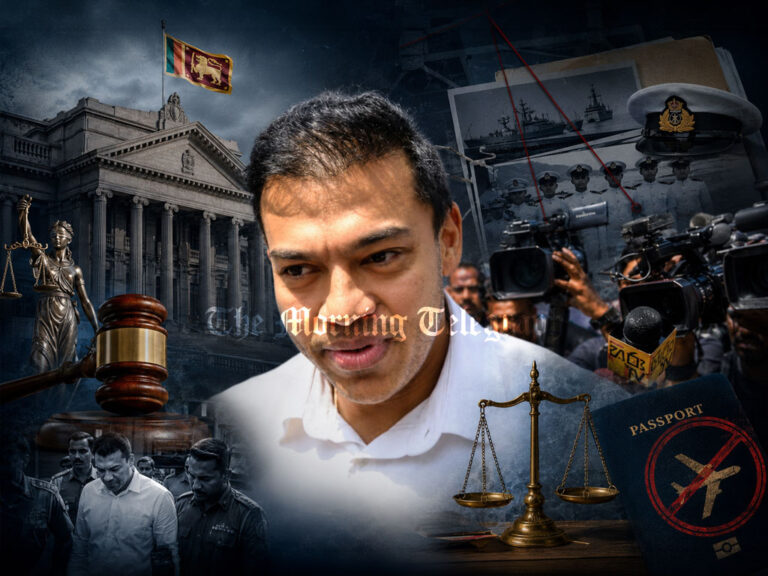
Fort Magistrate transfer raises questions after Isuru Nettikumar challenged CID evidence, torture claims, and political narratives in court.
The Fort Magistrate transfer of Isuru Nettikumar has triggered serious questions after the judge issued firm rulings in politically sensitive cases involving former President Ranil Wickremesinghe and former State Intelligence Service chief Suresh Salle.
In Sri Lanka’s legal circles, there is a familiar saying about the Fort Magistrate’s Court. Magistrates appointed there either rise to the very top of the field or they go home.

The reason is simple. Many of the country’s most politically explosive, socially sensitive, and high-profile cases involving powerful figures often pass through this court.
That reality was seen again when the cases involving former President Ranil Wickremesinghe and former SIS chief Suresh Salle were taken up before the Fort Magistrate’s Court. During those proceedings, Fort Magistrate Isuru Nettikumar’s direct orders, based on law and evidence without favouring any side, became a major talking point in legal circles.
However, questions remain after information emerged that the magistrate who stood firmly for judicial neutrality has now been abruptly transferred by the Judicial Services Commission.
He has been replaced as Fort Magistrate by Pasanna Amarasekera, who had been serving as a judge at the Galkissa Court.
What makes this appointment particularly noteworthy is that Pasanna Amarasekera was appointed to the Galkissa Court after the sudden transfer of the then Galkissa judge during a case involving a group including Wasantha Samarasinghe last year.
This raises concerns about whether the latest transfer was purely an administrative decision or whether it was linked to the magistrate’s firm questioning of investigative agencies, their conduct, and their alleged evidence-free narratives in highly sensitive cases.
Ranil Case: Court Demands Evidence, Not Delay
During the trial concerning former President Ranil Wickremesinghe, Magistrate Isuru Nettikumar sent a clear message to the Criminal Investigation Department.
The message was simple: either produce evidence that is admissible before court or close the case.
That position became significant because it challenged the practice of keeping cases alive without presenting sufficient evidence capable of supporting further proceedings.
In relation to the first and second suspects in the Easter attack case currently being heard at the Fort Magistrate’s Court, Magistrate Nettikumar had already ruled that there was insufficient evidence to proceed under the Prevention of Terrorism Act.
That ruling firmly established that the court would not allow investigative agencies to waste time or harass individuals without evidence.
For many observers, this was not merely a procedural intervention. It was a clear reminder that politically sensitive investigations must still be governed by the basic principles of law, admissible evidence, and due process.
Suresh Salle Case: CID Conduct Comes Under Scrutiny
The impartiality and firmness of Magistrate Isuru Nettikumar became even more visible in the case of former intelligence chief Suresh Salle, who is in custody over the Easter attack.
During that case, the suspect’s legal team made a serious revelation in court regarding alleged cruel and inhuman treatment by the Criminal Investigation Department.
They submitted that the treatment had violated the human rights of a citizen, even if that citizen was a suspect in a sensitive investigation.
According to the submissions made in court, a few days after the third suspect was taken into custody, several officers allegedly entered his cell at night and took him away.
The legal team alleged that he was stripped naked, handcuffed with his hands to the front of his body, forced to bend forward with his back facing those officers, and subjected to a body search in front of other detainees.
They described the incident as cruel, inhuman, and degrading treatment.
Acting immediately on those serious submissions, Magistrate Nettikumar ordered that the suspect be referred to a court psychiatrist, a nutritionist, and an eye hospital.
He also gave firm instructions to the CID that his orders must be implemented exactly as issued.
He warned that if any order was not carried out, steps would be taken under contempt of court.
That warning placed a clear limit on the arbitrary conduct of investigation officers and signalled that the court would not remain silent when allegations of mistreatment were placed before it.
Court Pushes Back Against The ‘Grand Narrative’
Another major moment came when Additional Solicitor General Dilip Peiris, appearing for the prosecution, attempted to construct what was described as a large “cinematic narrative” or Grand Narrative.
Instead of presenting independent evidence, the prosecution attempted to connect political events from 2015 up to the assumption of the presidency by Gotabaya Rajapaksa.
However, Magistrate Isuru Nettikumar, standing firmly for the rule of law, questioned these hypothetical stories advanced by the prosecution.
He directly asked whether independent witnesses had presented evidence, separate from the ideologies of investigators, and whether there was any real connection between the events being placed before court.
His warning deserves serious attention across the justice system.
“Do not play games with this investigation. This is said to all parties. This is not a game. This is a very sensitive issue. For justice to prevail in the end, it must be proven beyond reasonable doubt. It is with that in mind that the court looks at every statement. The court views the ideologies beneath that with suspicion.”
The magistrate also advised the prosecution that if a case was being built on circumstantial evidence, it had to be woven like a strong rope.
He further warned against presenting facts in a way that made unproven matters appear as though they had already been proven.
That position struck directly at the danger of turning investigations into political storytelling exercises instead of evidence-based legal proceedings.
Does The Transfer Send A Dangerous Message?
This article does not seek to criticise court procedure or judicial appointments.
However, as part of the media’s investigative role, one unavoidable question must be asked.
Is it merely a coincidence that a judge who questioned investigative agencies over evidence-free political narratives, while those agencies appeared to be running media shows around sensitive cases, has now received a sudden transfer?
What indirect message does this send to investigative agencies?
What does it mean when a judge who stood up for human rights, issued warnings under contempt of court, and pushed back against alleged cruel treatment of suspects is moved from one of the country’s most important magistrate courts?
The issue is not only about one magistrate. It is about public trust in the justice system.
If a judge who refused to allow the justice delivery process to become a political witch hunt is suddenly transferred, the wider public will naturally ask whether independence inside sensitive courts is being protected or weakened.
The Fort Magistrate’s Court has long carried a reputation as a place where judges either rise to the highest levels of the legal field or are forced out of the path.
This latest development now risks reviving that old saying with fresh force.
What happens next could be critical, because the transfer of Magistrate Isuru Nettikumar has opened a deeper debate about judicial independence, investigative accountability, human rights, and whether courts will be allowed to demand evidence when politically charged narratives enter the courtroom.