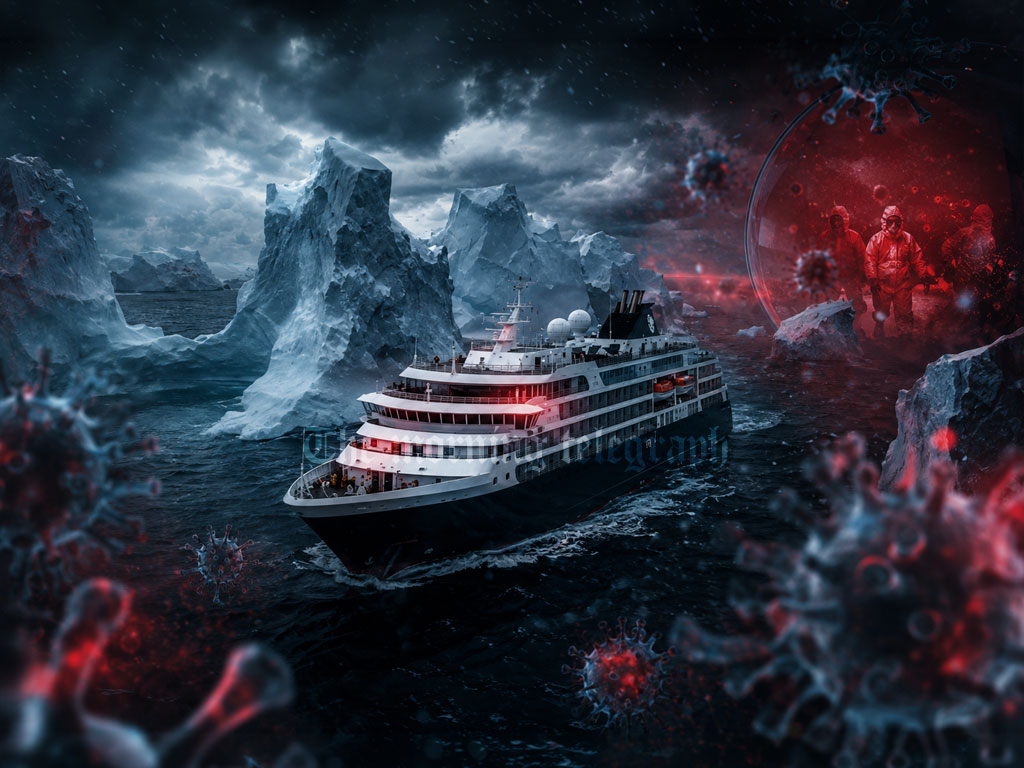
Andes Hantavirus outbreak on MV Hondius cruise ship raises alarms. Unlike other strains, this virus spreads human to human. Symptoms, risks, and what we know.
Have you ever imagined that life’s biggest dream could turn into your worst nightmare in just an instant? People who save money for months and board the world’s most modern, luxurious cruise ships have no reason to think that way. While enjoying the beauty of the icy Atlantic Ocean or the iceberg filled Antarctica, suddenly an announcement comes from the ship’s captain. “Do not leave your rooms. We are fighting an invisible enemy.”
This is precisely the terrifying situation that passengers aboard the famous MV Hondius are currently facing. This enemy is not COVID. It is a completely different, unfamiliar, yet extremely dangerous virus. It is the Andes strain of the Hantavirus.

You might think, “Hantavirus is transmitted by rodents, so how could it cause such a problem inside a ship?” True, generally Hantavirus spreads that way. But this story is far more different and complex. Hantavirus is not a newly discovered phenomenon. Its history dates back to the Korean War. Soldiers camped near the Hantan River in Korea contracted this mysterious illness, which is how the virus got its name.
Normally, this virus enters human populations through rodents. When the urine, droppings, and saliva of infected rodents dry and turn into dust, inhaling that dust can cause the disease. It can also be contracted by touching a rodent or touching contaminated surfaces and then touching your eyes or nose. The biggest relief was that ordinary Hantavirus does not spread from person to person. So, being near an infected patient would not put you at risk.
But as every rule has an exception, there is one dangerous member of the Hantavirus family. That is the Andes Orthohantavirus, or the Andes strain. This Andes strain was first discovered in South America, particularly around Argentina and Chile. It differs completely from other Hantavirus strains for one major reason. It is the only known Hantavirus strain capable of human to human transmission.
Now you can understand what is happening aboard the MV Hondius. If it were an ordinary Hantavirus, even if there were an infected passenger, there would be no risk of transmission to others. But because of this Andes virus, it can spread rapidly to thousands of other passengers and crew through an infected person’s respiratory droplets from coughing, sneezing, or talking, or through close contact.
MV Hondius is not an ordinary vessel. It is specifically designed for expedition cruises in polar regions. Therefore, its interior is a largely sealed environment. The ship’s air conditioning system recirculates the same air repeatedly. Regardless of modern filters, microscopic viral particles may still have some ability to travel through them. Passengers spend time in close contact during meals, entertainment, and in the ship’s pool areas. There is no better breeding ground for human to human transmission of the Andes virus.
Although a ship has a medical bay, it only has basic facilities. If a severe condition like Hantavirus Pulmonary Syndrome (HPS) develops, patients would require intensive care units and ventilators simultaneously on a large scale. Such facilities are impossible to have on a ship. After contracting the Andes Hantavirus, initial symptoms appear within a few days, resembling a common flu. These include high fever and muscle pain, especially in the thighs and lower back, extreme tiredness and fatigue, nausea, vomiting, and abdominal pain.
Many people would dismiss these as a minor viral fever. But the truly terrifying phase begins later. After 4 to 10 days, the virus directly attacks the lungs. This condition is called Hantavirus Pulmonary Syndrome (HPS). During this, fluid begins to fill the lungs. The patient struggles to breathe. It is an extremely painful experience, like drowning on land.
The most tragic fact is that once HPS develops, there is a fatality rate of between 30% and 40%. Furthermore, no specific vaccine or treatment has yet been discovered worldwide. The only available intervention is providing oxygen and supporting the body’s own fight against the virus. That is the question everyone is asking. How could a disease transmitted by rodents get onto a ship sailing among icebergs?
Most likely, a passenger or crew member who had travelled in a South American region, for example, Patagonia in Argentina, before boarding the ship may have visited an area inhabited by infected rodents. The virus would have entered their body at that time. The incubation period for Hantavirus can extend up to several weeks. So, they would have boarded the ship as a perfectly healthy person, showing no symptoms. But after the ship sailed into the middle of the ocean, that person’s symptoms would have started to appear, and through their coughs and speech, the Andes virus would have begun spreading to others. This is like a time bomb exploding.
As I said at the beginning, we think we have conquered nature. We boast about our advanced technology, luxurious lifestyles, and financial power. But seeing what is happening on the MV Hondius, we understand that a viral particle invisible even under a microscope, whose very existence is hard to confirm, can bring any advanced technology in the world to its knees. After the COVID pandemic, the world became highly alert to such viruses. But as time passed, we forgot that fear and started living normally again.
However, incidents like this repeatedly remind us that there are still things hidden within nature that we do not know about, things capable of destroying us. Perhaps it is a cruel twist of fate. People who set out to experience the ultimate joy of life end up trapped in a dark room, fighting for their own breath. Is this a coincidence? Or a warning from nature? Regardless, at this moment, we should pray that the helpless people stranded on the MV Hondius can safely reach shore from this terrifying situation.
It is also essential that we pay more attention to keeping our environment clean and being aware of the potential dangers from animals like rodents. Life is a very strange thing. We can never predict what will happen in the next second. Therefore, caution and awareness are our only weapons.