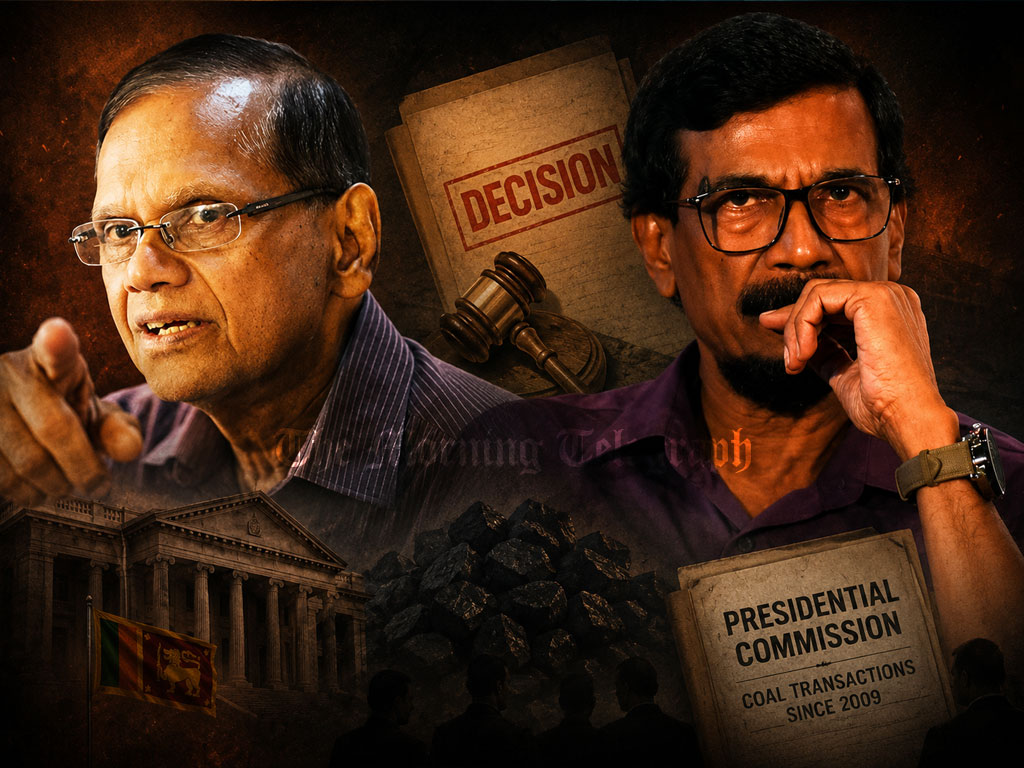
Coal Commission row deepens as G.L. Peiris says Tilvin Silva’s remarks suggest a pre-decided outcome before judges complete inquiry.
Coal Commission concerns have intensified after Joint Opposition Leader and former Foreign Affairs Minister Professor G.L. Peiris questioned the true purpose of the Presidential Commission appointed to investigate coal transactions since 2009.
Professor Peiris also strongly criticised ruling party General Secretary Tilvin Silva for making statements that appeared to reach conclusions before the Commission completed its investigations.
Speaking to the Daily Mirror, Professor Peiris said the Commission had been appointed under the Special Presidential Commissions of Inquiry Act No. 7 of 1978.

Explaining the special nature of such a Commission, he said: “Unlike other Commissions, every member of such a Commission must be a serving judge of a rank not lower than a District Court. As a result, the proceedings of this Commission take on a character very similar to a trial conducted in a court of law.”
Professor Peiris referred to a statement made by Tilvin Silva at the Janatha Vimukthi Peramuna’s May Day rally regarding the appointment of a Commission with judicial powers.
According to Peiris, Silva had stated that within another three months, the accusers would become the accused, and that all party members would be absolved of responsibility.
Quoting Silva’s remarks, Professor Peiris said such a statement was an insult to the judges serving on the Commission.
“This is an insult to the Commission. It consists of serving judges. If we want an impartial decision, they must be allowed to act independently and objectively. Mr. Tilvin Silva is a powerful political figure in this country. If such a person states in advance what the Commission’s decision will be, then what is the purpose of appointing such a Commission? This makes it clear that the government has already made its decision,” he said.
Professor Peiris further noted that the Commission’s procedure involves lawyers and cross-examinations, similar to an ordinary court process.
He stressed that the most serious aspect is that a Special Presidential Commission has the power to recommend the removal of a person’s civic rights.
He also warned that such a Commission can recommend revoking civic rights for seven years. If that recommendation is passed by Parliament, the person concerned would lose those civic rights.