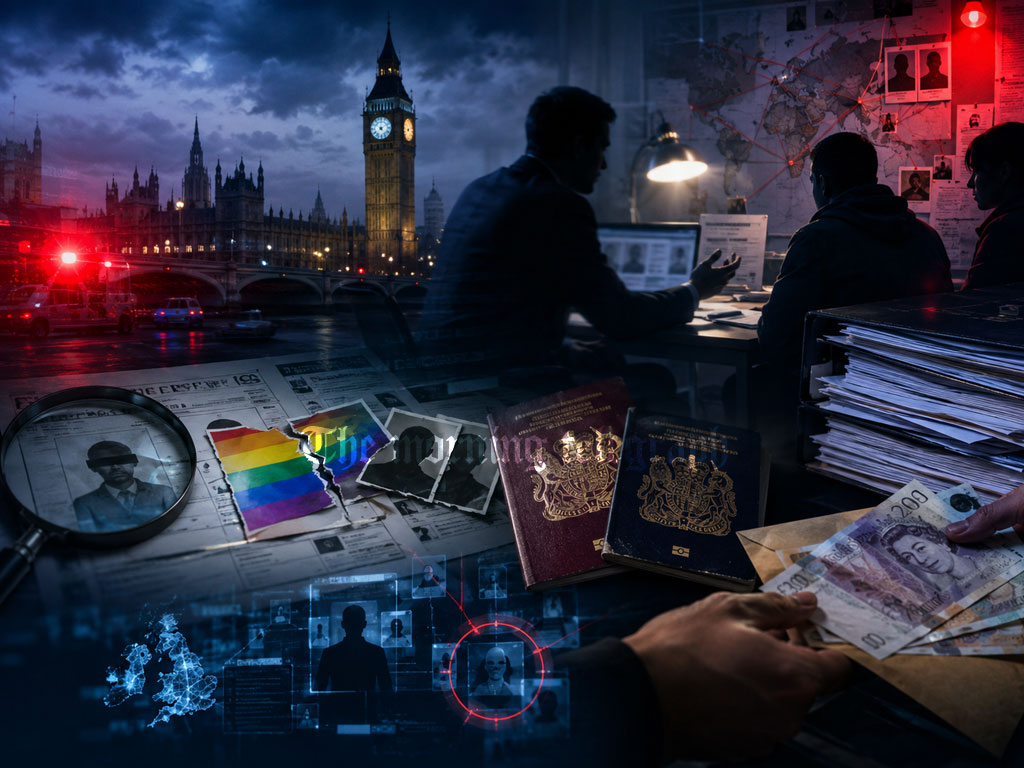
UK asylum fraud claims surface as the BBC has uncovered advisers helping migrants fake sexuality-based applications to remain in Britain.
UK asylum fraud allegations have intensified after the BBC has uncovered an informal network of law firms and advisers charging migrants thousands of pounds to remain in Britain by pretending to be gay.
In the first part of this undercover investigation, the BBC reveals how immigration solicitors and advisers allegedly help people approaching the end of their visas create false stories and collect fake evidence, including letters of support, photographs, and medical reports.
The migrants then claim asylum on the basis of being gay, arguing that returning to countries such as Pakistan or Bangladesh would place their lives at risk.
Responding to the BBC’s findings, the UK Home Office said: “Anyone who attempts to abuse the system will face severe penalties, including removal from the UK.”

Under the UK asylum system, protection is available to people who would face danger if returned to their home country. This can include countries such as Pakistan and Bangladesh, where homosexuality remains illegal.
But the BBC investigation finds advisers are charging migrants who want to stay in the UK and are allegedly helping them abuse the system in an organised way.
Those involved are usually not people who entered Britain through small boats or illegal routes. Instead, many are people whose student, work, or tourist visas have expired.
This group now accounts for 35% of the total number of people who applied for asylum in the UK, a figure that exceeded 100,000 in 2025.
After gathering initial evidence and intelligence, undercover BBC reporters set out to test how willing immigration advisers were to help prepare fraudulent asylum claims.
They posed as international students from Pakistan and Bangladesh whose visas were nearing expiry.
The investigation found that one law firm charged up to £7,000 for a fake asylum application, while promising that the risk of rejection by the Home Office was “very low”.
Advisers allegedly told applicants to visit doctors and claim they were suffering from depression to make their cases appear truthful. One person falsely claimed to have HIV.
One immigration adviser boasted that she had prepared fake applications for more than 17 years, saying she could make someone pretend to be in a gay relationship if needed.
She also told the undercover reporter that after securing UK asylum, he could bring his wife from Pakistan by having her submit another fake application claiming she was gay.
Another lawyer working for a different firm said he had helped people pretend to be gay or atheist to obtain asylum. He said he could prepare such an application for £1,500, with another £2,000 to £3,000 needed to create evidence.
‘No one here is gay’
On a Tuesday evening, more than 175 people gathered at a community centre in a quiet area of Beckton, East London. Some had travelled from South Wales, Birmingham, and Oxford.
The event was organised by Worcester LGBT, a group that describes itself as advocating for gay men and women seeking asylum.
According to the group’s website, only genuine gay asylum seekers could attend. But outside the community centre, several men told the undercover reporter that the reality was very different.
“Most of the people here are not gay,” said one person, Farhan.
Another man, Seshan, said: “No one here is gay. Not even 1% is gay. Not even 0.01% is gay.”
The undercover reporter’s route to this meeting began in late February, when he identified Masdul Hasan Shakil, a paralegal at the immigration law firm Law & Justice Solicitors, based in Birmingham and London.
Shakil is also the founder and chairman of Worcester LGBT. Until recently, he used the group’s website to promote his legal services.
In a brief phone conversation with Shakil, he told the undercover reporter that an asylum application required a serious threat and said he did not see a valid reason for one.
But about an hour later, the reporter received an unexpected call from a woman named Tanisa. The conversation moved into Urdu, and she appeared keen to help him remain in the country by discussing the possibility of claiming asylum on the basis of being gay.
When he told her he was not gay, she replied: “Listen. No one here is real. This is the only way everyone uses to live here now.”
Although she would not say who had given her his number, the BBC matched the photo and first name on her WhatsApp account to Tanisa Khan, who acts as an adviser for Worcester LGBT.
‘A complete package’
That evening, the undercover reporter travelled to Forest Gate, East London, for an initial consultation with Tanisa.
The meeting was not held at a law firm’s office. It took place at her home, where she invited him in and took him upstairs to a bedroom.
Sitting on the edge of the bed, Tanisa explained: “This is the only way to get a visa at this time, and it’s open. That’s the asylum visa category… given under human rights and based on being gay. There’s no hope of any other visa.”
Tanisa stressed that he would need to work hard to make the plan succeed because he would have to memorise the story for the Home Office interview.
“You’re the one taking the exam. I’ll prepare everything for you, but in the end, you’re the one who has to go in,” she told him.
The 45 minutes spent in Tanisa’s bedroom gave an insight into how sophisticated fake asylum application fraud can be and how difficult it may be for officials to detect.
Asylum applicants are first called for a screening interview by the Home Office. They then face a “substantive interview” lasting several hours, where their claims are examined in detail.
Home Office refusal decisions can later be challenged in court and, in some cases, overturned.
“There’s no special test to find out if someone is gay,” Tanisa told the undercover reporter. “The main thing is what you say. You just tell them, ‘I’m gay, that’s my truth’.”
“There are many organisations where people like you, who aren’t gay, apply for visas. You’re not the only one,” she assured him.
She then described how the alleged fraud would work.
“The way we do it is, I’ll give you a complete package including photos of you at clubs, other supporting evidence, a letter from an organisation, and additional supporting letters, so you can be well prepared for the interview with the Home Office.”
Tanisa, who claimed to have been preparing fake applications for over 17 years, said photos of the reporter at LGBT events and tickets bought for those events would be used as evidence.
“I’ll give you a letter from someone, along with some photos. That person will write that they’ve had a sexual relationship with you,” she said.
Tanisa’s service cost £2,500. She warned that the fee could rise if the asylum claim was unexpectedly refused by the Home Office and an appeal to the tribunal became necessary.
She made clear that, in her view, a successful application was worth the effort.
“You can live here, work here. You’ll also be eligible for benefits,” she said.
But when the reporter asked what would happen to his wife in Pakistan if his application succeeded, given that he would have told the Home Office he was gay, Tanisa replied: “If you bring her here, we’ll claim asylum for her too. After she comes here, we can say she’s a lesbian.”
Providing evidence
Tanisa is not a government-approved immigration adviser, meaning it is illegal for her to provide immigration advice.
She was reluctant to explain her connection to the paralegal the reporter had spoken to earlier that day, saying only that she had worked with him.
“People like solicitors need to guide. But the ground-level work isn’t what they do,” she said, referring to the process of creating evidence. “We’re the ones who do the ground-level work.”
However, her connection to Shakil became clearer during two later meetings, both held at the Ilford offices of Law & Justice, where Shakil works.
“I work with a solicitor. That’s why I use his office,” she said.
During one meeting, when the undercover reporter asked to meet Shakil to thank him for introducing him to Tanisa, she took him to a nearby room to meet him.
Tanisa also explained the role of Worcester LGBT, which she described as “our organisation”.
According to its website, Worcester LGBT is “officially recognised by the Home Office as an organisation that supports LGBT+ asylum seekers”.
She told the reporter he needed to attend the next meeting in early April, where there would be “genuine people” as well as people like him preparing fake applications.
“This meeting is important because if you’re gay, you must provide evidence to the Home Office that you’re connected to a gay organisation,” she said.
She also said Worcester LGBT could issue a letter for his asylum application.
“We’ll issue a letter saying you’re a member of ours, genuinely connected to our organisation, someone we know personally. This kind of evidence is very powerful.”
The BBC showed its footage to Ana Gonzalez, an immigration law specialist with 30 years of experience.
She said Tanisa had clearly broken the law by “creating a fraudulent application to present on behalf of this individual”.
“People like this cause huge problems for genuine asylum seekers and refugees,” Gonzalez said.
“Especially with a sensitive subject like LGBTI. Because if you’ve been tortured, if things have happened to you, there’s often a way to prove it physically. That’s not the case with the gay community. It often depends on relationships, behaviour, and how convincing you can be.”
After the BBC contacted Tanisa about her comments to the undercover reporter, she said it was a “misunderstanding” caused by miscommunication and claimed she did not speak Urdu fluently.
She denied instructing the reporter to make false statements or create fake evidence.
Shakil said he had passed the undercover reporter’s details to Tanisa without knowing she would advise him to submit a fraudulent asylum application.
He said Worcester LGBT does not create or support fraudulent evidence and that it is not the group’s role to determine whether someone is genuinely gay.
He added that Worcester LGBT was conducting an internal investigation into Tanisa’s activities and that she held no decision-making authority within the organisation.
Law & Justice Solicitors said Tanisa had no professional connection to the firm and that it was investigating whether she had “unauthorised access” to its London office.
The firm also said the undercover reporter was never its client.
During the period of the meetings with Tanisa, the undercover reporter also met an adviser at Connaught Law, a firm located in the heart of London’s legal district.
He met Akheel Abbasi, a senior legal adviser at Connaught.
Abbasi claimed he could help the reporter remain in the country and appeared ready to guide him on how to create evidence for a fake application.
He assured the reporter that the risk of refusal by the Home Office was “very low”.
Abbasi said his fee would be £7,000. Once paid, he said, his office would guide the undercover reporter on the required process and the evidence he needed to provide.
“Where to go, what to do,” he said. “Submit evidence from their societies, associations, and clubs. Places they go, where there are such gay clubs.”
At one point, when the undercover reporter asked whether he would have to go to a gay club, Abbasi replied: “Yes, you have to go.”
“But I’m not like that,” the reporter said.
Abbasi laughed and replied: “I’ll take some photos there.”
The legal adviser also said the reporter would need to find someone willing to pose as his male partner.
When the reporter mentioned that his wife was in Pakistan, Abbasi immediately suggested creating a story that he now had a male partner, claiming the UK’s “situation is more open”.
“We’ll prepare a statement for you. When you read it, you’ll understand exactly how this works,” he said.
When contacted, Connaught Law said it was conducting an internal investigation and had taken steps to suspend Abbasi, while reporting the matter to the Solicitors Regulation Authority.
Abbasi denied allegations of dishonesty and impropriety, saying he only prepared applications based on client instructions and did not create false stories or evidence.
‘It’s a huge problem’
Worcester LGBT holds monthly meetings attended by people from across the country, many of whom appear to be fraudulent asylum claimants.
But Worcester LGBT is not the only community group used by people pretending to be gay in asylum claims.
Ajmal Khan, the UK-born founder of the Muslim LGBT Network based in Luton, said: “It’s a huge problem. There are people who try to pay for recommendation letters from my organisation, but I never accept them. All my work is voluntary.”
He said some people openly admit: “I’m not gay, but I want to stay in this country.”
It is difficult to know exactly how many applications are fraudulent.
But Home Office statistics show that Pakistani nationals represent a very high share of asylum claims made on the basis of sexuality.
In 2023, the latest year for which data is available, initial decisions were made on 3,430 LGBT asylum applications.
Nearly 1,400 new applications were made on the basis of sexual orientation that year.
Pakistanis accounted for 42% of those applications and have submitted the highest number of such claims over the past five years.
That same year, Pakistanis ranked fourth among all nationalities making asylum claims, representing only about 6% of total applications.
There is no recent data on claims based on sexuality.
However, Home Office statistics experts say the number of asylum applications from Pakistanis, Bangladeshis, and Indians who originally entered on student or work visas has risen dramatically.
In 2023, nearly two-thirds of those claiming asylum on the basis of sexual orientation were approved at the initial stage.
Ali, not his real name, came to the UK from Pakistan in 2011 as a student.
When his visa was about to expire three years later, he sought advice from a solicitor who told him the only way to stay was to build a false story claiming he was gay.
“She advised me to see a doctor and claim I was suffering from depression because of the visa issue,” he said.
“I didn’t take the medication she gave me. But she insisted I take it and show it to the Home Office as evidence to prove I was depressed.”
His initial Home Office interview failed, and the process moved to an appeal, costing him more than £10,000.
Following the solicitor’s advice, he attended Pride parades, visited more than 10 gay clubs, took photographs, and submitted them as evidence.
The BBC has also seen evidence of him falsely claiming to have HIV to obtain a supporting letter from a charity that helps people with HIV.
Eight years after arriving in the UK, and with legal costs mounting, Ali returned to Pakistan in 2019.
When his wife came to the UK as an international student in 2022, he was unable to join her because of his failed asylum attempt.
But he told the BBC that three of his friends successfully claimed asylum by making false claims about their sexuality.
“They got married in Pakistan and brought their wives here. Now they have children,” he said.
Tough immigration laws
Labour MP Jo White, a member of the Home Affairs Select Committee, said the government must take “robust action” against the law firms and advisers uncovered by the BBC.
The MP for Bassetlaw told BBC Radio 4’s Today programme that she expected the police to launch an investigation.
“The government must act very strongly on this. This evidence should go directly to police authorities, and I expect them to launch their work and shut this down,” she said.
She also called on the Home Office to suspend student visas from Pakistan, noting that the Home Office had recently taken such action for nationals from Afghanistan, Cameroon, Myanmar, and Sudan due to widespread visa fraud.
Conservative shadow home secretary Chris Philp said the BBC investigation had “revealed the fraudulent nature of many asylum claims” and that the advisers identified should be “prosecuted for immigration fraud”.
“The whole system is corrupt,” Philp said.
“The asylum system needs to be completely reorganised so that only a very limited number of people who face genuine persecution and can provide genuine evidence can claim asylum. Also, migrants who claim asylum illegally should be banned completely from re-applying.”
Imran Hussain, director of external affairs at the Refugee Council, said “shameless advisers who prey on vulnerable people for profit must face consequences for their actions”.
He added: “We work daily with LGBTQ+ refugees from countries like Uganda and Pakistan who have been imprisoned, tortured, and abused because of who they are. They have come to Britain to live a safe and open life. This abuse must not be used to undermine the credibility of those who genuinely need asylum.”
Responding to the BBC investigation, Reform UK home affairs spokesperson Zia Yusuf said: “This is a scandal of enormous proportions requiring urgent investigation. Any lawyer found to be helping fraudulent asylum claims should be prosecuted and punished. The failed asylum system, full of loopholes created by the Conservatives, has allowed millions to enter the country. Those loopholes are being exploited by activist lawyers through fake claims. Reform UK will end this disgrace. We will leave the ECHR, reform the asylum system, and throw the full force of the law at those who abuse it.”
Liberal Democrat MP Anna Sabine told BBC Politics Live that anyone abusing the asylum system should “face the full force of the law”.
She added: “If this is happening on a large scale, it raises questions about what is really happening within the Home Office. At the same time, there are genuine LGBT groups dedicated to helping those who come to this country for legitimate reasons.”
The Home Office said making a fraudulent asylum application is a crime, and a person convicted in court could be sentenced to prison and later removed from the UK.
“Any attempt to abuse the protections designed for those genuinely fleeing persecution based on their sexuality is disgraceful,” a spokesperson said.
“The asylum system is built on robust safeguards to assess each application rigorously and fairly. Asylum is only granted to those who meet established guidelines. We actively expose and constantly review procedures to stop fraudulent activity.”
In March, Home Secretary Shabana Mahmood announced several significant changes to UK immigration laws.
Under those changes, refugees arriving in the UK will receive only temporary protection, with their claims reviewed every 30 months.
The day after that announcement, during a meeting with the undercover reporter, Tanisa confidently said the changes would not make it harder to obtain asylum based on fake evidence.
But she used the changes to pressure him to submit his application quickly.
“They’ve done this now,” she warned. “Who knows what they’ll do tomorrow or the next day?”
As the meeting came to an end, she made one final request of her prospective client.
“If you know anyone else who needs help in the future, you can bring them to me, can’t you?”