Sri Lanka rupee crisis is driven by fuel costs, tourism decline and trade deficits, HNB Stockbrokers says.
Sri Lanka rupee crisis is not by vehicle imports, HNB Stockbrokers has warned, pointing instead to deeper structural weaknesses.
Public opinion has increasingly blamed the recent sharp collapse of the local currency on the large outflow of dollars following the relaxation of vehicle import restrictions.
In response, the government recently introduced several measures aimed at discouraging vehicle imports in order to conserve the country’s existing foreign exchange.

However, HNB Stockbrokers says the foreign exchange pressure currently facing Sri Lanka cannot be explained by vehicle imports alone.
According to its analysis, the main reason for the problem is that Sri Lanka does has weak non oil trade surplus
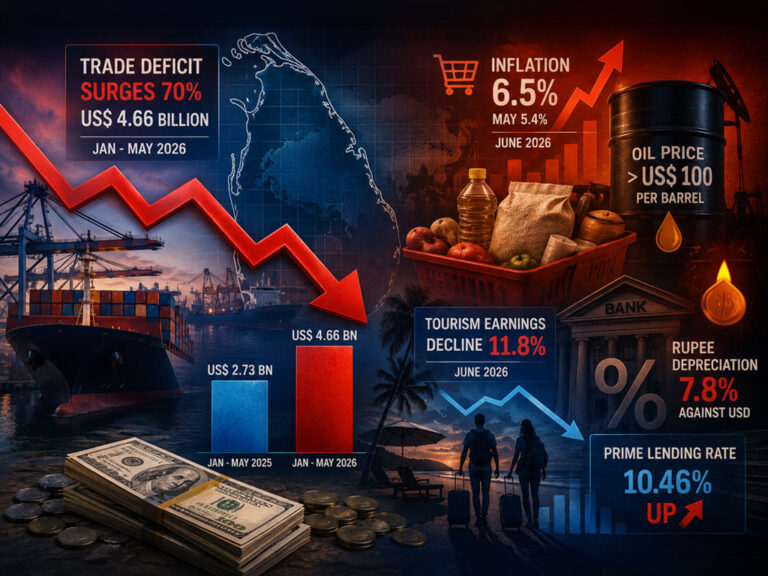
The current account surplus, which stood at US$ 479 million last year March, has rapidly fallen to US$ 45 million this year March.
This sharp decline was mainly caused by the increase in fuel import costs to US$ 612 million compared to March last year.
It was also worsened by a 37 percent fall in tourism revenue compared with the previous year.
During a period of low tourist arrivals, the current account came under further pressure from March due to rising fuel prices.
As a result, before a significant portion of foreign exchange inflows could be used to strengthen reserves or repay foreign debt, a large share had to be spent on the high fuel bill.
However, HNB Stockbrokers noted that vehicle imports did not contribute significantly to this situation, as March recorded the lowest vehicle import expenditure since August 2025.
Sri Lanka’s fuel import expenditure is around 3.6 percent of GDP, which is lower than fuel import spending in Asian countries such as Malaysia, Thailand, and Vietnam.
But the real problem, according to the analysis, is the gap between non-fuel imports and exports.
While several other countries maintain a surplus in non-fuel trade, Sri Lanka continues to run a trade deficit.
Countries such as Malaysia, Thailand, Vietnam, and Taiwan also import fuel.
However, they earn substantial foreign exchange by exporting value-added electronic goods, machinery, and services.
Those strong export earnings help them build reserves and absorb fuel price shocks.
Sri Lanka, by contrast, suffers from a weak buffer because of its non-fuel trade deficit
Therefore, the weakening of the rupee is not due to fuel alone, but also due to the structural weakness of the currency and the country’s trade position.
HNB Stockbrokers says the only sustainable long-term solution is to promote value-added exports as reactive measures such a import surcharges will be futile.
Although rationing schemes and high taxes may temporarily reduce pressure, they do not restore the current account.
Instead, they raise the cost of living and can cause government policies to fail.
The analysis also notes that demand can be controlled during an energy shock through cost reflective energy prices, or cost pass-through.
However, if a fuel pricing formula that reflects actual costs is not implemented through methods such as reducing subsidies, the rupee may have to depreciate further to ease the pressure.
HNB Stockbrokers further stated that pressure on the rupee may ease slightly with the expected US$ 700 million from the International Monetary Fund.
However, if domestic fuel and electricity tariffs are continuously maintained without being adjusted to cover actual costs while global fuel prices rise, pressure on the rupee will remain unchanged.