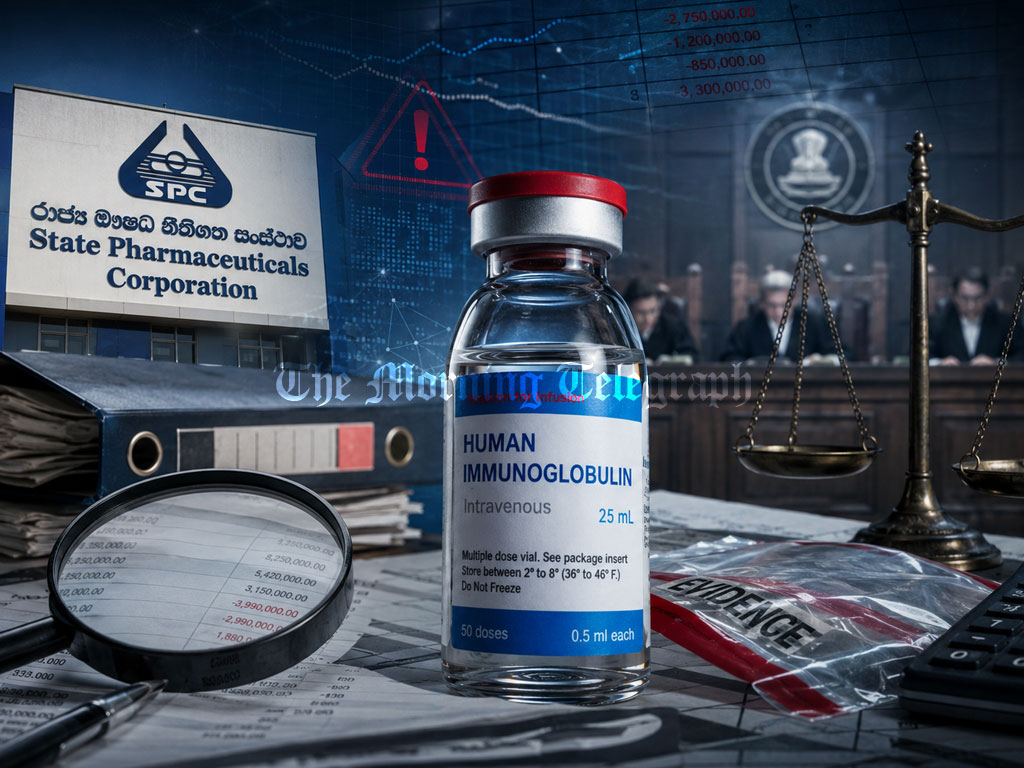
Communication 295 dispute exposes alleged SPC accounting gaps, digital evidence questions, and health sector failures in drug trial.
The Communication 295 mystery has become a major flashpoint in the substandard Human Immunoglobulin case, raising serious questions over state finances, health administration, and public accountability.
The case, heard on June 1, 2026, involves 12 defendants, including former Health Minister Keheliya Rambukwella. It has now become a landmark trial touching on Sri Lanka’s state administration, financial regulations, and the public’s right to health.
The testimony of Diana Nishanthi Dewasurendra, Accountant and Acting Deputy General Manager of the State Pharmaceutical Corporation, and Dinesh Thikshana, an officer from the Digital Evidence Unit of the Government Analyst’s Department, became central to the day’s proceedings.

Financial Reporting Gaps Exposed
A major dispute arose over differences between the data in Management Report “Communication 295,” presented by the prosecution, and the annual financial reports of the SPC.
During cross-examination, lawyer Nuwan Jayawerdena, appearing for the 6th accused, built an argument that State Financial Regulations had been violated.
“If the Pharmaceutical Corporation receives money annually from the Medical Supplies Division, shouldn’t that be recorded in the annual report?” he asked.
Witness Diana Nishanthi replied: “No, Your Honour. It is only recorded in the ledgers.”
The lawyer then asked whether, according to the report she prepared, the receipts could be recorded in the 2023 report.
“They could be included in the cash flow statement,” the witness answered.
At this point, the defence raised a broader issue of transparency within a state institution.
The defence argued that the failure to reflect billions of rupees in transactions, particularly the alleged Rs. 3.8 billion paid directly to suppliers by the World Bank and the Asian Development Bank, in the annual accounts was contrary to Public Sector Accounting Standards.
It was further alleged that Communication 295 was an informal document created specifically for the case and biased toward the prosecution.
Liquidity Crisis Or Accounting Strategy?
The defence also questioned whether a false institutional crisis had been created at the end of 2022 to justify emergency purchases.
“The SPC’s current liabilities are stated as Rs. 37.189 billion. Cash and cash equivalents are only about Rs. 15.937 billion. Didn’t the institution not even have enough money to pay at least the bank overdraft?” the lawyer asked.
“There was money to run the institution,” the witness replied. “When we had Rs. 57 billion to receive, we had to pay Rs. 37 billion.”
Through this line of questioning, the defence attempted to show that the institution was in a bankrupt position and unable to open Letters of Credit.
This appeared to be an attempt either to justify the method of paying suppliers or to explain delays in financial processing.
Judge Intervenes On Treasury Funds
A crucial moment came when Justice Viraj Weerasuriya directly intervened to question the witness regarding Treasury provisions.
“Is it correct that by October 4, 2022, there were no funds?” the Justice asked.
“No, we don’t just request funds and wait idly. We constantly work on it,” the witness replied.
The judge’s questioning appeared to focus on whether additional allocations had been obtained from the government by claiming a drug shortage, and whether those funds were then used to pay suppliers who allegedly provided substandard drugs.
This line of inquiry raised wider implications regarding the possible misuse of Parliament’s authority over public finance under Article 148 of the Constitution.
Responsibility And Human Cost
The most serious issue of institutional responsibility emerged during cross-examination by lawyer Harendra Banagala.
“Do you know that two deaths occurred from drugs supplied by Selegen Life Sciences?” he asked.
He further stated that although five deaths had occurred from drugs supplied by two companies, the full amount had still been paid.
“It might have happened. I cannot take responsibility for every decision,” the witness responded.
The defence suggested that paying the full amount to the relevant suppliers without blacklisting them, despite patient deaths allegedly linked to substandard drugs, raised serious concerns over negligence and public trust.
The witness’s attempt to limit her responsibility to the finance division highlighted, in court, the deeper problem of fragmented accountability within Sri Lanka’s state administrative system.
Digital Evidence Becomes Crucial
In the afternoon session, Deputy Solicitor General Lakmini Girihagama led the evidence of digital evidence expert Dinesh Thikshana, marking another important turning point in the trial.
“Can you see what a privileged person you mentioned has done?” the DSG asked.
“Those activities are recorded as a log file. By examining those, the activities of anyone can be seen,” the witness replied.
Computer evidence can be admitted in court under the Evidence Special Provisions Act No. 14 of 1995.
This showed the prosecution’s attempt to prove, through log files, who changed data inside a secure database system such as Oracle.
If supplier information, approvals, or payment data were intentionally altered, such digital records could become strong evidence in proving fraud, document manipulation, or forgery.
The record of the day’s trial revealed more than a dispute over accounting entries. It exposed serious questions about how administrative systems within the state health sector may have been weakened or misused.
While the defence attempted to challenge the prosecution by pointing to technical and accounting discrepancies, the prosecution sought to counter those arguments through digital evidence and Treasury-related data.
Ultimately, the most tragic victims remain the ordinary citizens who had a constitutional right to health protection, but allegedly suffered or died because of substandard drugs.
Complete Court Record
2026/06/01
When the substandard drugs case (01) against 12 defendants including former Health Minister Keheliya Rambukwella was taken up for hearing, Diana Nishanthi Dewasurendra, the Accountant and Acting Deputy General Manager of the State Pharmaceutical Corporation (SPC), who was giving evidence for the third day, responded to cross-examination by lawyer Nuwan Jayawerdena, appearing for the 6th accused, as follows:
Lawyer Nuwan Jayawerdena: If the opening balance for 2022 in document 295 is said to be Rs. 42.72 billion, is that correct?
Witness: No, Your Honour. That is not the opening balance.
Lawyer: Rs. 6.3 billion is not the opening balance.
Witness: Yes.
Lawyer: If the Pharmaceutical Corporation receives money annually from the Medical Supplies Division (MSD), should that be recorded in the annual report?
Witness: No, Your Honour. It is only recorded in the ledgers.
Lawyer: According to the report you prepared, can’t the receipts be recorded in the 2023 report?
Witness: They could be included in the cash flow statement.
Lawyer: Where is that mentioned in Communication 295?
Witness: It is not mentioned there.
Lawyer: Where is it mentioned in the 2023 annual financial report? (Shows the annual financial report) According to this report, where are the receipts mentioned?
Witness: The increase/decrease in trade debtors… Rs. 41 billion is mentioned as a receipt.
Lawyer: Is that noted for 2023?
Witness: That’s a single entry. It’s not separately mentioned.
Lawyer: Although the amounts receivable for 2023 are noted, the Rs. 41 billion mentioned by the witness is not there.
Witness: The names of debtors are mentioned in the annual accounts.
Lawyer: Is the amount due from the Health Department mentioned?
Witness: No, the financial report only shows the final balance.
Lawyer: The value of Rs. 41.739 billion due from the Health Department is also different.
Witness: That value came after subtracting 41.886.
Lawyer: I suggest that there are serious discrepancies between the data in Communication 295 and the data in the 2023 report you approved. Communication 295 was created to give evidence in this case.
Witness: No, Your Honour.
Lawyer: It mentions that World Bank funds were paid directly to suppliers. It shows a net value of Rs. 6.307 billion after subtracting that from the final balance. Is such a payment mentioned in the annual report?
Witness: No, Your Honour.
Lawyer: It’s a payment made for purchasing goods from the Pharmaceutical Corporation.
Witness: Yes. That money wasn’t paid through us. The World Bank paid the suppliers directly.
Lawyer: You are providing false information regarding this.
Witness: I disagree, Your Honour.
Lawyer: A note is also included in the 2023 annual report regarding this.
Witness: Note 36 makes a disclosure. It must be done according to financial reporting accounting standards. What we are doing here is a disclosure. The value mentioned is recorded less because the World Bank and Asian Development Bank made the payments. It’s not a direct receipt for us.
Lawyer: According to Communication 295, what is the total amount paid by the Asian Development Bank?
Witness: Rs. 95 million.
Lawyer: According to the annual report, what is the total amount paid?
Witness: Rs. 89.179 million… It’s mentioned under DHS. The total paid amount is recorded here as the World Bank and Asian Development Bank.
Lawyer: You are giving a completely wrong interpretation. This is a report created to favour the prosecution.
Witness: No, Your Honour, it’s a management report.
Lawyer: Communication 295 mentions Rs. 38 billion.
Witness: This amount receivable has been paid directly to suppliers. The Rs. 3.80 billion receivable from DHS should be reduced by the direct payments made by the World Bank and ADB. In the 2022 management balance, Rs. 6,385 million has been deducted.
Lawyer: According to this report, there are no stock deductions.
Witness: Yes.
Lawyer: DHS should be charged. Should the remaining amount be mentioned in the annual report?
Witness: The annual report must include this report’s deductions as well as other deductions.
Lawyer: Weren’t the financial data and other relevant facts mentioned in Communication 295?
Witness: Yes, Your Honour. We don’t change anything except what is needed for the account. We add what is needed for the next report.
Lawyer: Are you saying that the correct financial position of the institution cannot be obtained from a management report?
Witness: If there is a change, we take an entry. We have taken them accordingly.
Lawyer: Then why aren’t they in the reports prepared afterwards?
Witness: We brought those relevant to 2022. We didn’t bring the others.
Lawyer: What are the statements regarding the financial position of an institution? Would it be correct to say Statement of Comprehensive Income? Do responsible officers sign them?
Witness: Officers responsible for the financial position sign them.
Lawyer: Who signs the general ones?
Witness: The Chairman, Managing Director, General Manager, Accountant.
Lawyer: When signing a document, it’s with responsibility, isn’t it?
Witness: Yes, Directors… (end of page 4, paragraph) sign.
Lawyer: This document 295 is only signed. There’s no approval, preparation, or who checked it.
Witness: Yes, Your Honour.
Lawyer: What is the liquidity of an institution?
Witness: An institution needs liquidity to operate. It’s an amount of assets.
(Shows the 2022 annual report cash flow statement to the witness)
Lawyer: In the 2022 annual report cash flow statement, under changes in trade and other payables, a negative value is mentioned. What is that?
Witness: That’s the change in trade payables. Trade payables have increased. It’s shown as a negative value.
Lawyer: Is that an increase in the amount receivable?
Witness: Yes, Your Honour.
Lawyer: Looking at the document dated 2023.06.23, would the witness agree that for 2022, the change in payables is Rs. 154 million?
Witness: Yes, Your Honour.
Lawyer: What is the reason for that change?
Witness: Yes, the 2022 receivables decreased to Rs. 51 million.
Lawyer: I suggest that by 2022, there was no liquidity.
Witness: That cannot be said. We must look at current liabilities and current assets. Current assets were up to Rs. 64 billion, current liabilities up to Rs. 40 billion.
Lawyer: The SPC’s current liabilities are stated as Rs. 37.189 billion. According to the 2022 cash flow statement, cash and cash equivalents are only about Rs. 15.937 billion. But current liabilities are stated as Rs. 37.189 billion. Didn’t the institution not even have enough money to pay at least the bank overdraft?
Witness: There was money to run the institution.
Lawyer: But by the end of 2022, the corporation had no liquidity.
Witness: It cannot be said there was no liquidity. The final note was given based on cash and overdraft. That’s why a negative value occurred.
Lawyer: Do you agree that for 2022, there was bank overdraft interest to pay of Rs. 3.052 billion?
Witness: Yes, Your Honour.
Lawyer: Even after making such a payment, Rs. 15.937 billion was still payable.
Witness: This is bank overdraft.
Lawyer: I suggest that by December 31, 2022, the institution had no liquidity.
Witness: I disagree, Your Honour.
Lawyer: After examining the documents you brought today, please state how much money was required to be paid to open Letters of Credit (LCs)?
Witness: There is a letter sent on October 4, 2022, Your Honour.
Lawyer: Does it mention Letters of Credit?
Witness: It mentions that we have LCs amounting to US$ 32.6 billion to open.
Lawyer: As the Acting Deputy General Manager of the SPC, do you accept that letter?
Witness: Yes, Your Honour.
Lawyer: They were unable to pay for LCs that had been unpaid for over two years.
Witness: I cannot say anything without knowing where that is mentioned.
Lawyer: Do you know about the irregularities in procurement?
Witness: That’s not relevant to me, Your Honour, I am responsible for the finance division.
Lawyer: Under what regulations are suppliers paid? What documents are considered then?
Witness: Documents including inventory and invoices are checked, Your Honour.
Lawyer: Communication 295, which was presented as evidence to this Honourable Court, is not a formal document.
Witness: That cannot be said.
Lawyer: The data is incorrect.
Witness: We prepared the data correctly.
Lawyer: Communication 295 is an informal document.
Witness: I disagree.
Lawyer: I suggest that 295 and 295 A are documents created to favour the prosecution.
Witness: I disagree.
(Lawyer Amith Ariyaratne begins cross-examination)
Lawyer Amith Ariyaratne: Did you give a statement to the Criminal Investigation Department (CID)?
Witness: Yes, Your Honour.
Lawyer: How many?
Witness: I remember one. I don’t remember the date. It might be 2024.
Lawyer: When it was recorded, were the reasons given?
Witness: I don’t remember, Your Honour.
Lawyer: When the statement was recorded, were you told it was regarding Human Immunoglobulin?
Witness: No.
Lawyer: Were you told that drugs were imported using forged documents?
Witness: I don’t recall.
Lawyer: After giving the statement, were you asked to read and understand it before signing?
Witness: I might have signed.
Lawyer: It was read out, explained, and your signature was obtained confirming it was correct.
Witness: I don’t remember if I signed after giving a statement.
Lawyer: It is signed on April 12, 2025. I say that you read, understood, and signed it as correct.
Witness: I don’t remember, Your Honour.
(Lawyer Harendra Banagala begins cross-examination)
Lawyer Harendra Banagala: Does the corporation maintain a supplier register?
Witness: Yes, we maintain a register of suppliers to whom we need to pay. That register is updated and maintained.
Lawyer: If there is an error in that supplier list, or if a supplier is no longer a supplier, are you informed of that?
Witness: Yes, we are informed if they are blacklisted.
Lawyer: Is there a system to check for that?
Witness: We are informed through documents.
Lawyer: Do you remember a company called Isoless Biotech Pharma?
Witness: I have a vague memory.
Lawyer: Do you remember making a payment to them for a supply made to the institution?
Witness: No.
Lawyer: Do you remember them being blacklisted?
Witness: No, Your Honour.
Lawyer: If there are adverse effects from drugs supplied to your institution, is the payments division informed?
Witness: The relevant divisions inform us not to pay for them. They don’t even send a voucher for payment.
Lawyer: Do you remember purchasing drugs from companies called Selegen Life Sciences and Yshoh Biotech Pharma?
Witness: I’ve heard the names.
Lawyer: Do you know that two deaths occurred from drugs supplied by Selegen Life Sciences?
Witness: I’ve heard through the media.
Lawyer: Have you heard about three deaths from Human Immunoglobulin supplied by Yshoh Biotech Pharma?
Witness: No, the institution didn’t say. I learned through the media.
Lawyer: You are second in the hierarchy of the General Manager position you act for.
Witness: Fourth.
Lawyer: Do you have a responsibility regarding the drugs when the institution procures them?
Witness: I cannot take responsibility for every decision.
Lawyer: Who is above you?
Witness: The Chairman, Managing Director, General Manager.
Lawyer: You have a responsibility connected to the purchases.
Witness: Yes.
Lawyer: If a death occurs from a drug supplied by the institution, you, who made the payment, bear some responsibility.
Witness: There are instructions not to buy substandard ones.
Lawyer: You paid the full amount to the two companies mentioned earlier.
Witness: I cannot say for sure.
Lawyer: Even though five deaths occurred from drugs supplied by those two companies, the full amount was still paid.
Witness: It might have happened.
Lawyer: Did you pay them?
Witness: I cannot say without checking records.
Lawyer: Do you know for what purpose this legal action was brought?
Witness: I have a general understanding.
Lawyer: Why were you asked to give evidence?
Witness: I was questioned about the financial status of the SPC.
Lawyer: Do you know that no harm was caused by the Immunoglobulin related to this case?
Witness: I don’t know.
Lawyer: The reported effects were things like itching on hands and stomach.
Witness: I don’t know.
Justice Viraj Weerasuriya: Were you working there by October 2022? Had the Treasury released funds by that time?
Witness: Yes, Your Honour, there were financial difficulties after COVID. We requested funds from the Treasury for supplies. When we sent request letters, funds were released. We requested to maintain an overdraft. A significant amount was received from the Treasury in November of that year.
Justice: Is it correct that by October 4, 2022, there were no funds?
Witness: No, we don’t just request funds and wait idly. We constantly work on it.
(As Deputy Solicitor General Lakmini Girihagama questions regarding the 8th accused)
DSG Lakmini Girihagama: In document 8V dated March 16, 2023, is the first paragraph stating that the term loan of Rs. 51.3 billion as of December 31 is included as receivable from MSD in Communication 295?
Witness: Yes.
DSG: Is it mentioned in the Communication 295 you provided?
Witness: Yes.
DSG: What difficulty of the SPC in 2023 was written in document 8V7?
Witness: The delay in opening Letters of Credit.
DSG: Does it mention that orders sent by the MSD are prepared to some extent and LCs opened?
Witness: Yes.
DSG: Are the alternatives to be followed according to the difficulty in opening LCs mentioned there?
Witness: Yes, the full background is explained.
DSG: What was requested regarding the situation at that time?
Witness: That the bank overdraft should be converted into a loan and paid by the Treasury for the supply of goods.
DSG: Was it requested to be converted into a term loan according to the 2023 proposal?
Witness: No, this is a matter that went to the Cabinet.
DSG: It was requested due to the difficulties the corporation faced at that time.
Witness: It was not received in 2023.
DSG: Can you say how they managed amidst these difficulties? Please check if additional allocations were granted after March 2023, apart from the government allocated funds.
Witness: There were receipts of Rs. 8,000 million, Rs. 3,000 million, etc.
DSG: Did the Treasury respond regarding the institution’s difficulties?
Witness: Yes, additional allocations were given.
DSG: Considering the bank overdraft interest and values in 2023, can it be agreed that there were no liquid assets?
Witness: Total trade payables were Rs. 38 billion. Payments could be made to suppliers under trade payables from institutions including the MSD. When we had Rs. 57 billion to receive, we had to pay Rs. 37 billion.
(When the case resumed in the afternoon, the Attorney General’s representative informed the bench that they request witnesses Christine Joseph Sandwood (47th witness) and Gopal Singh (239th witness) be allowed to testify as contemporaneous witnesses. Subsequently, the officer from the Government Analyst’s Department’s Questioned Documents division, Ekanayake Mudiyanselage Dinesh Thikshana Ekanayake Kudangamuwa, was called. DSG Lakmini Girihagama led the witness’s testimony. After questioning the witness’s educational qualifications and experience, his evidence was recorded.)
DSG: What are digitally represented things?
Witness (Dinesh Thikshana): Data in mobile phones, DVRs, servers, etc., are stored digitally. Our job is to search for data related to a crime among these. Digitally represented things are PDFs, databases, the internet, etc.
DSG: How many analyses have you performed?
Witness: About 2,000 reports by 2026.
DSG: How many devices were analysed for that?
Witness: About ten thousand devices were analysed.
DSG: What does examining the database of digital devices mean?
Witness: The main tool for obtaining data from installed software.
DSG: Where is data stored?
Witness: Users store data through the database.
DSG: Data in mobile phones is stored in a way that can be retrieved. Data is primarily entered by users. Who are users?
Witness: Software monitors. Accordingly, there are different users in systems. There are those who view data, those who manage it.
DSG: What are computers and server computers?
Witness: We do our daily work on a regular computer. We can shut it down when needed. Server computers work 24 hours a day, all year round. They run business software. They are more durable.
DSG: What is a database?
Witness: The system where data is stored when the server computer is running.
DSG: What are the security standards when data is stored via users?
Witness: It is secure to the extent that who accesses the system is controlled.
DSG: What is restricting access to data?
Witness: There are many types of users: data entry operators, data retrievers, managers, etc. These people are not given unnecessary privileges. A data entry operator is not allowed to delete. That task is given to someone with higher privileges.
DSG: Can you see what a privileged person you mentioned has done?
Witness: Those activities are recorded as a log file. By examining those, the activities of anyone can be seen.
DSG: Is the data in Oracle software secure?
Witness: Yes, it’s expensive. There are data protections. It prevents unauthorised access.
DSG: What is unauthorised access?
Witness: The Oracle account prevents entry into the data system. Security measures are enabled for that. We have created a white list accordingly.
DSG: Can there be users who enter incorrect data in certain instances?
Witness: Access is only given to tables that need to be modified by a modify account. That is with limited privileges.