By Roy Denish.
The United States has delivered an advanced satellite communications system valued at $4 million to the Sri Lanka Navy, a move aimed at boosting surveillance across critical Indian Ocean shipping lanes while altering the geopolitical dynamics between regional powers India and China.
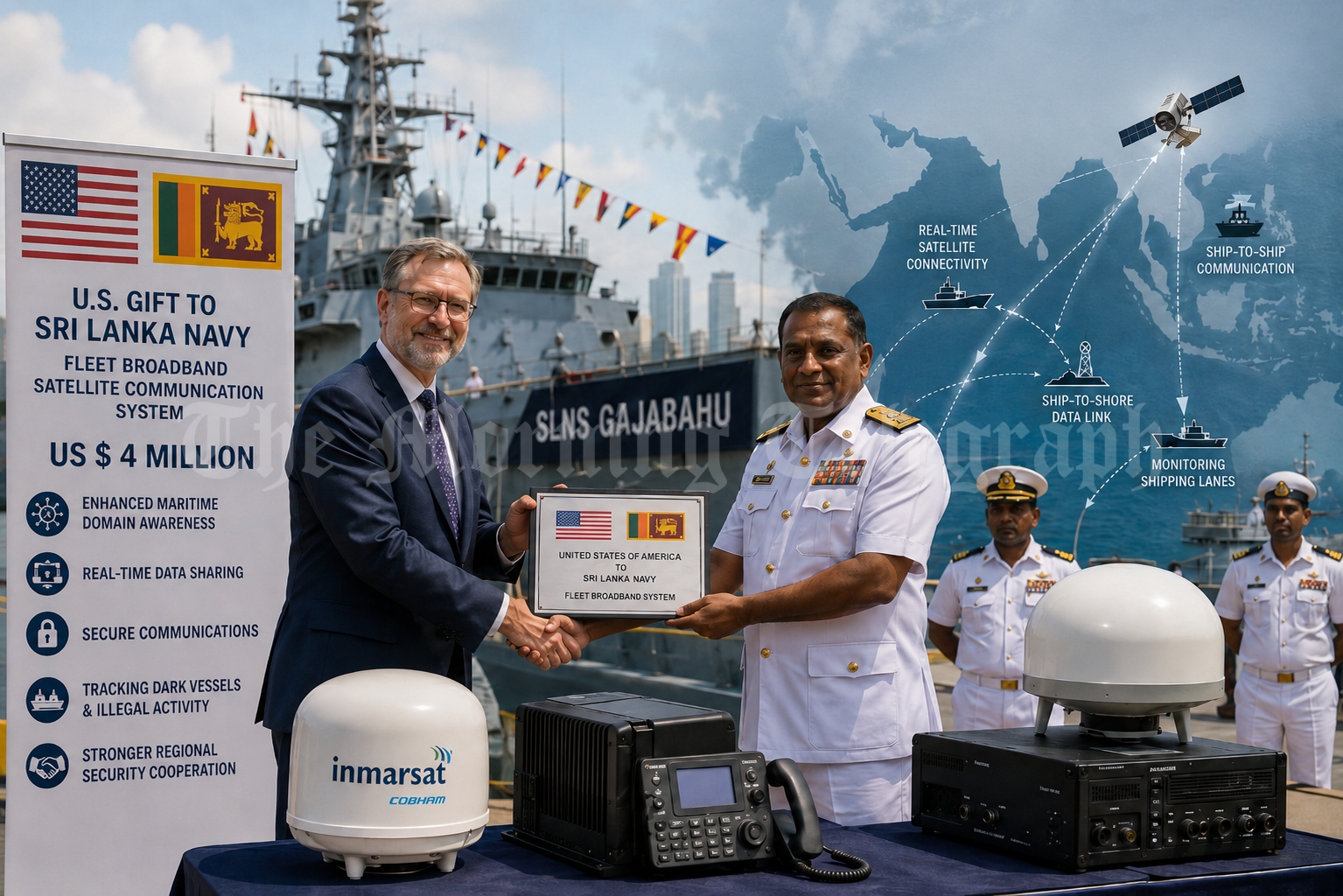
The grant, which exceeds 1.2 billion Sri Lankan rupees, was formally announced aboard the naval vessel SLNS Gajabahu at the Port of Colombo by Paul Kapur, the U.S. Assistant Secretary of State for South and Central Asian Affairs. Funded entirely by Washington, the comprehensive Fleet Broadband system will be installed across Sri Lanka’s entire fleet of offshore patrol vessels.
Manufactured through a partnership between Cobham and Inmarsat, the technology provides secure, real-time ship-to-ship and ship-to-shore data transmission far beyond coastal waters. Navies operating in deep-ocean zones often encounter communication gaps when relying on traditional high-frequency radio equipment. The new network utilizes high-bandwidth geostationary satellites to provide uninterrupted voice and IP data connectivity.

The tactical capabilities of the system focus heavily on maritime domain awareness. By facilitating high-speed data sharing, the technology allows Sri Lankan naval command centers to integrate live radar feeds and video imagery with the international Automatic Identification System.
This synchronization is designed to help authorities intercept vessels engaged in illicit trafficking, track sanctioned ships, coordinate regional disaster responses, and identify “dark vessels”—ships that intentionally deactivate their transponders to conduct illegal fishing or smuggling operations.
Kapur described the delivery as a transformational upgrade that ensures there will be no communication gap at sea for Indo-Pacific partners. He noted that the secure link allows Sri Lankan forces to disrupt illegal activity across the Indian Ocean before it reaches distant shores.
The deployment of secure, American-manufactured communications infrastructure carries significant strategic implications for the region. Sri Lanka sits directly along some of the world’s busiest commercial sea lanes, making it a focal point of geopolitical competition.
India traditionally views the Indian Ocean as its direct security sphere and closely monitors foreign military footprints in neighboring waters. However, because the system is supplied by the United States—a fellow member of the Quadrilateral Security Dialogue alongside India, Japan, and Australia—regional analysts view the upgrade as a step that aligns with New Delhi’s broader ocean security frameworks. The new data link is expected to let Sri Lankan vessels interface more smoothly with Indian and regional partner forces during joint security exercises.
Conversely, the deployment establishes a more rigid monitoring capability against Chinese operations. Beijing frequently routes civilian research vessels, space-tracking ships, and naval assets through Sri Lanka’s Exclusive Economic Zone, movements that have drawn official protests from India and Western nations. The encrypted nature of the Fleet Broadband system prevents outside actors from jamming or intercepting local naval communications, directly limiting the ability of foreign vessels to operate unmonitored in Sri Lankan waters.
Major General Aruna Jayasekara, Sri Lanka’s retired deputy minister of defense, said the introduction of the technology markedly improves fleet-wide connectivity and strengthens defense cooperation between Colombo and Washington. Navy Commander Vice Admiral Kanchana Banagoda also attended the delivery ceremony.