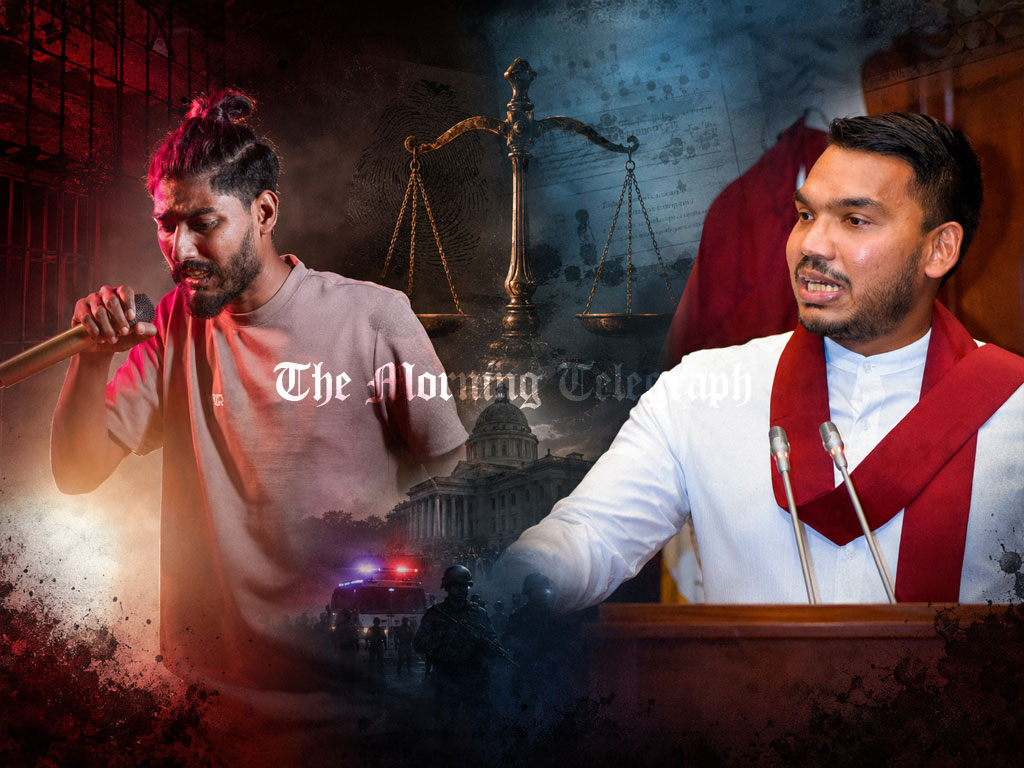
Namal Rajapaksa questions PTA enforcement after a Kilinochchi rapper’s arrest, alleging double standards between politicians and youth.
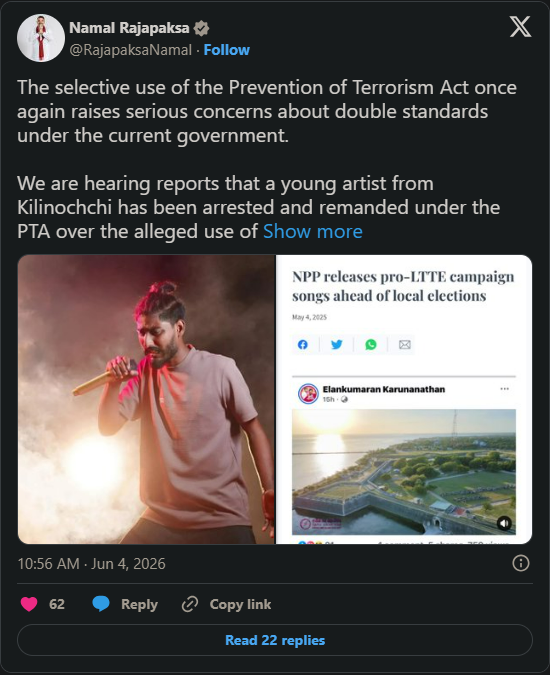
PTA enforcement has come under fresh scrutiny after the arrest of a young artist in Kilinochchi over a rap song allegedly containing LTTE-related content.
The incident has triggered a serious debate over whether the current government is applying the law equally or using one standard for politicians and another for ordinary youth.
SLPP Parliamentarian Namal Rajapaksa has strongly criticised the government over the matter, questioning why the Prevention of Terrorism Act is being enforced against a young artist while similar conduct by political figures has allegedly gone unchecked.

“How is it that one law applies to politicians, while another law applies to ordinary youth?” Rajapaksa asked.
According to Namal Rajapaksa, during the recently concluded Local Government election campaign, politicians from the National People’s Power also used songs with similar LTTE themes without facing any obstruction.
He claimed that an NPP Parliamentarian from the Jaffna District had publicly shared such songs on social media for political advantage.
“Where was the police during those instances? Why wasn’t the Prevention of Terrorism Act enforced then?” Rajapaksa questioned in a post on his official X account.
The SLPP National Organizer stressed that the LTTE remains a banned terrorist organization and said he does not approve of anyone glorifying it.
However, he argued that the law and accountability must apply equally to all citizens, regardless of whether they are politicians, artists, or ordinary young people.
Rajapaksa said that in a democratic society, it is unacceptable for one law to apply to politicians and another to apply to youth.
He further stated that if the government genuinely believes such actions are illegal, enforcement must be consistent, fair, and stable across all cases.
He warned that selective enforcement would lead the public to view the arrest of the Kilinochchi artist as a biased misuse of government power.
The controversy has now placed renewed attention on the PTA, its application, and the government’s responsibility to ensure that national security laws are not enforced selectively.