Suresh Sallay medical report triggers courtroom battle as five psychiatrists cite mental torture, suicide risk, and rights concerns.
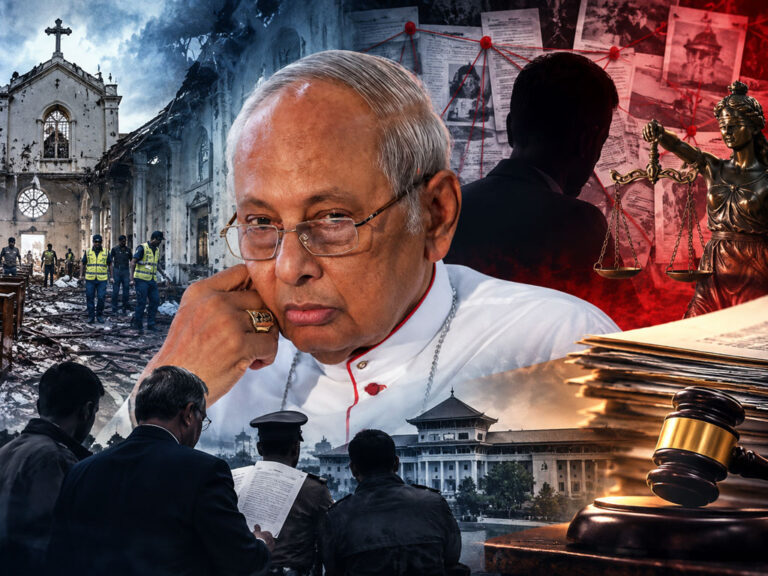
The Suresh Sallay medical report has triggered a dramatic courtroom clash over mental torture, forensic independence, constitutional rights, and the future direction of the Easter Sunday investigation.
The case concerning the health condition of former State Intelligence Service chief Suresh Sallay, who is being detained and questioned under remand orders by the Criminal Investigation Department in connection with the Easter Sunday terrorist attack, was heard today, June 4, before the Colombo Fort Magistrate’s Court.
The hearing has now become a significant moment in Sri Lanka’s legal history, going beyond the health condition of one suspect and opening a wider debate on the independence of forensic medicine, the protection of fundamental rights, and the influence of executive power over judicial processes.

The facts and arguments presented by lawyers from both sides before Colombo Fort Magistrate Prasanna Amarasena created a serious discussion on whether government medical findings can be rejected by another arm of the state when those findings raise allegations of torture.
The decisive order regarding the requests made by both sides is expected to be delivered in the future.
The central issue before court was the report prepared by a panel of five consultant psychiatrists, as ordered by court.
President’s Counsel Shavendra Fernando, appearing for suspect Suresh Sallay, presented the report to court and argued that it confirmed serious findings regarding the suspect’s mental health while in CID custody.
According to the report, the suspect had allegedly been subjected to mental torture on seven occasions while in CID custody.
The report further stated that he was suffering from anxiety and depression, and that there was a high risk of suicide.
The most controversial development during the hearing was the strong rejection of this government medical report by Additional Solicitor General Dileepa Peiris, who appeared for the CID.
The arguments presented by the defence, the prosecution, and the aggrieved party’s counsel turned the hearing into a deeply contested legal battle.
President’s Counsel Shavendra Fernando, appearing for the defence, told court that his client had been subjected to cruel torture and inhuman, degrading treatment while in CID custody.
“From that day until today, my client has been subjected to cruel torture and inhuman, degrading treatment while in CID custody. That has been stated in medical reports,” he submitted.
He further argued that the psychiatric medical report stated that his client had been subjected to mental torture on seven occasions.
Fernando also referred to Sri Lanka’s international and constitutional obligations against torture.
“There is an international obligation to prevent cruel torture. Domestic laws must be enacted for this. Action should be taken under the Torture Convention Act of 1984,” he said.
He added that Article 11 of the Constitution refers to persons subjected to torture and states that they must be treated independently.
Additional Solicitor General Dileepa Peiris, appearing for the prosecution, strongly challenged the defence position and accused the suspect’s side of attempting to mislead court.
“He has made the court a stage to mislead you, Your Honour,” Peiris submitted.
He further alleged that “these people have staged a drama” and were now presenting what he described as “a skilful performance worthy of an Oscar award.”
The prosecution argued that stress and anxiety can be experienced by any criminal suspect and claimed that the defence had targeted psychiatry after other doctors from several medical fields had stated that the suspect did not have a medical condition.
“Without crying before the Judicial Medical Officer, they cried before the psychiatrist — these people are fraudsters,” Peiris submitted.
He argued that the defence was attempting to divert the case by presenting a mental disorder.
President’s Counsel Rienzie Arsekularatne, appearing for the aggrieved party, also made submissions before court.
“When anyone is subjected to detention, their mood becomes depressed. Even if we are detained tomorrow, the same could happen to us,” he said.
Several key legal and constitutional questions emerged from the hearing.
One of the most striking issues was the Attorney General’s Department rejecting a government medical report.
This is considered a rare situation in Sri Lankan legal practice, as reports prepared by government Judicial Medical Officers or court-directed medical experts are generally treated as important evidence in criminal proceedings.
The rejection of a report from a panel of five consultant psychiatrists, especially by describing it as a “drama,” has created a serious institutional conflict between the Attorney General’s Department, the police, and medical specialists attached to the state health system.
Although the prosecution has the right to challenge any evidence, directly rejecting the opinion of a government specialist panel appointed by court order could raise public questions about the credibility of government medical reports in future cases.
The second major issue is Article 11 of the Constitution.
Article 11 clearly states that no person shall be subjected to torture or to cruel, inhuman, or degrading treatment or punishment.
This is an absolute right and cannot be restricted under any circumstance, even when a suspect is facing allegations connected to terrorism.
As the defence argued, if a medical report presents findings suggesting mental torture, those findings cannot simply be ignored.
The state has a legal duty to examine such claims seriously and, where necessary, act under the Torture Act No. 22 of 1994.
Another major point of dispute was the appointment of an independent medical board.
The Additional Solicitor General requested that a new specialist medical board be appointed through the Director General of Health Services.
However, the defence objected to this request, arguing that the Director General of Health Services is an executive appointment and therefore not sufficiently independent for a matter before court.
The defence instead suggested that a more judicially independent process would be to appoint such a board through the Chief Judicial Medical Officer of Colombo.
This argument is closely connected to the principle of separation of powers.
In judicial matters, especially where torture allegations are involved, it is important that executive influence is minimized when appointing specialists whose findings may affect the liberty, safety, and rights of a suspect.
The prosecution’s main objective, as reflected in the arguments of Additional Solicitor General Dileepa Peiris, appeared to be ensuring that the investigation continues without obstruction.
Based on the seriousness of the allegations linked to the Easter Sunday attack, the suspect’s previous conduct as presented by the prosecution, and the fact that general medical examinations had not identified serious physical illness, the prosecution challenged the psychiatric findings.
However, it is difficult to defeat a medical scientific conclusion solely through legal argument.
For that reason, the prosecution’s request for a fresh medical board can be viewed as a step available within the legal process.
At the same time, the use of strong expressions such as “a performance worthy of an Oscar award” may give the defence room to question the impartiality of the Attorney General’s Department.
The order expected from the Colombo Fort Magistrate’s Court will not only affect the future of suspect Suresh Sallay.
It may also determine the level of trust between Sri Lanka’s criminal justice system and the field of forensic medicine.
At a time when state institutions appear to be rejecting each other’s reports, the protection of judicial independence, medical neutrality, and transparency in the justice process has become a major challenge before court.