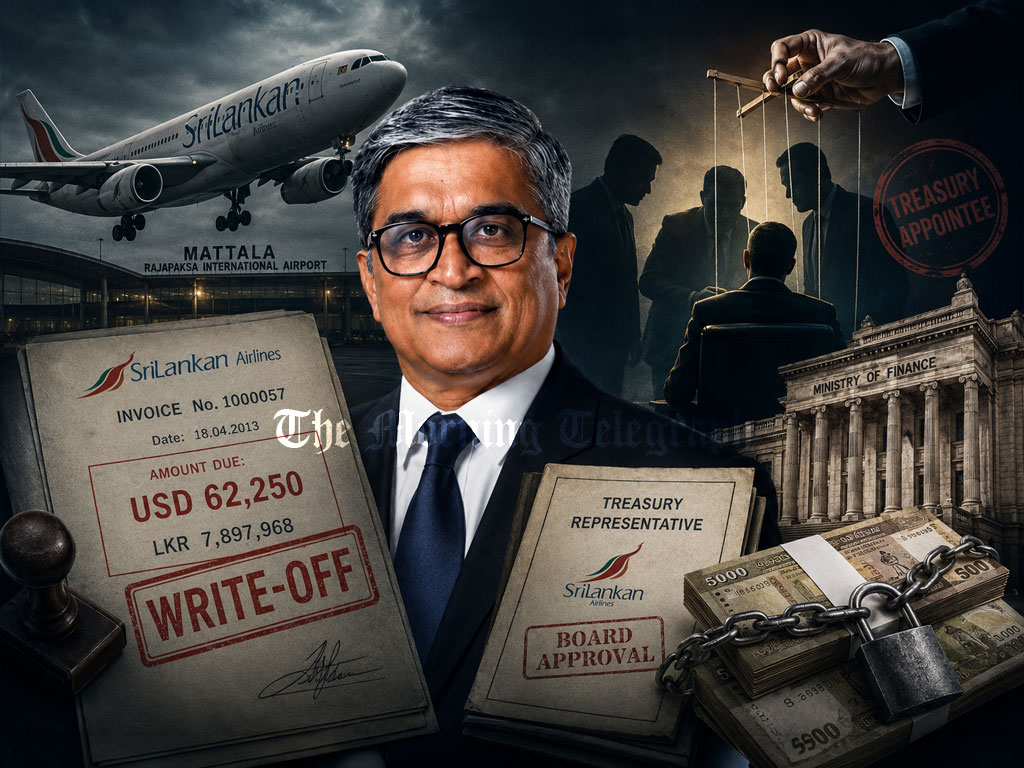
A man once appointed to protect public money at SriLankan Airlines is now accused in internal documents of helping erase a politically connected Rs. 7.3 million debt from the airline’s books. Years later, instead of facing public scrutiny, A. K. D. D. Dimal Arandara has been elevated to Chairman of the very airline taxpayers continue to keep alive, raising one explosive question for the NPP government: did it just hand SriLankan Airlines to the man who should have been investigated first?
COLOMBO — The long-vacant position of Chairman of SriLankan Airlines has finally been filled, but the appointment of former board director A. K. D. D. Dimal Arandara is now threatening to open a dangerous can of worms for the ruling NPP government.
For months, the national carrier operated without a permanent Chairman. Now, with Arandara appointed to the top seat, startling evidence has surfaced that raises a deeply uncomfortable question: who really is the new Chairman of SriLankan Airlines, and what side of his past has the public not been told?
SriLankan Airlines, sustained for decades on the life support of taxpayer funds, has long been criticised as a playground for political interference, conflict of interest, and systemic mismanagement. But newly exposed institutional audit documents now point to an even more disturbing story involving alleged bad faith, fiduciary failure, and the possible abuse of official position.

The Treasury Man Now Running the Airline
At the centre of this controversy is A. K. D. D. Dimal Arandara, who previously served on the SriLankan Airlines Board as a Treasury appointee, a role that should have placed him in the position of guarding public funds and protecting the financial interests of the Government of Sri Lanka.
Instead, according to internal documents and whistleblower allegations now in circulation, Arandara is accused of having played a key role in a boardroom decision that effectively wiped out a multi-million rupee debt owed to the airline by a politically connected former diplomat.
And now, despite those serious questions, Arandara has been appointed Chairman of SriLankan Airlines, effective June 9, 2026.
The 2013 Flight That Started the Scandal
The scandal dates back to February 26, 2013, when internal records allegedly show an irregular email exchange between Jaliya Wickramasuriya, then Sri Lanka’s Ambassador to the United States and a first cousin of former President Mahinda Rajapaksa, and Kapila Chandrasena, then Chief Executive Officer of SriLankan Airlines.
According to the documents, formal corporate, commercial, and regulatory protocols were allegedly bypassed when a scheduled commercial flight was dramatically altered.
On March 18, 2013, an A320 narrow-body aircraft scheduled to operate directly from Dubai to Colombo was reportedly substituted with a larger and more expensive A340 wide-body aircraft.
That aircraft was then allegedly rerouted via the underutilised Mattala Rajapaksa International Airport, reportedly to provide a special luxury transit arrangement for Wickramasuriya and his entourage.
A Multi-Million Rupee Bill Left Behind
The result was a major cost to the national carrier.
On April 18, 2013, SriLankan Airlines generated Invoice No. 1000057 under Jaliya Wickramasuriya’s name for USD 62,250, equivalent to LKR 7,897,968.
For more than a decade, this debt reportedly remained on the airline’s books. But instead of being pursued against the person under whose name the invoice was raised, the debt was allegedly classified as an amount receivable from the Ministry of Foreign Affairs.
That position collapsed on January 16, 2018, when the Ministry of Foreign Affairs reportedly issued an official letter disclaiming any knowledge of, or liability for, the debt linked to Wickramasuriya’s private travel arrangement.
Why Was the Debt Not Recovered?
The legal and governance question then becomes unavoidable.
Once the Ministry of Foreign Affairs disclaimed responsibility, why did SriLankan Airlines not aggressively pursue recovery from the original debtor or from those who authorised the irregular arrangement?
Instead, according to the documents now in circulation, the airline eventually struck off LKR 7,364,628 from its financial statements in 2024, classifying the amount as a bad debt.
That write-off now sits at the centre of the storm surrounding Arandara’s appointment.
The Public Enterprise Rule Question
The documents allege that the write-off violated Chapter 6.9 of the Public Enterprise Circular Operational Manual PED 01/2021, as amended by Circular PED 01/2021(i) dated May 16, 2023.
To write off a debt of this magnitude, the process should have been supported by proper documentation, including an Audit Committee Paper backed by relevant and exhaustive evidence.
But the documents claim that no such adequate supporting material existed.
This is where Arandara’s role becomes explosive.
Arandara’s Alleged Double Role
On September 11, 2024, during an official Audit and Management Committee meeting, Arandara, then serving as a Treasury representative and board member, allegedly recommended that the debt be written off based on a single line-item balance from a long-term debtor analysis sheet.
The matter was then fast-tracked to the higher Board of Directors.
Nine days later, on September 20, 2024, the Board reportedly convened to approve the matter. According to the documents, Arandara, who had recommended the write-off at committee level, then sat as a member of the Board and approved the very recommendation he had helped sponsor.
That raises a serious conflict-of-interest question.
Was Arandara acting as an independent guardian of Treasury interests, or was he effectively helping erase a politically sensitive debt owed to an airline already surviving on public money?
The Politically Connected Debtor
The allegations are even more troubling because Wickramasuriya was not an ordinary debtor.
He was a politically connected former ambassador who would later plead guilty in a United States Federal Court in connection with diverting approximately USD 332,000 in state funds into private bank accounts during the purchase of a new Sri Lankan embassy building in Washington, D.C.
That background makes the alleged write-off of the SriLankan Airlines debt even more disturbing.
The documents in circulation accuse Arandara of acting in bad faith and failing in his fiduciary duty as a Treasury representative. They further allege that his actions prevented the recovery of funds owed to an airline sustained by Treasury cash and public sacrifice.
Whistleblowers and the Presidential Inquiry
What makes this scandal more explosive is that whistleblowing employees from the airline’s finance department had reportedly preserved documentary evidence for years before submitting a formal complaint to a Presidential Special Committee of Inquiry mandated to investigate frauds between 2010 and 2015.
According to the allegations, those finance employees provided specific documentary evidence relating to Wickramasuriya, the aircraft rerouting, and the later write-off decision.
But instead of the matter resulting in visible accountability, the person now accused in those documents has been elevated to the highest corporate seat in the airline.
NPP’s Clean Governance Promise Under Pressure
That is why Arandara’s appointment has now placed the NPP government in a difficult position.
The party that came to power promising clean governance, public accountability, and a break from the old culture of political protection must now answer whether it knowingly appointed a man whose previous boardroom conduct is being questioned in relation to a multi-million rupee write-off.
The controversy deepened further after an internal communication reportedly announcing Arandara’s appointment carried the line that his appointment had the concurrence of H.E. the President.
According to high-level sources cited in the documents, Arandara himself allegedly ordered the Company Secretary to insert this statement.
If true, that raises another serious issue: was the President’s name used to intimidate whistleblowers, silence internal opposition, and give political cover to a controversial appointment?
The Alleged Ministry and Airline Network
The matter does not end there.
The documents also allege the existence of a wider network within the Ministry of Finance and SriLankan Airlines.
They claim that Arandara answers to the Ministry of Finance, where Anil Jayantha serves as Deputy Minister of Finance and Planning, while Anil Jayantha’s wife, Anusha Fernando, is described as a highly placed official inside the airline’s Finance Department.
Whistleblower claims further allege that Anusha Fernando has been leveraging political proximity, together with Arandara’s Treasury positioning, to support the possible appointment of her airline batchmate, Mohan Meegolla, to the vacant Chief Executive Officer position at SriLankan Airlines.
A Possible Capture of the National Carrier
These allegations, if proven, would point to a deeply troubling pattern: control of the national carrier being consolidated through a network linking the Ministry of Finance, the Treasury representative, the airline’s Finance Department, the Chairman’s office, and potentially the CEO’s office.
For finance department employees who reportedly raised concerns, Arandara’s appointment has allegedly created a climate of fear.
The whistleblowers who preserved and submitted documents now find themselves under the authority of the very individual they had reportedly implicated in alleged financial misconduct.
This is why the appointment cannot be treated as a routine boardroom change.
SriLankan Belongs to the Public
SriLankan Airlines does not belong to any political family, ministry network, board faction, union, or corporate clique.
It belongs to the people of Sri Lanka, whose taxes have been repeatedly used to keep the airline alive despite years of losses.
The public therefore has a right to know whether the new Chairman was part of a process that erased money owed to the airline, whether proper recovery action was ever taken, whether the write-off complied with public enterprise rules, and whether the NPP government carried out proper due diligence before placing him in charge.
The Rs. 7.3 Million Question
At a time when SriLankan Airlines is asking the public to continue carrying its financial burden, the appointment of a Chairman linked in documents to an alleged Rs. 7.3 million write-off demands immediate scrutiny.
The government must now decide whether it will protect the promise of clean governance or defend another controversial appointment inside the national carrier.
Because if the allegations are accurate, this is not merely a story about a Chairman.
It is a story about how a Treasury appointee, placed on the board to protect public money, allegedly helped erase a politically connected debt and was later rewarded with the highest seat at SriLankan Airlines.