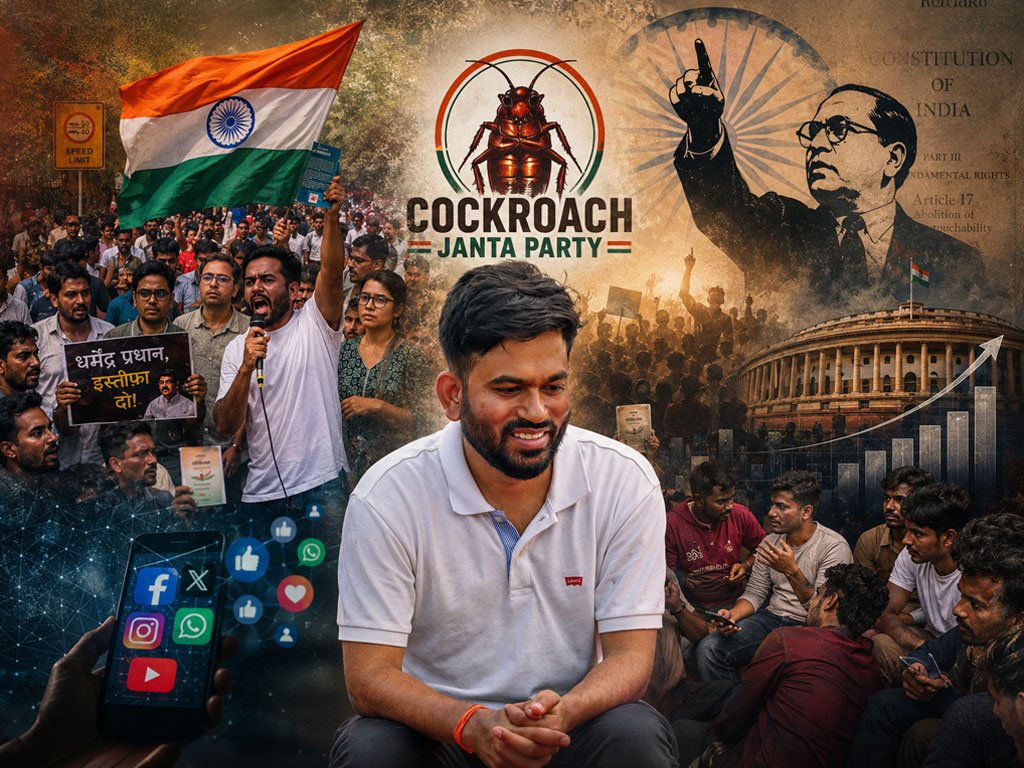
The India Cockroach movement links youth anger, Dalit politics and digital activism in a challenge to the country’s traditional power structures.
The India Cockroach movement has emerged as a new political challenge after the resignation of the country’s Education Minister, adding another dimension to India’s traditional political landscape.
Prime Minister Narendra Modi has managed the immediate crisis with political caution. The opposition Congress party has also gained some political advantage from the controversy.
However, the movement appears to represent something broader than a conventional contest between the government and opposition. It raises questions about youth frustration, caste inequality, digital activism and the changing character of political resistance in India.
This second part examines that wider political and social context.
Get Breaking News First
on WhatsApp

India’s Expanding Economic and Political Power
India has become one of the world’s most powerful states. Its economy is now described as the fourth largest globally, while its population of approximately 1.48 billion ranks first in the world.
The country’s gross domestic product stands at about US$4.5 trillion. Its annual economic growth rate is estimated at between 6.5% and 7%.
India’s per capita income is around US$2,800.
The service sector contributes approximately 55% of the economy. Industry accounts for 27%, while agriculture represents about 18%.
India also has a young population. Around half of its people are described as youth. However, unemployment among young Indians remains between 15% and 20%.
India functions almost like a separate world because of its many religions, languages and cultures.
According to Indian data, the country is making a major contribution to Asia’s economic rise alongside China and Indonesia.
However, India’s labour force has a different relationship with the global economy. Its educated professionals and executives have become deeply integrated into international companies and decision-making structures.
Indian executives increasingly influence major global business decisions. This provides India with an important economic advantage.
For countries competing with India, that influence represents a formidable challenge.
Cultural Influence Extends Beyond the Economy
India’s influence does not come from economic growth alone.
Through films, music and yoga, the country has developed substantial cultural soft power. Indian culture now reaches audiences across the world.
This creates a cultural challenge as well as an economic one.
In major economies with significant immigration, political and social influence has also begun shifting towards communities of Indian origin.
India is the world’s largest democracy. Therefore, unlike China, it presents an economic, political and cultural challenge at the same time.
Britain has even had a prime minister of Indian heritage. This reflects how deeply Indian influence has entered major Western political systems.
India’s geopolitical reach is spreading across the world in ways far more subtle than its direct influence on Sri Lanka.
However, the international response to this expansion is not always one of admiration or affection.
India Cockroach Movement and the Dalit Question
Any analysis of the India Cockroach movement must also examine the position of the Dalit population.
Dalits are communities historically treated as “untouchables” under India’s caste system. They have faced generations of caste-based exclusion and discrimination.
Under the Indian Constitution, many Dalit communities are officially recognised as Scheduled Castes.
India’s Dalit population is estimated at approximately 201 million, or 20.1 crore. This represents about 16.6% of the country’s population.
In other words, roughly one in every six Indians belongs to a Dalit community.
India introduced constitutional protections and legislation to address the discrimination faced by these groups.
Article 17 of the Constitution abolishes untouchability and prohibits associated discrimination.
The Scheduled Castes and Scheduled Tribes Prevention of Atrocities Act of 1989 also criminalises caste-based violence and discrimination.
In addition, 15% of positions in central government employment and state educational institutions are reserved for Scheduled Castes.
Reservation arrangements also exist for representation in Parliament, state legislatures and local government bodies.
However, legal protection has not eliminated caste discrimination.
Dalits still face poverty, income inequality, limited access to quality education, insecure land ownership and difficulty obtaining stable employment.
Reports of caste-based attacks and violence continue.
Unemployment among Dalit youth, barriers within education and discriminatory recruitment practices also remain unresolved.
The continuing need for a quota system demonstrates the depth of inequality affecting a large section of India’s population.
Where India’s Dalit Communities Are Concentrated
States with large Dalit populations include Uttar Pradesh, Bihar, West Bengal, Tamil Nadu, Andhra Pradesh, Rajasthan, Madhya Pradesh, Maharashtra and Karnataka.
Dalits remain one of India’s largest and most historically oppressed social groups.
Despite constitutional protection and reservation policies, they continue to experience serious social and economic disadvantages.
India’s growing global power cannot completely conceal this internal reality.
The country may occupy an increasingly large space in international politics, but caste inequality continues to shape the lives of millions.
Ambedkar’s Influence on Dalit Political Identity
Dr. B.R. Ambedkar is regarded as the great liberator and philosophical leader of India’s Dalit communities.
A distinguished jurist, Ambedkar served as chairman of the committee that drafted India’s Constitution.
He played a central role in developing Article 17 and the constitutional rejection of untouchability.
Ambedkar later adopted Buddhism as his religious philosophy.
Today, many Dalits continue to study Buddhist thought and follow the path he established.
Ambedkar foundations remain active within Dalit communities. They combine political commitment, social organisation and religious philosophy.
These groups often demonstrate a direct and determined commitment to advancing the rights of their communities.
Abhijeet Deepke and a Gen Z Protest Movement
Abhijeet Deepke has emerged as the leading figure in the Indian protest movement.
The 30-year-old political communications specialist became the public face of what has been described as India’s first major Gen Z protest campaign.
The movement reportedly began after Deepke shared a satirical message on social media. From that post, the “Cockroach Janata Party” was born.
The campaign followed controversy over an alleged comment by Chief Justice of India Surya Kant, who was accused of comparing unemployed young people to “cockroaches.”
The Chief Justice later said that his remarks had been misinterpreted.
Nevertheless, the controversy generated significant anger among young people.
What began as a digital expression of frustration quickly developed into a broader youth movement.
NEET Paper Leak Fuels Nationwide Anger
The movement expanded further after the leaking of the NEET medical entrance examination paper.
The controversy reportedly affected nearly two million students.
Large demonstrations followed in New Delhi and other Indian cities.
The protesters demanded accountability over failures within the country’s education and examination systems.
The eventual resignation of Education Minister Dharmendra Pradhan was viewed by demonstrators as a major victory.
However, the unrest should not be understood only as a protest over one examination or one minister.
It also reflected deeper frustration over unemployment, educational inequality, political exclusion and the limited opportunities available to young people.
Deepke’s Dalit Background Shapes the Movement
Abhijeet Deepke comes from a Dalit family in Maharashtra.
There is little doubt that the experiences of his family and the wider struggles of Dalit communities influenced his political outlook.
He is also influenced by Ambedkar’s ideas.
His identity represents a political and generational face of caste oppression that has often remained unspoken.
That identity now operates through technology, social media and modern political communications.
Deepke previously worked with the social media team of the Aam Aadmi Party.
That experience allowed him to develop skills in political satire, memes and digital messaging.
He later withdrew from the party’s activities.
Although the Congress party is now seeking political advantage from the protests, the movement may have foundations that extend beyond party competition.
The demonstrations can also be viewed as a response to caste inequality and the social pressures connected to it.
Digital Activism and Geopolitical Questions
Deepke returned to India while pursuing higher education in the United States and became involved in leading the protests.
Despite facing criticism and threats, he repeatedly urged demonstrators to remain peaceful.
In that respect, the method resembles Sri Lanka’s “Aragalaya of Love.”
The author argues that Sri Lanka’s protest movement gained momentum through American assistance and social media projects.
Deepke’s links to American education have therefore raised geopolitical questions within this interpretation.
The use of students for wider political purposes is not new.
Students have played major roles in political movements throughout the world. Scholarships, education and international networks can also create political relationships.
The author compares this process with the political emergence of Rohana Wijeweera and Harini Amarasuriya.
From this perspective, student mobilisation can become geopolitically damaging to the countries involved.
Social Media as a Form of Soft Power
Deepke’s greatest strength lies in his ability to use social media.
Facebook and other digital platforms have helped generate protests capable of destabilising political systems across South Asia.
The region has witnessed how online networks can function as a powerful form of American soft power.
Therefore, the Indian youth uprising should also be examined through a geopolitical lens.
Caste discrimination continues to burn beneath the surface of Indian society.
It would be unrealistic to assume that major powers such as the United States and China are not studying those internal divisions.
Wherever serious political and social problems exist, geopolitical interests eventually become involved.
However, Deepke’s role should not be reduced entirely to foreign influence.
By following Ambedkar’s political path, he has opened a potentially powerful route for India’s underprivileged communities.
Could a New Dalit Political Force Emerge?
The movement could eventually create space for a separate political party representing Dalit interests.
Its future will depend on whether supporters can preserve the organisation, maintain discipline and develop a clear programme.
Recent events suggest that the awakening is not directed against Indian identity itself.
Instead, it appears focused on ensuring that marginalised communities can repeatedly mobilise in defence of their rights.
That foundation has now been established.
The future strength of the movement will depend heavily on caste identity and the limitations that caste politics places on broader unity.
Socialists represent only about 2.5% of India’s population, while Dalits account for approximately 16.6%.
This numerical difference could become politically significant.
The so-called untouchable communities have now touched Indian politics with unusual force.
For India, this is both a warning and an opportunity.
Lessons From Sri Lanka’s 2022 Aragalaya
Prime Minister Modi’s diplomatic understanding during Sri Lanka’s 2022 Aragalaya may also offer lessons.
The author suggests that former President Gotabaya Rajapaksa possessed some understanding of the crisis.
However, the concentration of approximately 74% of political authority within one family or dynasty made a sustainable solution difficult.
The author also argues that American and geopolitical involvement in India’s Cockroach movement resembles the forces at work during Sri Lanka’s 2022 protests.
Should the Cockroach movement develop into a force capable of changing governments, the economic consequences for India could become substantial.
India’s size and international importance mean that domestic instability would not remain an internal matter.
Why India’s Stability Matters to Sri Lanka
Any serious destabilisation of India would directly affect Sri Lanka’s economy.
India remains Sri Lanka’s closest major neighbour and an important source of trade, investment, tourism and political support.
A prolonged crisis in India could therefore weaken Sri Lanka’s already vulnerable economic position.
Sri Lanka’s current political system would also face severe pressure from the regional consequences.
The India Cockroach movement has revealed the strength of youth frustration, Dalit identity and digital organisation.
Its future direction remains uncertain.
However, the movement has already demonstrated that communities historically excluded from power can use technology, satire and peaceful mobilisation to challenge traditional political structures.
Whether it becomes a lasting political force or fades after its immediate victory will depend on leadership, organisation and the ability to unite people beyond caste boundaries.
For India, the movement represents a warning about unresolved inequality.
For Sri Lanka, it is a reminder that political instability in its largest neighbour would carry consequences far beyond India’s borders.