By Roy Denish
More than a marketplace, Sea Street is a living testament to gold’s enduring power. In a world of paper promises and economic uncertainty, generations of Sri Lankans have trusted physical gold as a store of wealth, security, and tradition proving that true value is built on trust, heritage, and resilience.
The sterile charts of the COMEX and the pronouncements of central bankers seem a world away from the beating heart of the real gold market. Yet, to understand the true, human value of gold, a value the manipulators in global finance desperately try to erase, one must stand on Sea Street in Colombo, Sri Lanka.
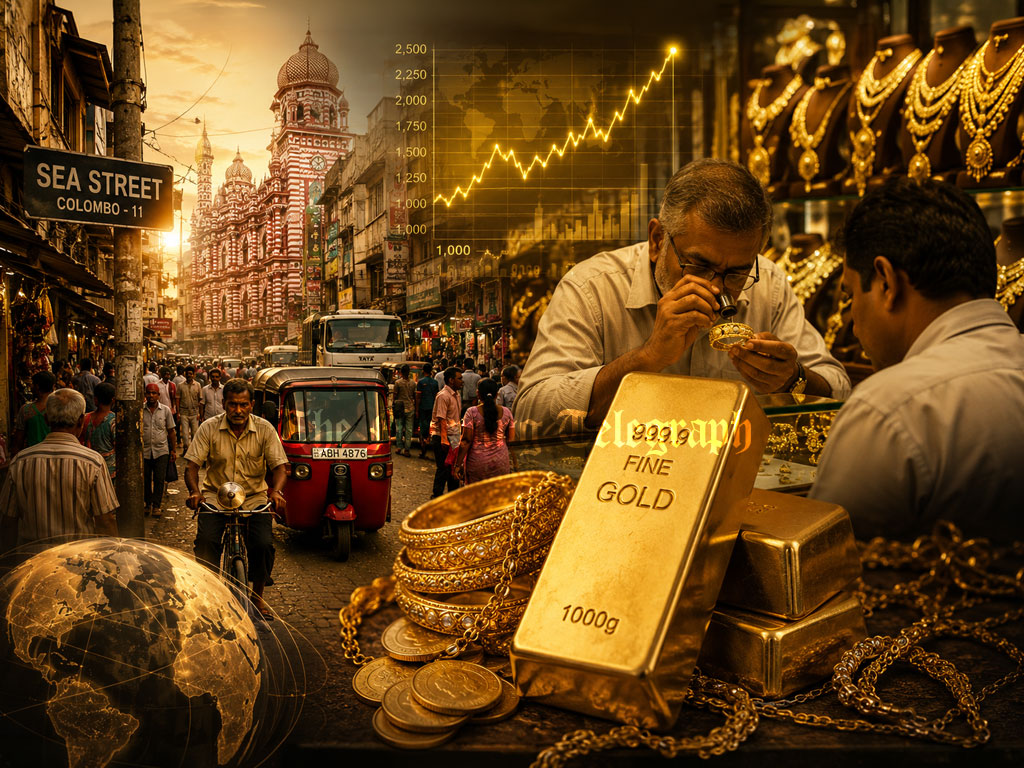
This chaotic, glittering artery in the Pettah district is not a market; it is a monument. It is here that gold’s power transcends mere financial theory, becoming a cultural anchor against the violent storms of economic uncertainty.
The Glint of History and the Roar of Commerce
Walk onto Sea Street, and you are immediately assaulted by a sensory explosion that makes Wall Street feel like a tomb.
The sound is a deafening, polyglot roar: the incessant, high-pitched “tring-tring!” of the bicycle bells dodging pedestrians; the deep-throated rumble of lorries; the rapid-fire Tamil and Sinhalese bargaining; and, beneath it all, the rhythmic, metallic tap-tap-tap of a hundred tiny goldsmith hammers working in the heat of a back room.
The colour is a visual feast, not just the opulent, blinding yellow of 22-carat gold stacked in every window, but the backdrop of the vibrant Pettah market itself. It is the candy-striped façade of the nearby Jami Ul-Alfar Mosque, the scarlet stain of chewed betel nut on the pavement, and the bright, swirling silks of saris that brush past you.
The history is palpable. This street, once closer to the churning ocean from which it takes its name, was settled by the Chettiar traders from South India in the 19th century. They brought with them centuries of gold craftsmanship and a deep-seated tradition of finance, building Hindu temples, kovils, that still stand sentinel today, marking their cultural claim. Sea Street, or Chettiartheru in Tamil, is their enduring legacy, a testament to the fact that wherever trade flourished on the ancient maritime routes, gold followed, carried by merchants who valued hard currency above all else.
The Value That Lies Beneath the Glitter
On Sea Street, gold is not an abstract futures contract; it is a visceral, tangible measure of a life. The gold you see is purchased for weddings, where a dowry of heavy, ornate jewellery signifies a family’s honour; it is bought for newborns, securing their future; and it is purchased by everyday citizens, not speculators who view it as the only true hedge against a devaluing rupee and a precarious economic future.
The local price of gold in Sri Lanka is determined, yes, by the global USD price and the volatile rupee-to-dollar exchange rate. But the true valuation on Sea Street is set by trust. Deals are struck on a handshake, often in cramped, fluorescent-lit shops where a merchant, steeped in family tradition, can seemingly appraise a customer’s intent with a glance. Here, the weight and purity of a gold sovereign or a TT bar of 999 gold are more reliable than any bank guarantee.
A Profound Opportunity for the Prudent
What the hidden forces of derivatives and central bank leasing attempt to hide is this bedrock reality: Gold is a universal language of trust and wealth preservation.
The market manipulators in London and New York fear the price of gold because its rise indicts their paper currency systems. But on Sea Street, the daily trade is a quiet, powerful vote of no confidence in the illusion. Every transaction is a decision to trust something tangible, beautiful, and eternal over a promise scribbled on a piece of government paper.
This profound cultural belief system, woven into the very fabric of Sri Lanka’s commerce, is why the global price suppression cannot hold. The demand for physical metal, the kind you can touch, weigh, and verify, the very kind traded on Sea Street will always soar during a crisis, simply because a gold chain means survival, while a paper contract is just a fleeting promise.
For the investor who seeks true wealth protection, the lesson of Sea Street is clear: look past the global noise. Focus on the physical asset that has held its value for the Chettiars, for emperors, and for the common family, an asset that speaks louder than any manipulated price chart. Your future, like the heritage of Sea Street, should be anchored in the unshakeable value of physical gold.