By Roy Denish
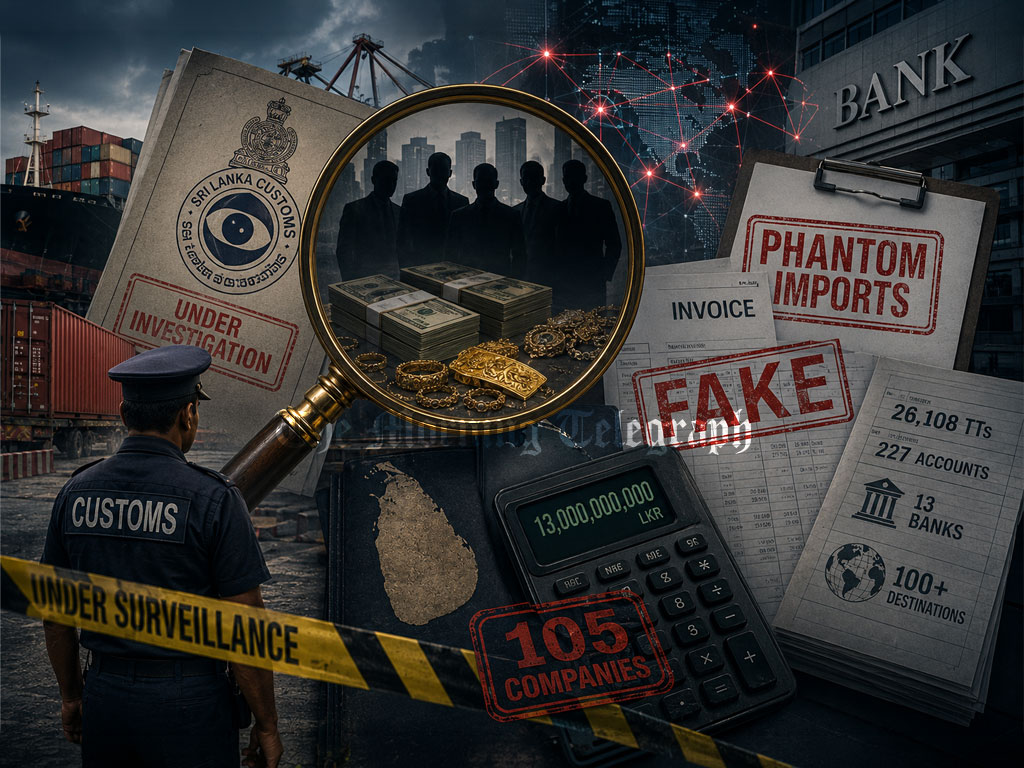
One hundred and five companies. Over Rs. 13 billion moved out of Sri Lanka. More than 26,000 foreign transfers. What investigators have uncovered is not just a tax evasion scheme—it is a sophisticated financial network that allegedly drained foreign exchange reserves through phantom imports, shell companies, and forged trade documentation, raising serious questions about banking oversight and corporate accountability.
Sri Lankan law enforcement and customs authorities have launched a sweeping investigation into a massive financial racket involving trade misinvoicing and “phantom imports” that siphoned over 13 billion rupees (approximately 43 million USD) out of the island nation’s recovering economy.
The sophisticated network, which targeted high-tariff and luxury commodities like gold jewelry, hardware, and premium bathroom fittings, bypassed mainstream conglomerates. Instead, investigators revealed the scheme relied on a rapidly rotating web of disposable shell companies designed to evade regulatory detection and bypass standard customs duties.

Public Security Minister Ananda Wijepala revealed the details of the ongoing probe, disclosing that the multi-billion-rupee scam operated through 26,108 separate Telegraphic Transfers (TTs) routed across 227 accounts spanning 13 commercial banks.
According to police and customs intelligence, the syndicate utilized a network of 105 front companies registered by a tightly knit group of 55 individuals. Operating under a strategic blueprint of rapid rotation, these entities—including front operations named Next Gen Private Ltd. and AY Investments Ltd.—would register under dummy directors, execute an intense volume of high-value foreign currency transfers over a short six-month window, and abruptly dissolve before statutory audits could take place.
The financial investigation, spearheaded by the Central Investigation Bureau (CIB) alongside the Financial Crimes Investigation Division (FCID), uncovered that a substantial portion of the capital siphoned through these accounts was linked to high-profile institutional crime, including a recent 13 billion rupee banking fraud at National Development Bank (NDB) and localized narcotics distribution liquidity. The illicit funds were systematically layered through commercial bank branches in areas such as Pettah, Fort, and Kolonnawa before being transferred out of the country to over 100 international destinations.
In thousands of flagged transactions, no physical cargo ever arrived at Sri Lankan ports. The front companies utilized forged import invoices for everyday commodities purely as administrative cover to clear billions in outbound bank transfers. In instances where physical shipments did arrive, importers engaged in aggressive under-invoicing, declaring a fraction of the actual transaction value to evade massive state revenues generated through Import Duties, Value Added Tax (VAT), and Port and Airport Development Levies.
The staggering drain on the country’s foreign exchange reserves has prompted a coordinated state crackdown. Sri Lanka Customs and the Inland Revenue Department have executed a joint data-sharing initiative to cross-reference maritime import declarations with real-time corporate tax filings.
Under the heightened enforcement protocols, the Central Valuation Directorate of Sri Lanka Customs has escalated its use of statutory powers under the Customs Ordinance to flag and reject suspicious transaction values falling below global market baselines. Shipments failing to meet realistic evaluation metrics are frozen at points of entry, with authorities demanding heavy security deposits from importers pending the outcome of comprehensive Post-Clearance Audits (PCA).
The widening probe has also turned its focus onto institutional accountability. State investigators are actively reviewing potential internal compliance failures within the 13 involved commercial banks, probing how thousands of high-value outbound transfers bypassed standard anti-money laundering triggers. Authorities stated that the aggressive enforcement drive is designed to protect the national treasury and secure vital foreign reserves in compliance with current macroeconomic stabilization targets.