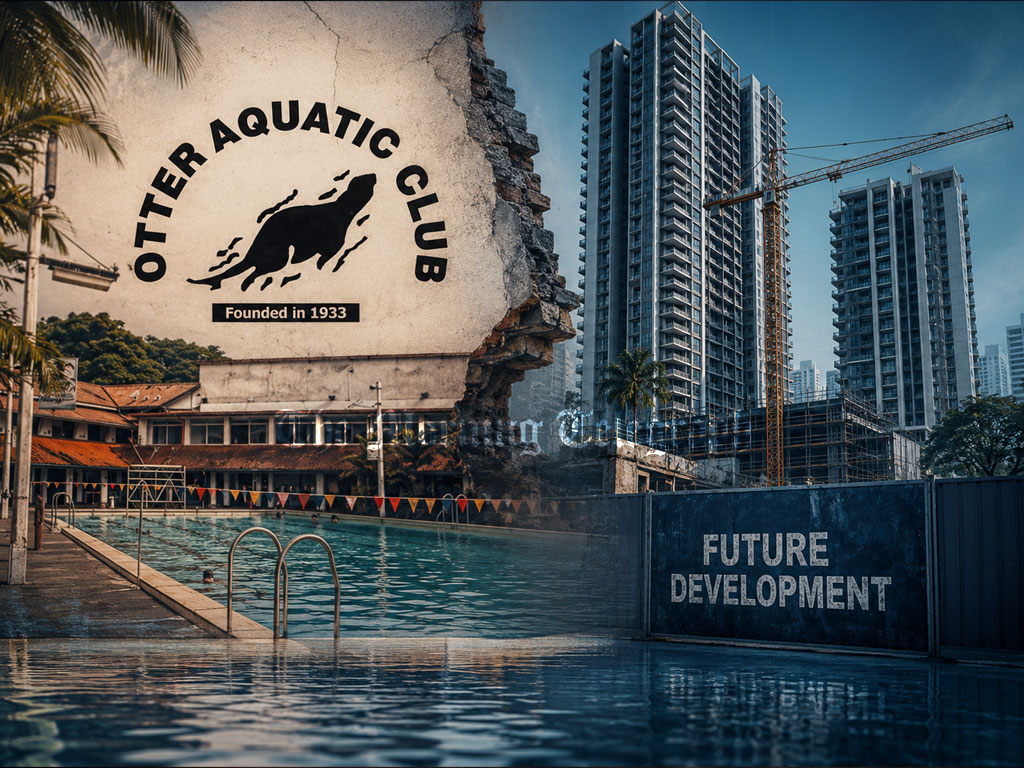
Once the playground of Colombo’s elite, Otters Aquatic Club now stands at the crossroads of history and high-rise development. As luxury towers rise and historic social institutions disappear, Colombo faces a difficult question: is modernization preserving the city’s future, or erasing its soul?
The fading afternoon sun casts long shadows over the weathered tiles of the Otters Aquatic Club on Bauddhaloka Mawatha. For nearly a century, this Colombo 7 institution stood as a relaxed sanctuary of sports, community, and leisure, providing a contrast to the high-walled exclusivity of Colombo’s more rigid social clubs. Today, however, the heavy hum of city traffic outside feels closer than ever, signaling a profound transformation for the historic landmark.
Founded in 1933, the club once buzzed with life, boasting a membership that grew to over five thousand. It was a place where generations of Colombo families learned to swim, where tennis courts echoed with friendly rivalries, and where notable figures, including the late visionary author Sir Arthur C. Clarke, spent quiet afternoons.

In its heyday, the club was a vibrant playground for the Colombo 7 elite, serving as a bachelors’ paradise and a hub for all sorts of social activities. On warm afternoons, the poolside ambience was electric. Bikini-clad girls walked up and down the deck, while ladies in elegant, flowing linen dresses sipped cocktails under wide umbrellas. Waiters dressed in classic white sarongs and crisp shirts moved gracefully through the crowds, carrying trays of short eats and cold drinks. The club boasted top-tier amenities, from its pristine swimming pools to sprawling tennis courts and a lively bar section. As night fell, the energy shifted into a more intimate, gossipy atmosphere, with men staying up until the early hours of the morning, sharing stories and nursing drinks long after the city had gone to sleep. On Friday nights, the air would swell with the raucous rhythm of late-night baila sessions, the dance floor packed with the city’s prominent figures loosening their ties.
Yet, beneath this glamorous, nostalgic charm, financial and structural strain had been mounting for years. While the elite enjoyed the facilities, a culture of entitlement began to erode the club’s foundations. The very same rich and famous members who demanded flawless service would routinely throw temper tantrums over minor inconveniences, arrogantly sending back plates of hot bite to the kitchen if the spice levels failed to meet their exact whims. Behind this facade of high society lay a more cynical reality, as the club frequently became a hunting ground for politicians looking for corporate fund-raising, shaking hands and securing pledges between drinks. Worse still, a significant number of these affluent members accumulated prolonged bar and restaurant tabs that were simply left unsettled for months, treating the institution like a personal charity.
This internal erosion mirrored a staggering institutional failure. Systematic financial mismanagement and rampant tax evasion eventually caught up with the club. Official state audits and urban development assessments revealed deep operational vulnerabilities, highlighting severe infrastructure neglect and a massive tax backlog stretching back to 2005. In total, the club owed the Urban Development Authority (UDA) and local government bodies over one billion rupees in unpaid lease rentals and accumulated taxes. Internal arguments among the management regularly went sour, collapsing into bitter disagreements as factions clashed over how to settle the ballooning debts, even attempting a desperate, last-minute proposal to lease part of the historic grounds to a commercial supermarket chain; a plan that was swiftly shot down by state authorities.
The turning point came when state authorities intervened, issuing eviction notices over the unresolved use of state property. In an initial bid to preserve the club, the UDA stepped in, handing operational management to the Waters Edge hospitality group. Waters Edge possesses strong corporate credibility within Sri Lanka’s hospitality sector as a state-owned, premier luxury resort based in Battaramulla, renowned for high-end banquets and sports facilities. Its entry brought much-needed administrative structure and transparency to a club suffering from years of neglect. However, because Waters Edge acted as an interim custodian rather than a long-term property investor, its mandate was fundamentally limited. It could stabilize daily operations, but it could not execute the massive capital injections required for a permanent structural overhaul.
The final chapter of the club’s historic footprint began to take shape early this year. In February 2026, a major corporate development occurred when Prime Lands Residencies PLC secured a 99-year lease agreement from the state for a staggering 3.2 billion rupees, following formal approval from the Cabinet of Ministers and the UDA. The coveted 158-perch property, primarily utilizing the former Otters Club car park area, is now slated for a massive 22.4 billion rupee mixed-development project named “The Elizabeth.” Plans reveal a towering 24-storey structure containing 229 luxury residential units, a development that will fundamentally redefine the Colombo 7 skyline.
Corporate and state officials have offered reassurances that the iconic club will not be entirely erased, noting that the multi-billion rupee project is structured to relocate and incorporate modern Otters Aquatic Club facilities within the 4th and 5th floors of the new building. For the club’s remaining loyalists, the news brings a mixture of pragmatic hope and quiet melancholy. While a modernized facility promises to rescue the club from physical decay, the casual, open-air charm of the old premises will inevitably change.
The fate of the Otters Aquatic Club is not an isolated incident; it mirrors a broader, more alarming trend sweeping through the capital’s historic recreational landscape. Across the city, at the edge of the Wellawatte coastline, another legendary institution is facing its demise. The Kinross Swimming and Life Saving Club, founded in 1941, has long been a pillar of Sri Lanka’s aquatic history. For 85 years, it was the birthplace of champion sea swimmers, pioneering lifesavers, and deep community bonds. Today, however, Kinross is gasping to stay afloat, shuttered and sidelined by an insurmountable lease dispute with its landlord, Sri Lanka Railways, which abruptly escalated demands to millions of rupees before putting the historic premises up for tender.
The simultaneous shuttering of the Kinross Sports Club and the drastic physical dismantling of the Otters Aquatic Club represent a deeply critical turning point for Colombo’s urban identity. What is being witnessed is the aggressive monetization of public and semi-public spaces under the banner of progress. When iconic institutions are either priced out of existence or compressed into the lower levels of luxury concrete high-rises, the city loses more than just bricks and mortar; it loses its social fabric. The transition of these historic landmarks from accessible, open-air community sanctuaries into exclusive corporate real estate assets serves as a stark testament to a changing metropolis; one where heritage is traded for capital, and where the rich history of Colombo’s civic life is systematically erased by the relentless demands of high-rise modernization.