By Roy Denish
The Middle East edged closer to a wider conflict as President Trump threatened overwhelming military action against Iran, while a deadly strike on a commercial tanker triggered diplomatic outrage from India and heightened fears of regional escalation.
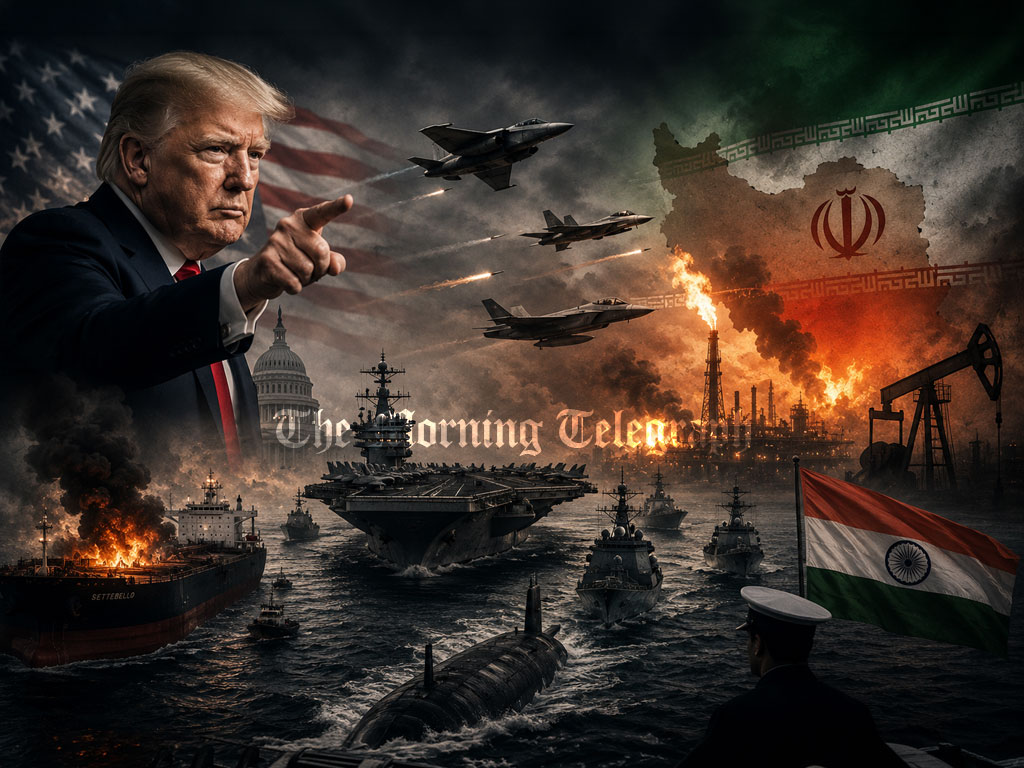
WASHINGTON — President Donald Trump threatened Thursday to launch major sea and air strikes against Iran, declaring that the U.S. military would hit the country “VERY HARD TONIGHT” and vowing to eventually seize control of its critical oil infrastructure.
The escalatory warning came after U.S. and Iranian forces exchanged heavy fire for two consecutive days, shattering a fragile ceasefire that had been in place since April. Trump asserted that much of Iran’s navy, air force, and radar capabilities have already been neutralized in previous engagements, clearing the path for an intensified bombardment. The U.S. military currently maintains an estimated 10 to 15 major warships in the Persian Gulf and surrounding waters, anchored by the nuclear-powered aircraft carrier USS Abraham Lincoln Strike Group and flanked by Arleigh Burke-class guided-missile destroyers and Ticonderoga-class cruisers.

Defense officials say any imminent offensive would rely heavily on long-range Tomahawk land-attack cruise missiles fired from these naval vessels to strike deep within Iranian territory. From the air, the Pentagon is poised to deploy multirole F/A-18E/F Super Hornets from the carrier deck, alongside land-based F-35 Lightning II stealth fighters and long-range B-52 Stratofortress bombers. These aircraft are equipped to drop heavy payloads of satellite-guided Joint Direct Attack Munitions and GBU-39 Small Diameter Bombs, precision glide weapons that have already been used this week to dismantle Iranian air defense and ground control sites.
Meanwhile, the Indian government has summoned the U.S. Embassy’s Deputy Chief of Mission in New Delhi and lodged a strong protest after U.S. Navy assets attacked a commercial oil tanker off the coast of Oman, killing three Indian nationals. The Ministry of External Affairs confirmed Thursday that three sailors aboard the Palau-flagged vessel Settebello died after a U.S. aircraft fired precision munitions into the ship’s engine room for allegedly non-compliant behavior under the current blockade. New Delhi condemned the lethal strike, reiterating demands for an immediate de-escalation of regional tensions and demanding unimpeded, safe navigation for commercial mariners in international waters.
While Trump noted in an interview that he preferred not to target civilian infrastructure such as power plants and bridges to avoid humanitarian suffering, he insisted that Iran would pay a heavy price for stalled diplomatic negotiations. The president also outlined a longer-term strategy to take total control of Iran’s oil and gas markets, specifically targeting Kharg Island, the main hub that handles the vast majority of Iranian crude exports. Iran’s Foreign Ministry responded by stating that the persistent American attacks have rendered the temporary ceasefire practically meaningless, as both sides remain deadlocked over U.S. demands for Iran to surrender its highly enriched uranium stockpile.