SriLankan Airlines reports stronger revenue, but old debt, interest costs, forex losses and State-bank liabilities still keep dragging it down.
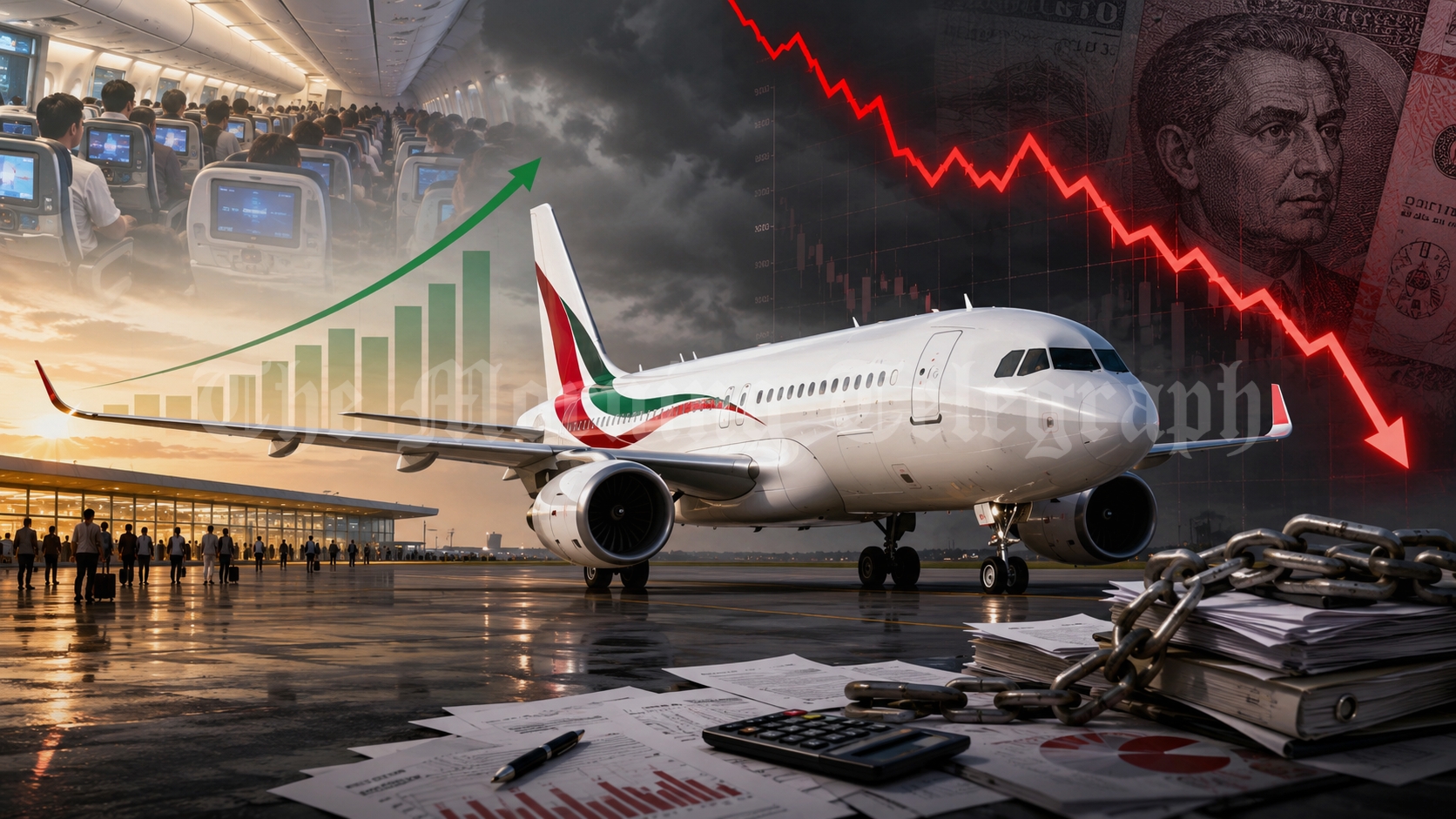
SriLankan Airlines is flying more passengers, earning stronger traffic revenue and showing clearer signs of operational recovery, but the national carrier remains trapped by a much deeper crisis: its balance sheet is still bleeding.
That is the core issue behind the latest debate over SriLankan Airlines. The carrier may be improving as an aviation operation, but it remains financially broken as a State-owned company weighed down by years of accumulated debt, interest costs, foreign exchange pressure and legacy liabilities.
In simple terms, SriLankan can sell more tickets and still lose money. Passenger revenue alone is not enough when the income earned from flying is swallowed by old debt, interest payments, aircraft costs, foreign exchange losses and State-bank obligations before it can become real profit.

For the 2025/26 financial year, passenger revenue reportedly rose to Rs. 265.9 billion, while total net traffic revenue increased to Rs. 333.5 billion. Earnings before interest and tax, known as EBIT, also improved to Rs. 26.4 billion. On the surface, those figures indicate that the airline’s core business has started to recover.
But that is only one part of the picture. Once debt costs and currency-related financial pressure were counted, SriLankan Airlines’ loss before tax widened to Rs. 23.2 billion. In other words, the airline’s planes may be fuller and its revenue may be stronger, but the company is still struggling to escape financial damage built up over many years.
The issue is not simply whether people are flying SriLankan. The real question is whether SriLankan can earn enough from its operations to cover the massive financial burden already sitting on its books.
That burden is severe. The Auditor General reported that, as at March 31, 2025, the SriLankan Airlines Group had accumulated losses of about Rs. 596.46 billion. Current liabilities exceeded current assets by around Rs. 346.48 billion, while the Group’s equity stood at a negative Rs. 379.52 billion.
Those numbers show that the crisis runs far deeper than one poor financial year. Negative equity means the company’s liabilities are greater than its assets. In plain language, the airline has been weakened financially to the point where better revenue alone cannot repair the damage quickly.
That is why old debt remains one of the biggest reasons SriLankan continues to struggle. Even when the airline earns money from passengers, cargo and related services, a large share of that income must go toward servicing past obligations. A company can look busier and still remain financially unhealthy if its debt burden is too heavy.
Interest payments are another major factor. If an airline earns operating income but carries large loans, interest expenses can wipe out much of the benefit. Reports indicate that SriLankan still carried Rs. 24.7 billion in interest expenses during 2025/26, even after restructuring efforts.
That means a major portion of the money earned by the airline does not go into building a stronger fleet, improving services, expanding routes or strengthening competitiveness. Instead, it goes toward servicing old debt. This is one reason the taxpayer question cannot be pushed aside.
Foreign exchange losses also continue to hurt the airline badly. Airlines operate in a global industry where many major costs are linked to the US dollar. Aircraft leasing, fuel, spare parts, maintenance, insurance and international debt are all heavily exposed to foreign currency movements.
SriLankan’s own financial clarification for 2024/25 showed how sharply currency movements can affect the bottom line. The Group recorded a loss of Rs. 2.735 billion in 2024/25, compared with a profit of Rs. 7.925 billion in 2023/24. A major reason was that exchange gains fell sharply from Rs. 26.717 billion to Rs. 3.925 billion.
That is a key point for the public to understand. Rupee-dollar movements can make the airline appear better or worse on paper, even when planes are still flying and passengers are still buying tickets. In an industry with heavy dollar-linked costs, currency pressure can damage the bottom line very quickly.
The Government’s role also shows how serious the financial problem remains. Reports have stated that Rs. 91.3 billion in loans from State banks had been restructured, while the Government continues to inject capital into the airline twice a year to enable repayments to State banks.
That means SriLankan Airlines is not surviving only through ticket sales. It is also surviving because the State is supporting its debt structure. When the Government supports a State-owned airline, the burden does not vanish. It moves into the public finance system, where taxpayers ultimately carry the risk.
This is why the debate over SriLankan Airlines should not be reduced to national pride or emotional arguments about having a flag carrier. The real question is whether Sri Lanka can continue to justify a State-owned airline that needs repeated financial support while the country is still recovering from a historic economic crisis.
Sri Lanka has already faced fuel queues, power cuts, inflation, higher taxes, debt restructuring and IMF-backed reforms. In that environment, every rupee used to support a loss-making State enterprise must be examined carefully. The public has a right to ask whether that money could be better used for hospitals, schools, transport, welfare, debt reduction or essential infrastructure.
The Auditor General’s warning over material uncertainty about the airline’s ability to continue as a going concern makes the issue even more serious. Such a warning means the company’s survival depends heavily on continued financial support, restructuring, creditor confidence and the Government’s willingness to keep backing it.
This does not mean SriLankan Airlines has no value. A national carrier can support tourism, connectivity, cargo, employment and the country’s international image. But those benefits must be measured against the financial cost. A flag carrier cannot be defended forever if its losses are repeatedly transferred to the people.
The latest restructuring efforts may improve the airline’s future. But restructuring must not become another polite term for another bailout. The Government must clearly explain how much debt remains, how much has been transferred or restructured, how much taxpayers are exposed to, and whether the airline has a realistic path to becoming financially sustainable.
SriLankan Airlines is not losing money simply because passengers are not flying. It is losing money because even improved operations are being swallowed by old debt, interest payments, foreign exchange losses and a balance sheet damaged by years of mismanagement.
That is the heart of the story. The planes may be fuller, but the balance sheet is still bleeding.
#SriLankanAirlines #SriLankanAirlinesCrisis #SriLankaEconomy #SriLankaNews #SriLankaDebt #StateOwnedEnterprises #AirlineDebt #SriLankaAviation #EconomicCrisis #TheMorningTelegraph