By Roy Denish
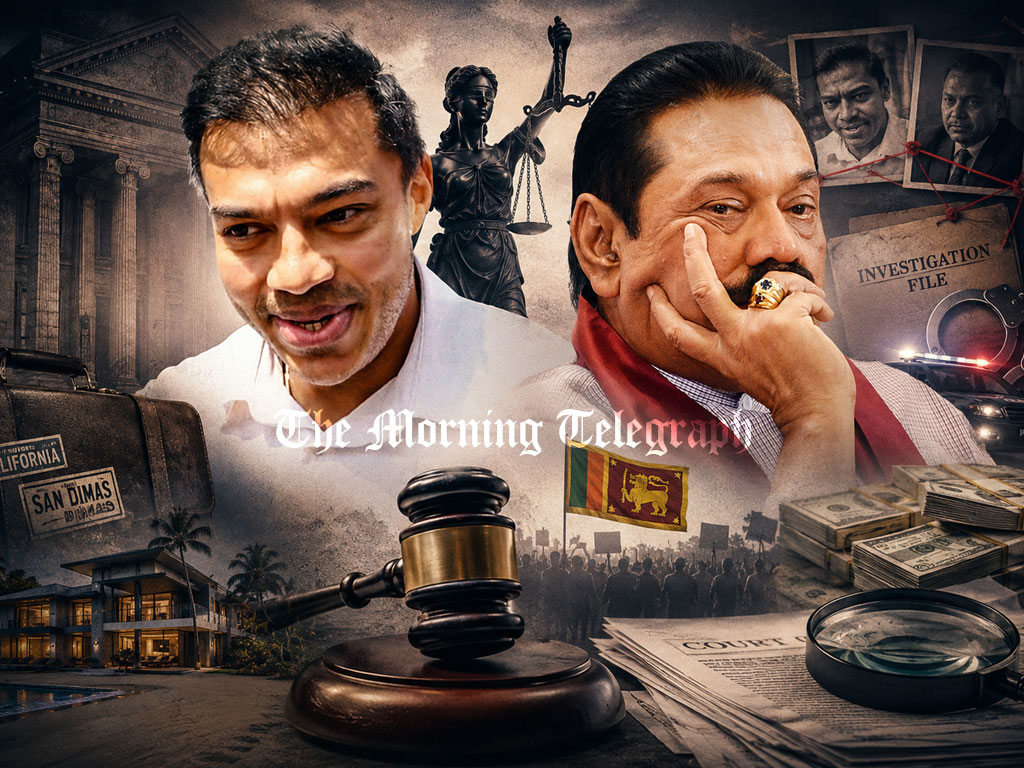
Sri Lanka’s once-dominant political dynasty is facing its toughest reckoning yet as arrests, court warrants, bribery investigations, and wealth probes close in on key members of the Rajapaksa family. What was once seen as untouchable political power is now being tested in courtrooms, exposing questions about privilege, state resources, and accountability.
Rajapaksa’s legacy is eroding fast and furious, the tainted heirloom is facing the long arm of the law and prolonging battles at the courts. For nearly two decades, the Democratic Socialist Republic of Sri Lanka operated under a quiet domestic premise: certain names were heavy enough to warp the trajectory of a police investigation or flatten a judicial docket. Executive immunity, legislative supermajorities, and a carefully cultivated brand of nationalist populism turned the family name into a form of sovereign asset insurance. That insurance policy appears to have expired. What is playing out across the magistrates’ courts and the Court of Appeal in Colombo is not merely a collection of distinct criminal investigations. It is a systematic, institutional audit of an entire dynastic era.

The state’s apparatus is explicitly pulling apart the mechanisms of dynastic privilege. The Bribery Commission’s interrogation and subsequent arrest of Yoshitha Rajapaksa directly targets how state power was used to bypass standard military selection criteria. Investigators allege the standard science-and-math stream requirements for naval cadets were systematically rewritten to accommodate an arts-stream education, followed by a state-financed eighteen-month tenure at Britain’s Royal Naval Academy. It is a case study in how public defense budgets were allegedly treated as private family endowments. Simultaneously, the Matara Magistrate’s Court has issued warrants for former Economic Development Minister Basil Rajapaksa following his failure to appear over the “Brown Hill” land acquisition probe. This sits alongside the older, unresolved Colombo Fort investigation into the diversion of 7.8 million rupees from the Sri Lanka Tourism Promotion Bureau to print campaign materials. Even the former chief executive, Gotabaya Rajapaksa, who once wielded the totalizing authority of the 20th Amendment, now finds his freedom contingent on a defensive writ application in the Court of Appeal, a desperate constitutional maneuver to stave off arrest by the Criminal Investigation Department.
The judicial files detail a network of physical assets and foreign patronage that sustained this domestic influence. In Colombo 7, financial investigators have focused heavily on the Torrington Avenue property that served as the base for the Carlton Sports Network. The state’s argument is that prime urban real estate and media infrastructure were accumulated under the guise of charitable foundations while using funds drawn from state development channels. This domestic accumulation stands in contrast to the family’s origins. Financial watchdogs have traced a paper trail back to San Dimas, California, where Gotabaya and Basil Rajapaksa lived as private citizens holding standard clerical and municipal jobs prior to 2005. The core of the state’s multi-jurisdictional financial investigation rests on a stark mathematical question: How did modest suburban California incomes transform, over the span of fifteen years, into a real estate portfolio that includes the multi-million rupee beachfront estate in Malwana and the land blocks of Matara?
This domestic asset accumulation was mirrored by an equally non-transparent web of international relationships. Parliamentary scrutiny has frequently returned to the deep-seated foreign patronage that defined the family’s governance model—exemplified by Namal Rajapaksa’s lavish, state-sponsored birthday celebrations in China, funded directly by foreign entities. For independent anti-corruption monitors, events like these were not merely instances of diplomatic excess; they were the visual confirmation of a transactional foreign policy where sovereign infrastructure decisions became inextricably tangled with personal dynastic benefits.
Ultimately, it seems the family’s most enduring monument will not be a highway, a port, or a cricket stadium, but rather the creation of a brand new, highly lucrative sector in the local economy: the luxury legal defense industry. For men who once split their time between the sunny suburbs of San Dimas and the corridors of supreme state power, life has transformed into a relentless, exhausting tour of the Colombo court circuit. It is a poetic twist of statecraft where the family’s finest remaining asset is no longer a political mandate, but a collection of highly loyal, incredibly expensive defense attorneys billing by the hour to explain how massive tracts of beachfront property and state-funded naval degrees naturally materialize out of thin air. If history remembers them for nothing else, it will at least recognize their final, unintentional contribution to the republic—single-handedly keeping the nation’s printer cartridge industry afloat through an endless, beautiful mountain of bail applications, writ petitions, and medical leave certificates.