Sri Lanka democracy faces a major test as anti-corruption reforms advance while judicial and security proposals raise concerns over state power.
Sri Lanka democracy faces a defining test in 2026. A government elected on promises of accountability and “system change” is advancing anti-corruption reforms while also pursuing judicial and security measures that have triggered serious questions about institutional independence.
The issue is not whether corruption should be confronted. It must be.
The deeper question is whether accountability can remain credible if reforms simultaneously increase political influence over institutions designed to restrain state power.

Sri Lanka Democracy and the Anti-Corruption Drive
There is genuine evidence of an expanded anti-corruption effort.
The Anti-Corruption Act No. 9 of 2023 broadened Sri Lanka’s asset-declaration framework. CIABOC subsequently launched its Centralized Electronic Assets and Liabilities Declaration System on April 29, 2026, not in March as some earlier reports stated.
The Government also instructed 250 State institutions to establish Internal Affairs Units. These units are intended to identify corruption risks, improve transparency and provide mechanisms for reporting misconduct.
President Anura Kumara Dissanayake has repeatedly framed 2026 around strengthening the rule of law and the principle that everyone should be equal before it. In February, the Government’s official news service quoted him saying the administration wanted to establish the supremacy of the rule of law and give practical meaning to equality before the law.
A Presidential Commission has also been investigating alleged irregularities at the Colombo Municipal Council between 2010 and 2025, including complaints submitted by the public.
However, the Government’s transparency record has not been without controversy.
A July 2026 proposal to amend the Anti-Corruption Act raised concern over access to asset declarations. Following criticism, Leader of the House Bimal Rathnayake announced that the draft would be revised to preserve public access to declarations made by elected representatives.
That reversal was important.
But it also demonstrated why public scrutiny matters. Anti-corruption laws become weaker when transparency depends on political discretion rather than stable institutional rules.
Judges’ Retirement Age Raises Independence Concerns
The more serious institutional confrontation concerns the Government’s proposal to increase the retirement age of superior court judges.
Sri Lanka’s Constitution currently fixes retirement at 65 for Supreme Court judges and 63 for Court of Appeal judges. The Government has approved publication of legislation seeking to increase those limits by two years.
The proposal has attracted unusually broad criticism.
LAWASIA said the change appeared to be an ad hoc initiative without adequate consultation and warned that it could undermine public confidence in judicial independence. It endorsed concerns previously raised by the Bar Association of Sri Lanka.
The Commonwealth Lawyers Association likewise warned against piecemeal constitutional reform and stressed the need for adequate consultation before changing judicial tenure.
The Church of Ceylon has also urged the Government to reconsider the proposal, arguing that the amendment could damage confidence in the rule of law and judicial impartiality.
These objections do not prove improper political intent.
But in matters involving judges who are already serving, appearances matter almost as much as intentions.
An independent judiciary must not merely be free from political interference. Citizens must also be confident that it is.
Security Reform Creates a Second Democratic Test
Concerns over Sri Lanka democracy extend beyond the courts.
The proposed Protection of the State from Terrorism Act, or PSTA, is intended to replace the Prevention of Terrorism Act. The Justice Ministry began public consultations on a new counterterrorism law after acknowledging the need to replace the PTA.
Human Rights Watch has warned that the draft retains powers capable of enabling many of the abuses historically associated with the PTA.
The Centre for Policy Alternatives identified one particularly serious provision: under the draft, remand can extend for one year, while combined remand and detention can reach two years without a person being charged.
International civic-freedom monitoring has also raised concerns about broad definitions, surveillance powers, weak safeguards against arbitrary detention and potential restrictions on expression. As of July 2026, the legislation had Cabinet approval but had not yet been tabled in Parliament.
The Online Safety Act creates another point of concern.
In February 2026, the Human Rights Commission of Sri Lanka warned about threats to freedom of expression, particularly investigations involving journalists and allegedly defamatory speech. In May, the Commission again called for repeal of the Online Safety Act.
National security is a legitimate responsibility of government.
But laws designed to fight terrorism or online abuse must not become tools that discourage journalists, activists or ordinary citizens from lawful criticism.
Easter Sunday Accountability Must Remain Above Politics
The renewed Easter Sunday investigations demonstrate why credible accountability institutions matter.
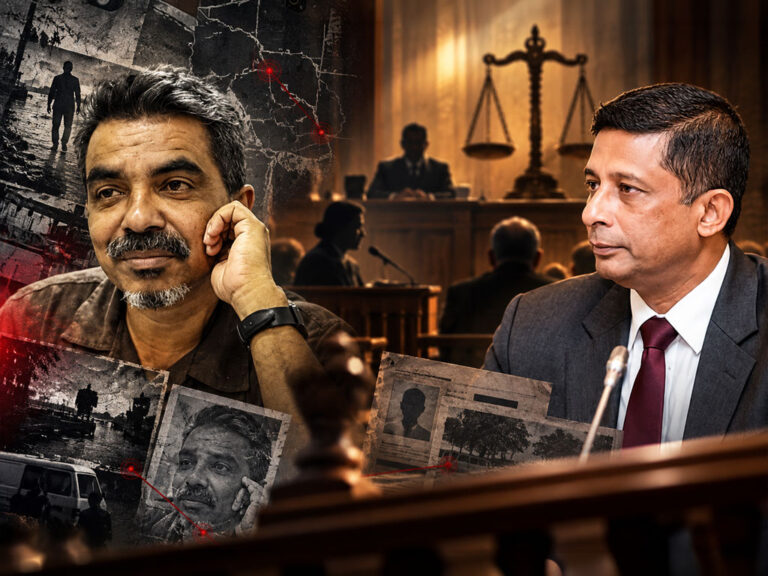
On July 31, 2026, former Police Chief Pujith Jayasundara and former Defence Secretary Hemasiri Fernando were convicted by a divided three-judge High Court bench and sentenced to death for criminal negligence linked to their failure to prevent the 2019 Easter bombings despite intelligence warnings. They retain the right to appeal.
The attacks killed more than 260 people and injured around 500.
Former intelligence chief Suresh Sallay was arrested on February 25, 2026 under the Prevention of Terrorism Act in connection with the continuing investigation. Authorities had not publicly specified charges at the time of his arrest, and Sallay has previously denied wrongdoing.
Separately, the Supreme Court ruled in January 2023 that former President Maithripala Sirisena and several senior officials had violated victims’ fundamental rights by failing to act on intelligence before the bombings.
Sirisena was ordered to pay Rs. 100 million, while Pujith Jayasundara and former intelligence chief Nilantha Jayawardena were ordered to pay Rs. 75 million each. Other officials were also ordered to pay compensation.
These proceedings are evidence that public office must not provide immunity from accountability.
But accountability remains legitimate only when investigators, prosecutors and judges can act without political direction.
That is where the Government must be especially careful.
Reform Cannot Become Political Revenge
Crushing corruption is necessary.
So is protecting judicial independence, freedom of expression and due process.
Those objectives should reinforce one another, not compete.
A government cannot credibly demand transparency from its opponents while weakening transparency rules itself. It cannot claim fidelity to the rule of law while pursuing institutional reforms that create doubts about judicial independence.
And it cannot replace one controversial security law with another that reproduces the same fundamental-rights concerns.
That does not mean every investigation is political revenge.
Nor does criticism of government legislation prove authoritarian intent.
But democracies are protected precisely by refusing to rely on the good intentions of whoever happens to hold office.
Strong institutions are built for the day when those intentions may no longer be trusted.
Sri Lanka’s anti-corruption campaign can become one of the most important reforms of the post-crisis era.
But Sri Lanka democracy will ultimately be judged by a higher standard: whether the same Government that demands accountability from others is equally willing to place limits on its own power.
Reform must punish corruption.
It must never punish democracy.