
More than a year after Sri Lanka’s Supreme Court ordered US$1 billion in compensation for the X-Press Pearl disaster, environmental lawyer Ravindranath Dabare says the country’s struggle to recover the money exposes serious weaknesses in international corporate accountability.
COLOMBO, October 17, 2026 — More than a year after Sri Lanka’s Supreme Court ordered companies associated with the X-Press Pearl maritime disaster to pay an initial US$1 billion in compensation, only approximately US$1 million has reportedly been recovered against that order, highlighting the difficulty of enforcing environmental judgments against multinational corporations.
Attorney-at-Law Dr. Ravindranath Dabare, representing the Centre for Environmental Justice (CEJ), has warned that the enormous disparity between the compensation ordered and the amount received demonstrates the limitations faced by countries seeking redress for environmental destruction involving international businesses.
The X-Press Pearl caught fire in May 2021 before sinking off Sri Lanka’s western coast in June, releasing plastic pellets and other hazardous material into the marine environment.
The vessel was carrying dangerous chemicals, including nitric acid, caustic soda and methanol, together with approximately 1,680 tonnes of plastic pellets.
The fire and sinking caused extensive coastal pollution, damaged marine ecosystems and disrupted fishing activities, leaving affected communities struggling with the economic consequences.

Supreme Court Ordered US$1 Billion in Compensation
On July 24, 2025, a five-judge bench of the Supreme Court delivered a landmark judgment in fundamental rights proceedings arising from the disaster.
The Court ordered companies connected to the vessel’s ownership, operation and local representation to make an initial compensation payment of US$1 billion, recognising the extensive environmental harm and economic losses suffered.
The judgment required the money to be paid in instalments within one year, beginning with US$250 million by September 23, 2025.
It also provided for further compensation orders and the establishment of mechanisms to oversee environmental restoration and payments to affected communities.
However, reports concerning the enforcement proceedings indicate that the initial payment requirements were not met.
Dabare said only approximately US$1 million had been recovered against the billion-dollar order.
That figure concerns reported compliance with the Supreme Court’s compensation judgment. It should not be confused with separate payments previously made towards wreck removal, coastal clean-up operations and assistance to fishing communities.
X-Press Feeders and its insurers have stated that they have spent more than US$170 million on such activities. The companies have also disputed the basis of the Supreme Court’s compensation assessment and maintained that further engagement with Sri Lankan authorities is necessary.
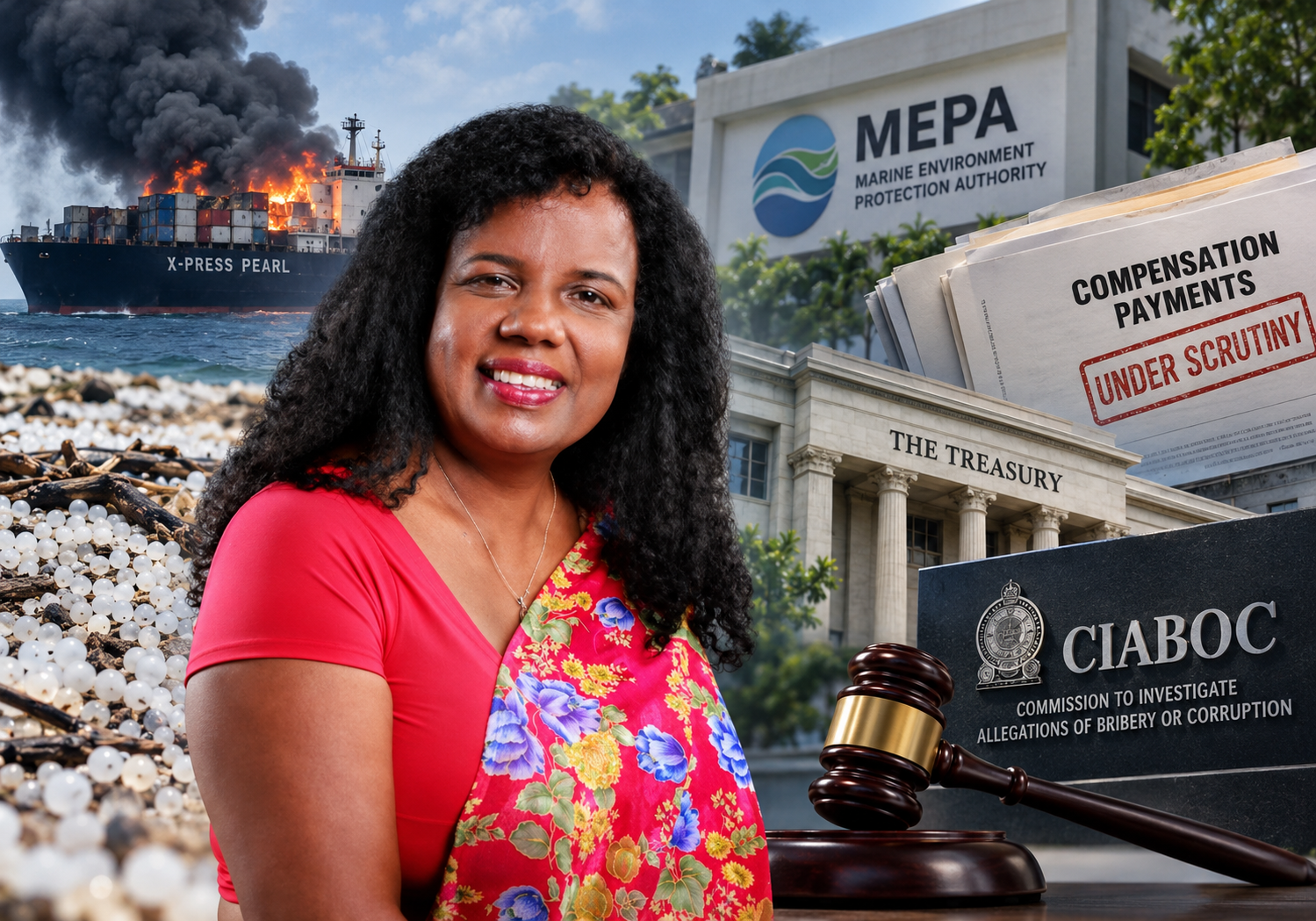
By Roy Denish. Dr. Ajantha Perera seeks a CIABOC probe into X-Press Pearl compensation payments, questioning transparency and the handling of funds.
Read MoreInternational Legal Barriers Complicate Recovery
Dabare argues that the difficulty of enforcing the judgment reveals a broader weakness in the international legal system.
Countries with limited financial and institutional resources can face considerable obstacles when pursuing claims against multinational corporations operating across several jurisdictions.
International litigation can involve substantial legal expenses, conflicting regulatory frameworks and complicated enforcement procedures.
According to Dabare, environmental justice should not depend on the economic strength of the country affected or its ability to sustain lengthy legal proceedings.
He has called for a legally binding international treaty capable of holding transnational corporations accountable for environmental damage.
Such a framework, he argues, should be supported by a dedicated international tribunal empowered to address serious environmental harm that crosses national boundaries.
The proposal reflects a growing concern that domestic legal judgments, however significant, may not deliver effective remedies when enforcement requires cooperation across jurisdictions.
Fishing Communities Continue to Bear the Cost
Beyond the legal dispute, the consequences of the X-Press Pearl disaster remain closely connected to the livelihoods of Sri Lanka’s coastal communities.
Fishing families faced restrictions on their activities following the fire, while marine pollution affected fishing grounds and raised concerns about the long-term condition of coastal ecosystems.
Although compensation and relief payments have previously been made through separate arrangements, questions remain about the adequacy, distribution and recovery of funds intended to address the wider damage.
The central issue is no longer simply whether Sri Lanka has secured a favourable judicial ruling.
It is whether that ruling can be translated into meaningful financial recovery, environmental restoration and adequate assistance for those who suffered losses.
Dabare maintains that international mechanisms must be strengthened so that environmental destruction by multinational corporations can be addressed effectively, irrespective of the resources available to the affected country.
For Sri Lanka, the X-Press Pearl judgment established an important legal precedent.
Recovering the compensation remains the unfinished task.
Unless enforcement produces tangible results, the gap between what the Supreme Court ordered and what the country actually receives will continue to define the struggle for justice following one of Sri Lanka’s worst maritime environmental disasters.