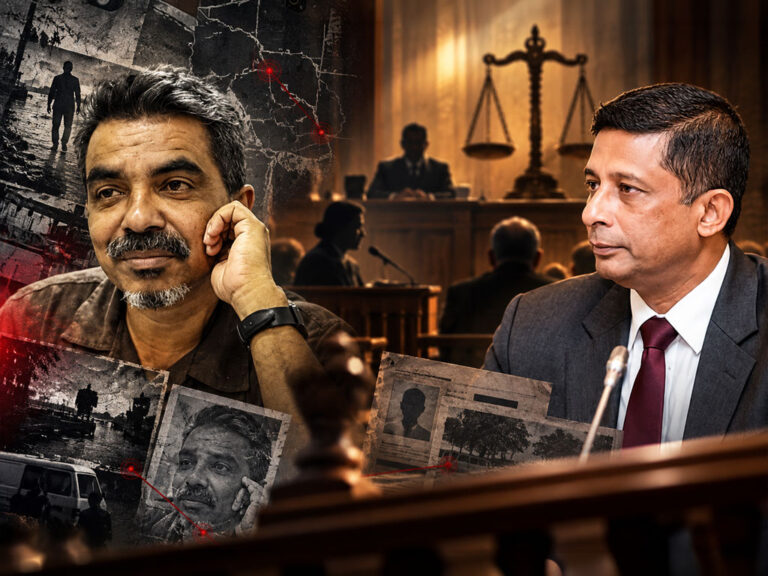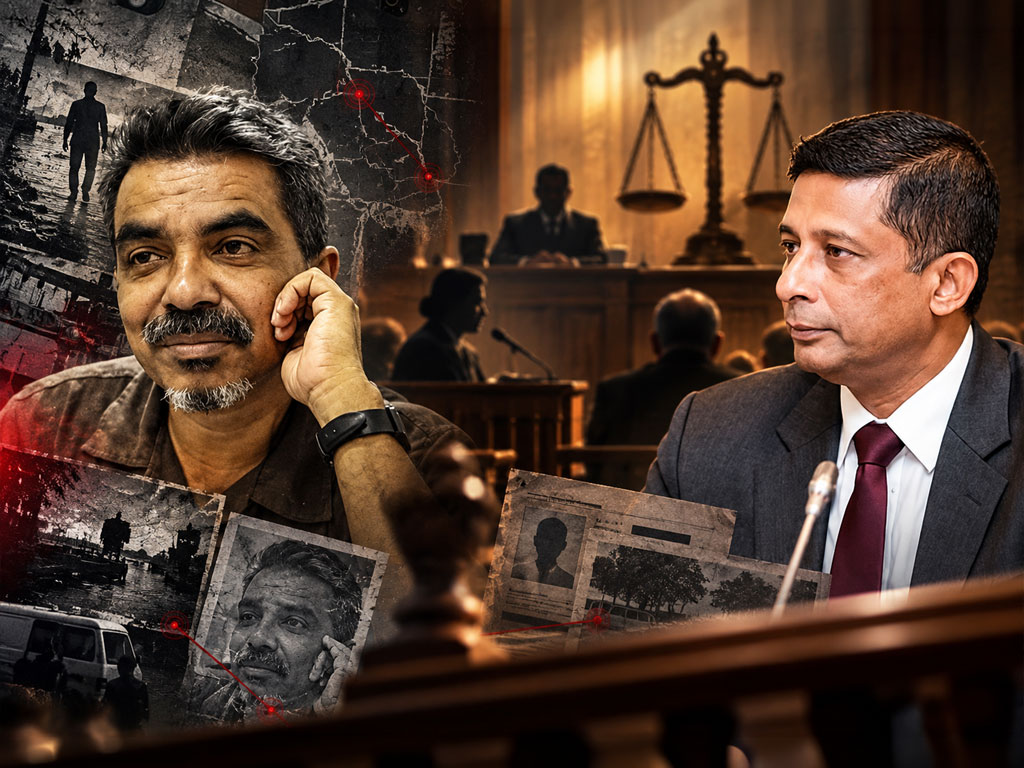
Former intelligence chief Suresh Sallay testified about military intelligence records, while a former LTTE member known as Murali faced questioning over his relationship with missing journalist Prageeth Eknaligoda and an alleged conversation about targeting former President Mahinda Rajapaksa’s aircraft.
COLOMBO, October 17, 2026 — Former State Intelligence Service Director Major General (Retired) Suresh Sallay and former LTTE member Sumathipala Suresh Kumara, known as Murali, gave evidence before a three-judge High Court bench on Friday as proceedings continued in the case concerning the abduction and enforced disappearance of journalist Prageeth Eknaligoda.
The hearing, held on October 16 at the Permanent High Court Trial-at-Bar on Wijerama Mawatha, Colombo, examined Sallay’s involvement in military intelligence administration and Murali’s account of his interactions with Eknaligoda before the journalist disappeared in January 2010.
During cross-examination, Murali acknowledged having maintained a close relationship with Eknaligoda while associated with the Liberation Tigers of Tamil Eelam (LTTE). He was also questioned about a conversation in which the journalist allegedly referred to firing a missile at an aircraft carrying then-President Mahinda Rajapaksa.
When the prosecution sought clarification, Murali described the remark as part of a discussion about whether Sri Lanka’s political leadership could be changed following the end of the civil war.
His evidence records an alleged conversation, not a judicial finding that Eknaligoda belonged to the LTTE, planned an assassination or participated in any criminal conspiracy.
The hearing was conducted before Presiding Judge Nayana Seneviratne and High Court Judges Nalin Hewawasam and Lakmali Hewawasam.

Suresh Sallay Questioned About Military Intelligence Operations
Sallay, who is in custody in connection with investigations into the 2019 Easter Sunday terrorist attacks, was brought before the court under heightened security in accordance with an earlier order requiring his appearance as a prosecution witness.
Deputy Solicitor General Wasantha Perera, appearing for the Attorney General, questioned the retired Major General about his previous responsibilities within Army intelligence.
Asked when he served as Director of the Army Intelligence Directorate, Sallay told the court that his tenure extended from late 2012 until late 2016.
Perera then questioned him about an armed intelligence unit that operated at the Girithale Army Camp.
Sallay replied that he had visited the location on three or four occasions.
The prosecution subsequently asked whether he remembered providing information to investigators examining Eknaligoda’s disappearance.
Sallay said he recalled an investigation having taken place and telephone records being supplied in connection with it.
However, when pressed for further details, the former intelligence chief explained that he could not accurately identify the statements and documents he had provided without consulting the original records.
He told the court:
“Your Honour… during my 38 years of service, I have worked closely with the Criminal Investigation Department on many occasions. I have given many statements. I have provided many documents. A military investigation was also held in connection with this incident. I handed over the relevant information to it. But more than 10 years have passed since this incident. Therefore, I cannot say without properly looking at the statement to confirm the statements and documents given regarding this incident.”
His remarks indicated that he remembered cooperating with earlier inquiries but was unwilling to confirm the precise contents of records from more than a decade earlier without reviewing them.
Following the conclusion of his evidence, Sallay was escorted back to the Criminal Investigation Department under heavy security.
His appearance in the Eknaligoda proceedings was as a prosecution witness. The source does not identify him as one of the accused in that case.
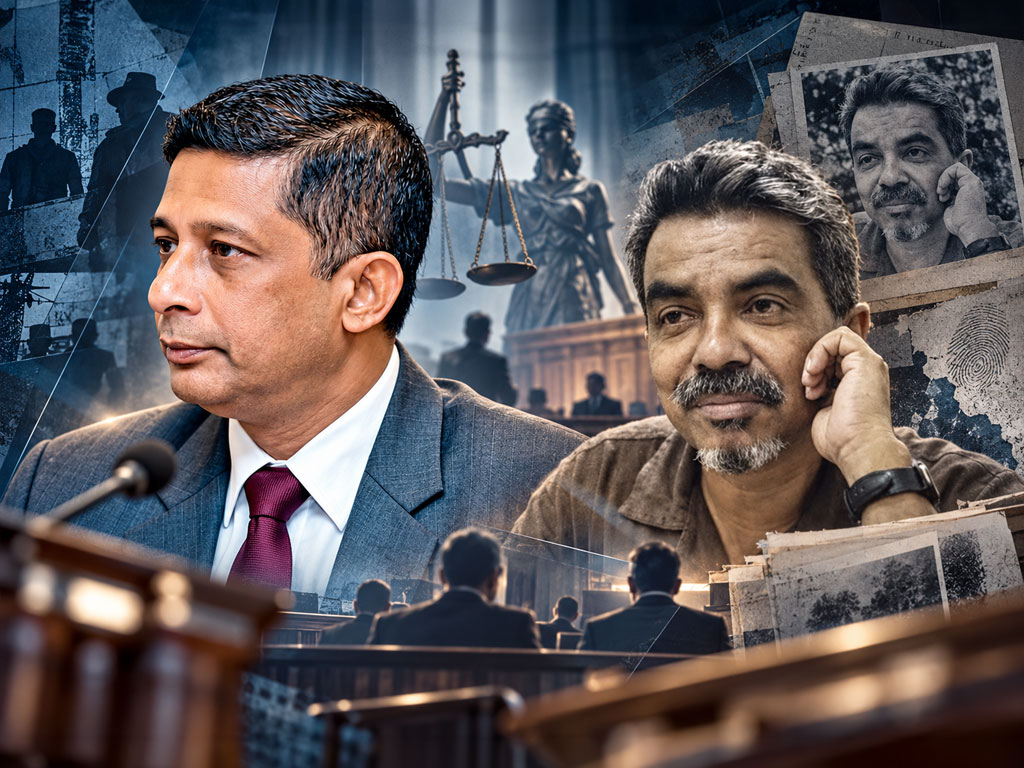
Former State Intelligence Chief Suresh Sallay was brought before a three-judge High Court bench as proceedings continued in the long-running case concerning the abduction and enforced disappearance of journalist Prageeth Eknaligoda.
Read MoreDefence Questions Murali About His Relationship With Eknaligoda
The court subsequently resumed the cross-examination of the fourth prosecution witness, Sumathipala Suresh Kumara, also known as Murali.
Attorney Asith Siriwardena, appearing for one of the accused, questioned the witness about his relationship with Eknaligoda during the period when Murali was associated with the LTTE.
The lawyer asked whether Murali had regarded Eknaligoda as a brother and maintained a close personal association with him.
Murali replied:
“Yes… Your Honour.”
When asked whether he had also shared his experiences from the battlefield with Eknaligoda, the witness again answered in the affirmative.
The defence then examined whether Murali had disclosed the relationship to senior LTTE figures.
He denied having informed LTTE leader Velupillai Prabhakaran about his friendship with Eknaligoda.
However, when asked whether he had told S. P. Tamilselvan and Gnanavel, whom counsel described as the head of the LTTE’s explosives operations, Murali said he had informed both individuals.
The lawyer also questioned him about Pottu Amman, the LTTE’s former intelligence chief, referring to his alleged role in directing suicide bombers.
Murali said he did not know about that particular role.
Asked separately whether he had informed Pottu Amman about his close relationship with Eknaligoda, the witness answered:
“Yes.”
The testimony concerned what Murali said about his own associations and disclosures. It does not independently establish the nature of Eknaligoda’s relationship with the LTTE or whether he was involved in any of its activities.
Witness Questioned About Alleged Missile Remark
Siriwardena then questioned Murali about a meeting at Habarana Watta, near Dambulla, where Eknaligoda allegedly spoke about targeting the country’s head of state.
The defence lawyer referred to a previous statement in which Murali had reportedly described Eknaligoda saying that a missile could be fired to assassinate the President.
Murali acknowledged having made that statement.
Asked whether Mahinda Rajapaksa was the head of state at the relevant time, the witness answered affirmatively.
Counsel then sought to establish when Murali had informed Pottu Amman about his relationship with Eknaligoda.
Specifically, he asked whether the disclosure occurred before or after the alleged conversation concerning the President.
Murali replied that he had informed Pottu Amman before that conversation.
The questioning revisited allegations previously raised in the trial about a meeting involving Eknaligoda and individuals formerly associated with the LTTE.
However, the witness’s acknowledgement that such a remark was made does not establish that any operational assassination plan existed, that weapons were available or that steps were taken to carry out an attack.
Prosecution Seeks Clarification of the Conversation
Following the defence’s cross-examination, Deputy Solicitor General Perera questioned Murali again about the circumstances in which the alleged remark had been made.
The prosecutor referred to earlier testimony in which the witness had reportedly indicated that the statement concerning the President’s aircraft had been given as an example.
Perera asked Murali to explain the apparent difference between that earlier account and his latest answers during cross-examination.
Responding, Murali described a discussion involving himself, a person he identified as Mr. Nadan and Eknaligoda at Habarana Watta.
According to the witness, the conversation concerned the end of the civil war and the country’s political future.
Murali recalled:
“Myself, Mr Nadan and Mr Eknaligoda were talking in Habarana Watta. Mr Nadan and I said that since the war is now over, one can live freely. Then Eknaligoda said that although the war is over, all the problems remain the same. Later Mr Nadan and I said that it cannot be changed. That this administration will last at least another 20 years. Then Eknaligoda said that if one thinks of changing it today, it can be changed today. We asked how. Then he said that the President travels in a flight. If a missile is fired at it, everything will change.”
The explanation placed the disputed remark within a wider conversation about the possibility of political change.
The testimony does not establish whether the statement was intended as a hypothetical example, a serious suggestion or something else. That distinction remains important when assessing its evidentiary significance.
No independent evidence of an actual missile attack plan was identified in the supplied account of Friday’s proceedings.
Eknaligoda Disappearance Trial to Continue on October 22
The Attorney General’s case concerns allegations that military intelligence personnel were involved in Eknaligoda’s abduction and enforced disappearance in January 2010.
The journalist disappeared on January 24, 2010, shortly before the presidential election.
The prosecution has alleged that the accused participated in a conspiracy involving his abduction and secret detention, with events linked to locations including Girithale, Habarana and Kottawa.
Those allegations remain before the court, and the accused are entitled to the presumption of innocence.
Friday’s hearing focused partly on the administration and records of Army intelligence operations and partly on Murali’s account of Eknaligoda’s contacts and statements before his disappearance.
The latter evidence must be assessed in its full context, including the distinction between an alleged political remark and evidence of participation in a criminal plan.
The principal case remains the alleged abduction and enforced disappearance of a journalist whose whereabouts have remained unknown for more than 16 years.
Further proceedings have been scheduled for October 22, when the three-judge bench is expected to continue examining the evidence.