By Roy Denish
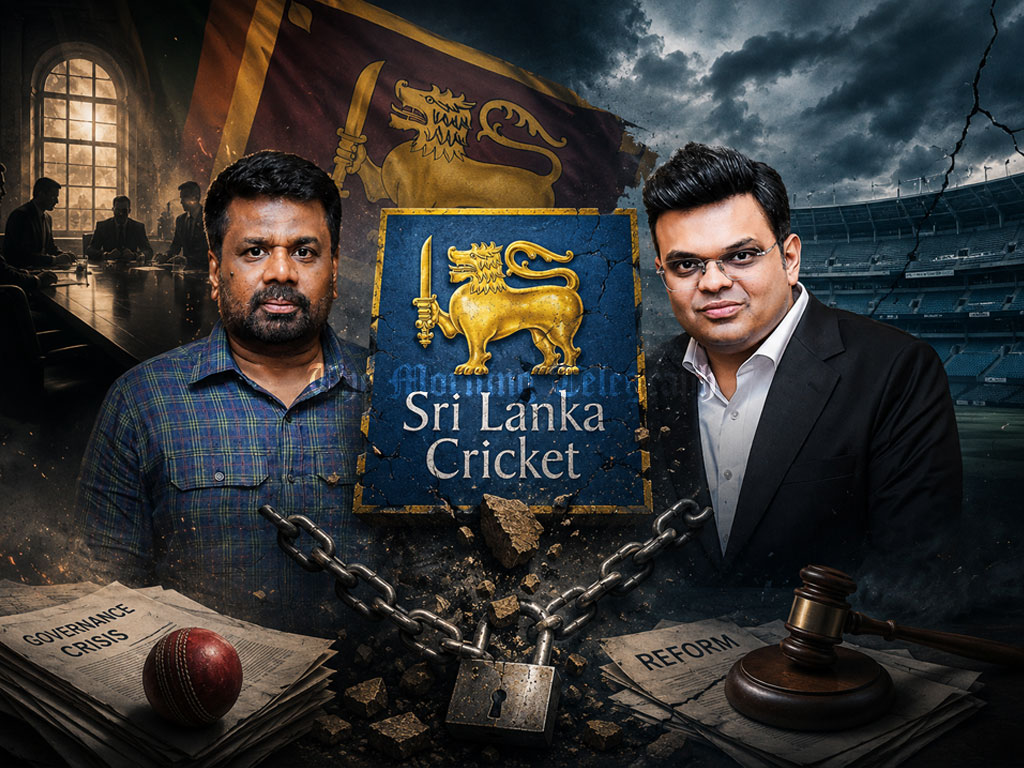
Sri Lanka Cricket’s governance crisis has exposed a decades-old legal contradiction between political control and sporting independence, raising urgent questions about democracy, accountability, and who truly owns the nation’s most beloved game.
Sri Lanka Cricket Faces A Governance Crisis
The ongoing governance crisis within Sri Lanka Cricket is not merely a localized administrative dispute.
It is a profound legal and democratic crisis that exposes the unsustainable friction between aging domestic statutory law, rigid international regulations, and the sovereign rights of the sports-loving public.
Resolving this deadlock requires an aggressive reconciliation of state accountability and institutional autonomy, a feat that the newly appointed Cricket Transformation Committee must achieve to safeguard the future of the nation’s most cherished sport.

Outdated Sports Law At The Heart Of The Crisis
The root of this systemic instability lies in a direct, irreconcilable contradiction between domestic law and global governance.
On one side stands the Sports Law Number 25 of 1973.
Enacted over five decades ago, this legislation grants immense, paternalistic, and unilateral authority to the sitting Minister of Sports.
Under Section 32, the Minister possesses the explicit legal right to dissolve the elected Executive Committee of any national sports association, cancel its registration, and appoint a temporary Interim Committee to manage its affairs.
Furthermore, Section 42 dictates that no national team selection is final or valid unless it has been submitted to and formally approved by the Minister in writing.
ICC Rules Clash With Local Law
While the 1973 legislation treats sporting bodies as statutory entities subject to state regulation to prevent corruption, these provisions run directly counter to the International Cricket Council Constitution.
Article 2.4 of the ICC Constitution explicitly mandates that all member boards must manage their affairs autonomously, strictly prohibiting government interference in the governance, administration, or daily operations of cricket.
Global authorities view ministerial dissolutions, state-appointed interim panels, and political oversight of team selections as direct breaches of this independence.
Consequently, what the local 1973 law authorizes as a valid exercise of state anti-corruption authority is simultaneously classified by global regulators as a punishable violation, routinely placing local cricket at risk of catastrophic international suspension.
Transformation Committee Asked To Break Deadlock
This long-standing legal deadlock triggered the current crisis following the resignation of Shammi Silva and his executive committee.
The Ministry of Sports intervened by establishing an interim council, a move fully legal under the 1973 Act, but one that immediately jeopardized the country’s standing with the ICC.
To navigate this impasse without triggering an international ban, the Ministry appointed the Cricket Transformation Committee.
Led by Eran Wickramaratne and featuring respected cricketing icons Kumar Sangakkara, Roshan Mahanama, and Sidath Wettimuny alongside legal professionals, the committee’s primary mandate is to design and oversee deep structural, constitutional, and administrative reforms.
This includes upgrading domestic tournament frameworks, standardizing administrative support, and creating a transparent pathway back to an elected body.
By doing so, the committee frames the state’s intervention not as a permanent political takeover, but as a temporary, necessary mechanism to cleanse the administration of corruption.
Cricket Must Return To The People
However, structural overhauls are meaningless without absolute transparency and democratic legitimacy.
The Transformation Committee has rightly anchored its reform process in the principle that cricket belongs to the spectators and the nation, rather than any select committee or political body.
By establishing an open window for proposals, they have invited fans, regional associations, former players, and umpires to directly shape the draft of the new sports constitution.
While some passionately advocate for a nationwide referendum to decide the fate of the sport’s governance, the committee is utilizing this extensive public consultation process to mirror that exact democratic standard.
This approach ensures that everyday stakeholders can voice their opinions on crucial changes, such as structural voting reforms to curb vote-buying and rigorous forensic audits, without the immense logistical hurdles and financial costs of a national ballot.
ICC Chairman’s Visit Raises Stakes
The urgency of this dual-track strategy was underscored by the arrival of ICC Chairman Jay Shah in Colombo for high-level talks with political leaders and the Transformation Committee.
During these crucial sessions, committee members presented detailed roadmaps and timelines to prove that these temporary measures and public consultations are a mandatory prerequisite for a clean, independent, and genuine democracy.
Sri Lanka Cricket Cannot Survive As A Political Hostage
The persistent structural chaos paralyzing Sri Lanka Cricket makes one reality undeniably clear: the sport can no longer survive as a hostage to the Sports Law Number 25 of 1973.
For over five decades, this archaic piece of legislation has acted as a legal Trojan horse, granting the state paternalistic, unilateral powers that completely undermine the modern administration of sports.
By codifying the Minister’s right to summarily dissolve elected bodies under Section 32 and demand political veto power over team selections under Section 42, the 1973 law traps local cricket in a perpetual cycle of state interference and international isolation.
It creates an untenable paradox where a valid exercise of domestic anti-corruption authority is automatically classified by the International Cricket Council as a punishable breach of independence.
Cosmetic Fixes Are No Longer Enough
Piecemeal amendments, temporary interim panels, and ad-hoc transformation committees are merely cosmetic bandages on a terminal structural wound.
The country cannot continuously rely on diplomatic damage control or the goodwill of visiting ICC officials to avert catastrophic global bans.
If the government is genuinely committed to transparency, democratic accountability, and the long-term survival of the game, it must move beyond temporary intervention and aggressively dismantle the outdated statutory framework that causes the friction in the first place.
Repeal The 1973 Sports Law
The Sports Law Number 25 of 1973 must be unconditionally repealed.
It must be replaced by a modern, autonomous legislative framework that permanently insulates sports bodies from political overreach while entrenching independent forensic auditing and democratic, fan-inclusive voting structures.
Cricket belongs to the nation and the spectators who sustain it, not to the whims of changing political regimes.
Repealing this obstructive law is no longer just a progressive recommendation.
It is an urgent national necessity to rescue Sri Lankan cricket from the shadow of political manipulation and restore its rightful place on the global stage.