CPC corruption allegations face fresh pressure as anti-bribery oil workers prepare to expose dark deals inside Sri Lanka’s fuel sector.
CPC corruption allegations are set to face a new challenge as an independent workers’ collective prepares to confront political henchmen and corrupt administrators.
The unbearable cost of living now faced by Sri Lankan citizens is not merely the result of an economic crisis.
It is also the direct outcome of massive corruption and waste that have allegedly taken root for decades inside national institutions such as the Ceylon Petroleum Corporation and the Ceylon Electricity Board, operating without proper control or accountability.

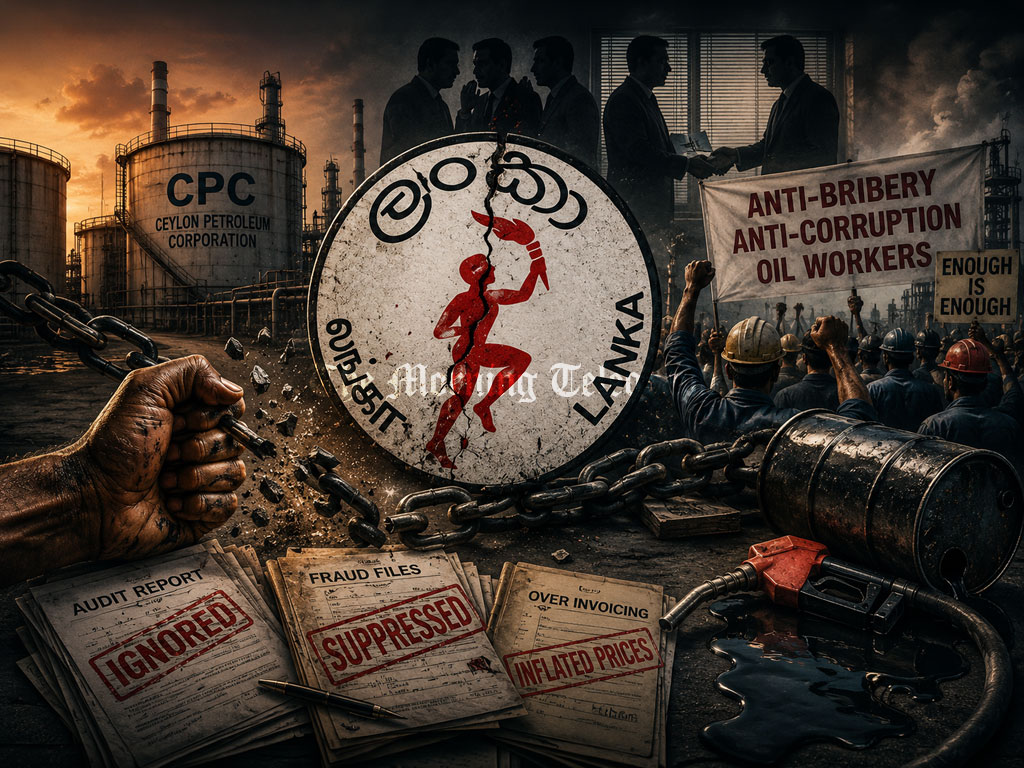
Against what critics describe as institutional terrorism, a new workers’ collective named “Anti-Bribery and Anti-Corruption Oil Workers” is expected to emerge next week, raising what its supporters call a genuine voice free from political agendas.
Many now view this development as a potentially decisive turning point within the country’s deeply corrupt institutional structure.
The majority of trade unions operating within the Ceylon Petroleum Corporation must be condemned with disgust for allegedly becoming puppets and gangs serving narrow political parties instead of defending the institution or the public.
None of these unions had the courage to stand up for the correct position when senior officials advanced what critics call ludicrous and fundamentally false claims that 2,000 tons of oil had mysteriously “evaporated.”
Their silence over the massive fraud files and audit reports that have accumulated over time clearly suggests that they too are stakeholders in this corrupt system.
It is also no secret that even the current government does not exclude any unions, including those linked to its own parties, because the authorities are well aware of their duplicitous behaviour and political nakedness.
On the other hand, the conduct of the present administration has also come under heavy criticism.
The Chairman of the Ceylon Petroleum Corporation, appointed under the current government, has so far failed to properly investigate any corruption allegation, including major frauds involving the importation of fuel ships at inflated prices under the guise of emergency purchases.
The direct result of this administrative weakness and failure is that corrupt senior officials accused of looting billions in national wealth have been allowed to retire without punishment.
Worse still, state patronage has allegedly enabled some of them to walk away with massive gratuity payments.
There can be no greater tragedy than the very high offices responsible for enforcing law and discipline becoming protectors of the corrupt.
Against this tragic and corrupt backdrop, the emergence of the “Anti-Bribery and Anti-Corruption Oil Workers” collective cannot be dismissed as just another traditional trade union.
Internal sources within the collective have emphasized that they have no political purpose, bias, or party agenda.
They say their sole objective is to fearlessly present true information and evidence relating to corruption and irregularities within the institution directly to the media and the relevant authorities.
With this new challenge against a bureaucracy that allegedly loots public funds regardless of party colours, and against the political authority that protects it, the public now holds strong hope that many dark deals buried for decades inside the Ceylon Petroleum Corporation will soon be exposed to society.