By Dwayne Ferreira.
A court-approved arrangement involving Israeli remittance provider Monox 019 could give affected workers access to their frozen balances, although the implementation process and payment timetable remain unclear.
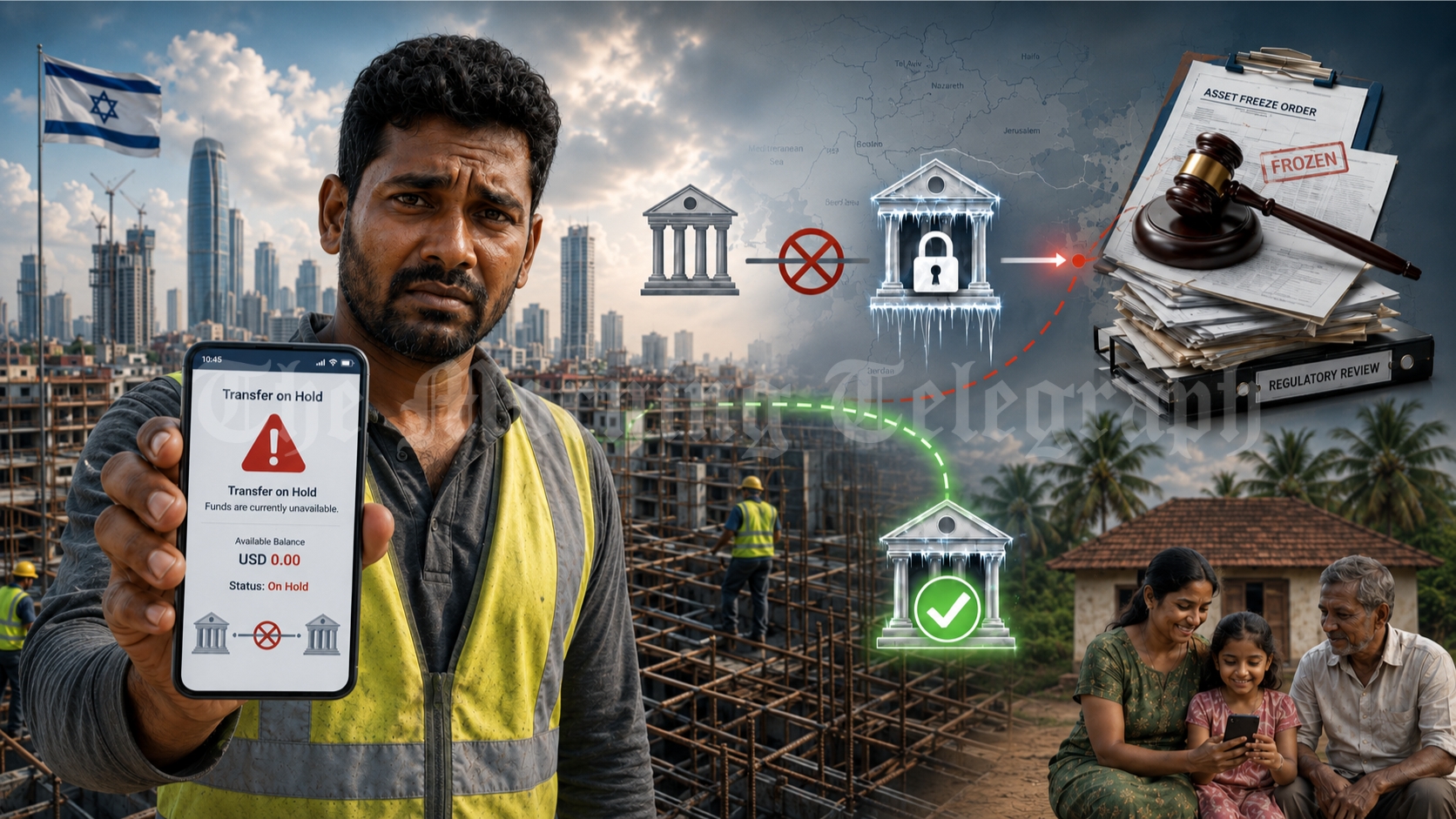
Approximately 5,100 Sri Lankan migrant workers in Israel may have been affected after millions of dollars handled by the money transfer company Global Remit became inaccessible following an Israeli police investigation and the suspension of the company’s financial services licence.
Sri Lanka’s Deputy Minister of Foreign Affairs and Foreign Employment, Arun Hemachandra, told Parliament that approximately US$6.9 million had been suspended as part of legal proceedings involving Global Remit.
However, the precise amount belonging specifically to Sri Lankan workers has not yet been publicly confirmed through a customer-by-customer reconciliation.
The Government has also rejected suggestions that the money disappeared because of a cyberattack. According to the Deputy Minister, the funds were blocked as a result of legal and regulatory action taken by Israeli authorities against the company.
Global Remit, formally registered as Global Remit – Currency Services Ltd, provided international money transfers, digital payment services and salary transfer facilities, primarily to foreign workers employed in Israel.
The company has historically been associated with Israeli businessmen Yariv Fisher and Oren Aley Raz, who founded and developed the business. More recent Israeli company records list Aley Raz and several corporate entities as holding interests in the company.
Police Investigation Triggered Shutdown
The crisis escalated after Israel’s Capital Market Authority suspended Global Remit’s licence in May 2026 following developments in an ongoing police investigation.
The investigation reportedly concerns suspected offences under Israel’s anti-money laundering laws involving the company, its managers or individuals acting on its behalf.
These remain allegations. No final criminal judgment establishing the company’s guilt has been publicly reported.
Following the licence suspension, the Bank of Israel disconnected Global Remit from the country’s national payment system. Banks holding the company’s accounts also froze activity while the status of funds covered by police seizure orders was examined.
The combined action meant Global Remit could no longer complete transfers, accept new transactions or provide customers with access to balances held through its platform.
Global Remit subsequently sought protection through the Israeli courts, claiming that it had been profitable before the seizure of its accounts and had suffered an immediate cash-flow crisis because it was suddenly prevented from operating.
Court filings placed the company’s total liabilities at approximately 35 million new Israeli shekels, equivalent to around US$12.4 million. Approximately NIS 23 million of that amount was said to represent money belonging to customers and other third parties.
The company estimated that it served approximately 10,000 regular customers and another 9,000 occasional customers. Many were foreign workers from Sri Lanka, Nepal, Thailand and the Philippines.
Some affected workers reportedly had the equivalent of several months’ salaries held in Global Remit accounts. While some workers transferred their salaries abroad immediately, others kept money in the application while waiting for more favourable exchange rates.
How Sri Lankan Workers Could Get Their Money Back
A potential recovery route has emerged through a court-approved arrangement involving Monox 019, another Israeli financial services and remittance company.
Under the proposed system, Monox would provide each eligible Global Remit customer with an advance or loan equivalent to the verified amount frozen in the customer’s account.
To receive the money, the customer would be required to sign an assignment-of-rights agreement. This would transfer the customer’s legal claim over the frozen Global Remit balance to Monox.
The worker would then receive access to the replacement funds through Monox and could transfer the money to Sri Lanka.
If Israeli authorities later release the original funds, Monox, rather than the worker, would be entitled to recover the corresponding amount.
A lawyer representing Global Remit said the arrangement was intended to place the risk of recovering the seized money on Monox. Under the proposed arrangement, customers would reportedly not be required to repay the advance from their future salaries if the seized funds were not eventually released.
Monox would also reportedly not charge affected workers a commission for receiving the replacement funds. Instead, the company would receive compensation from Global Remit for customers transferred to its remittance platform.
The arrangement could therefore allow Sri Lankan workers to receive their money without waiting for the wider police investigation and court proceedings to conclude.
However, court approval does not mean that payments will be immediate.
Israeli reporting indicates that the implementation timetable remains unclear. Some foreign workers have reportedly received general messages about the proposed Monox arrangement but have not yet been given complete instructions on how to apply or when funds will become available.
Eligibility will also depend on Global Remit’s records confirming the amount held for each customer.
Workers Must Preserve Evidence
Affected Sri Lankan workers should preserve all available evidence showing their Global Remit balances and transactions.
This may include screenshots from the Global Remit application, salary deposit records, transfer receipts, bank statements, identification documents, employment records and correspondence received from Global Remit or Monox.
Workers should also carefully examine any assignment-of-rights agreement before signing it. Where possible, the terms should be provided in a language the worker understands.
No worker should pay an unofficial intermediary who claims to be able to accelerate the recovery process.
Sri Lankan workers should follow instructions issued through the Embassy of Sri Lanka in Israel, the Ministry of Foreign Affairs, Foreign Employment and Tourism, the Sri Lanka Bureau of Foreign Employment and authorised Israeli representatives handling the court-approved arrangement.
The Sri Lankan Government says discussions are continuing at both diplomatic and banking levels to secure the release of the money.
Alternative remittance channels have also been introduced so that workers can continue sending new salaries to Sri Lanka without using Global Remit.
Money Frozen, Not Confirmed Lost
The most important distinction is that the workers’ money has not been confirmed as stolen or permanently lost.
The funds are understood to be frozen or held under legal restrictions connected to the Israeli investigation. This means recovery remains possible, either through the court-approved Monox arrangement or through the eventual release and distribution of the seized funds.
Nevertheless, significant uncertainty remains over when the Monox process will become fully operational, how individual balances will be verified and whether every affected Sri Lankan worker will qualify.
The case has also raised questions about how customer funds were protected when Global Remit’s accounts were frozen and why thousands of migrant workers lost access to salaries they had already earned despite not being accused of any wrongdoing.
For Sri Lankan families dependent on remittances from Israel, the proposed Monox arrangement represents the clearest recovery path currently available. Until formal applications and payment instructions are issued, however, it remains a potential solution rather than a completed repayment programme.
#GlobalRemit #SriLankanWorkers #IsraelRemittances #MigrantWorkers #FrozenFunds #ForeignEmployment #MoneyTransfer #SriLankaNews