By Roy Denish
A new State-backed media body, undefined “professional misconduct” rules and sweeping powers over journalists and online creators have triggered fears that censorship is being repackaged as reform.
New Media Professionals Bill Gazetted
Sri Lanka’s legislative landscape surrounding digital civic space and media freedom has undergone significant changes.
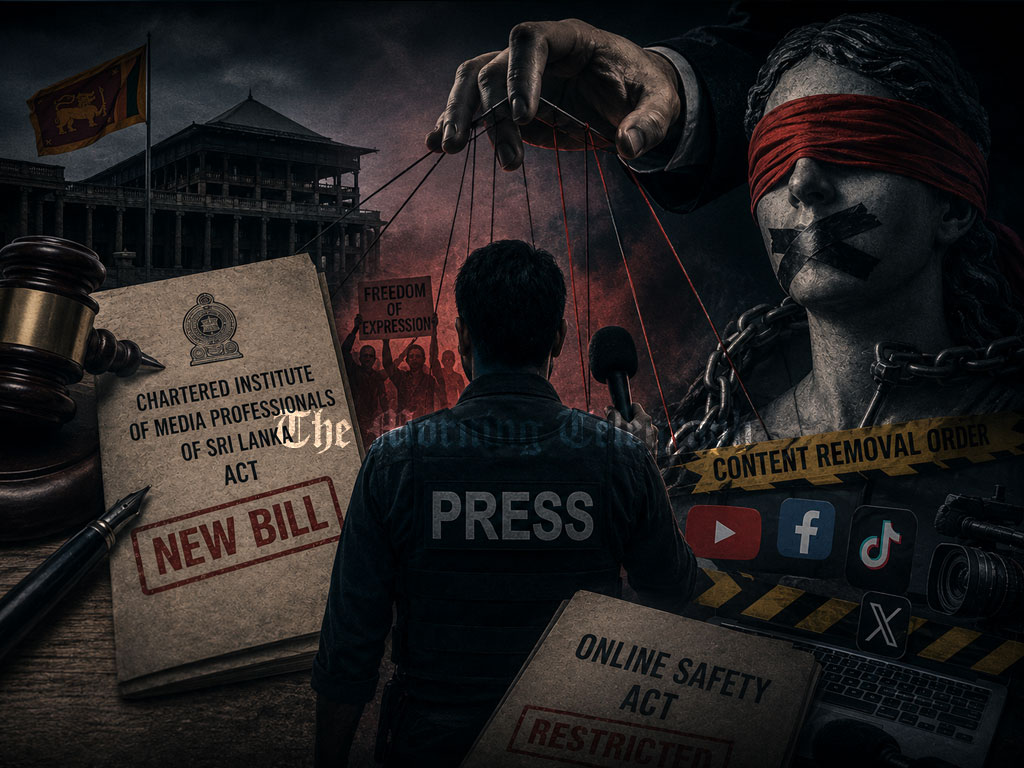
The latest development was the official gazetting of a new bill on June 5, 2026, titled the Chartered Institute of Media Professionals of Sri Lanka Act.
Introduced under the direction of the Ministry of Mass Media, the proposed legislation seeks to establish a corporate body responsible for formalising the professional rights and responsibilities of journalists.
The proposed institute would also maintain professional discipline through a specific code of ethics while regulating training and skills development within the media sector.

Authorities Say Bill Will Improve Journalism
The Government has presented the legislation as an initiative intended to improve the quality of journalism and establish clear professional standards.
However, the bill has triggered swift and unified opposition from independent media organisations, legal experts and civil society groups.
Critics view the proposal as a thinly disguised mechanism for State-mandated censorship and indirect regulation of the media.
Minister Given Power to Appoint Interim Council
The primary point of contention is the structure of the proposed institute’s leadership during its foundational period.
Under Clause 5 of the draft bill, the subject Minister is granted unilateral authority to appoint an Interim Council.
The proposed Interim Council would consist of the Ministry secretary and six members nominated by the Minister.
Political Appointments Raise Independence Concerns
The politically appointed Interim Council would be responsible for formulating the criteria governing the election of the institute’s permanent council.
Critics argue that this arrangement compromises the structural independence of the institution from its inception.
They say it would effectively allow the executive branch to influence the leadership, membership requirements and policy direction of the proposed media body.
‘Professional Misconduct’ Left Undefined
The bill also introduces wide-ranging disciplinary mechanisms without establishing clear legal boundaries.
Clauses 12 and 23 provide for the creation of a Disciplinary Committee empowered to investigate and penalise acts of “professional misconduct.”
However, the draft does not clearly define what constitutes professional misconduct.
Instead, the authority to determine whether an act amounts to misconduct would be placed in the hands of the institute’s council.
Journalists Fear Rules Could Target Critical Reporting
In a media environment already strained by subjective interpretations of speech, journalists fear the vague terminology could be used against critical reporting and investigative journalism.
They warn that legitimate journalism could be penalised under the stated objective of enforcing professional ethics.
The absence of clear definitions also raises concerns that disciplinary standards could change according to the preferences of the council or the political administration of the day.
Digital Content Creators Included Under Bill
The proposed legislation is not restricted to journalists working in traditional newsrooms.
The draft defines a “media professional” broadly enough to include journalists, editors, publishers and independent digital content creators.
This could bring people producing content on public platforms such as YouTube, Facebook and TikTok within the jurisdiction of the proposed institute.
Independent Digital Space Faces New Layer of Regulation
By bringing independent online creators into a statutory framework initially overseen by a politically appointed body, the legislation could create an additional layer of State pressure on digital expression.
Critics argue that online creators who operate independently of established news institutions could be particularly vulnerable.
Many do not possess the legal resources, institutional protection or financial support available to larger media organisations.
Bill Follows Controversial Online Safety Act
The proposed media institute forms part of a broader regulatory framework that has directly affected Sri Lanka’s digital civic space over the past two years.
This environment has been dominated by the enforcement and continuing adjustment of the Online Safety Act, which was enacted in early 2024.
The Act established a powerful Online Safety Commission appointed by the executive.
Commission Holds Broad Content Removal Powers
The Online Safety Commission was granted broad authority to declare certain online communications prohibited statements.
It may also order the removal of content within short periods and issue directions to internet service providers.
The Government stated that the legislation was intended to address online harassment, fraud and other harmful activity.
However, human rights organisations and legal institutions, including the Human Rights Commission of Sri Lanka, have repeatedly raised concerns about its broad definitions of false or harmful speech.
Concerns Over Chilling Effect on Expression
Critics argue that criminalising vaguely or subjectively defined forms of expression could produce a severe chilling effect on digital speech.
Independent journalists, activists and content creators may avoid publishing legitimate criticism because of uncertainty about how authorities could interpret their work.
The fear of legal proceedings, official inquiries or rapid content-removal orders can encourage self-censorship even when the content is lawful and in the public interest.
Independent Media Faces Growing Pressure
The combined effect of the proposed media institute and existing online safety legislation creates a challenging environment for independent journalism and digital advocacy.
Journalists and online creators must navigate unclear boundaries surrounding what authorities may consider disruptive, misleading, unethical or harmful.
The absence of precise definitions makes it difficult to predict whether investigative reporting, political criticism or public-interest commentary could trigger disciplinary or legal action.
Debate Intensifies Over Who Defines Media Ethics
The move to establish a statutory professional media body has intensified the debate over who should determine the ethical limits of journalism and digital commentary.
Supporters of independent regulation argue that professional standards should be developed and enforced by journalists and media organisations without political interference.
Critics fear that placing such authority within a structure created by legislation and initially controlled by ministerial appointees could weaken the independence required for genuine media accountability.
Free Expression Remains at Centre of Dispute
As Sri Lanka continues navigating difficult economic and governance transitions, the balance between protecting the public from genuine online harm and preserving freedom of expression remains deeply contested.
The Government maintains that regulation is necessary to promote responsibility, professional standards and public safety.
Independent media groups and civil society organisations argue that vague laws, politically influenced appointments and extensive disciplinary powers could instead undermine constitutional freedoms.
The proposed Chartered Institute of Media Professionals has therefore become the latest point of friction between State regulators and the wider civic community over the future of media freedom and digital expression in Sri Lanka.