By Roy Denish.
Grave hunters in Bakamuna are accused of smashing tombstones, opening fresh graves and performing occult rituals that terrified villagers.
Grave hunters have turned a public cemetery in Bakamuna, Polonnaruwa, into the centre of a disturbing criminal investigation after tombstones were allegedly destroyed, fresh graves opened, and ritual objects found inside the burial ground.
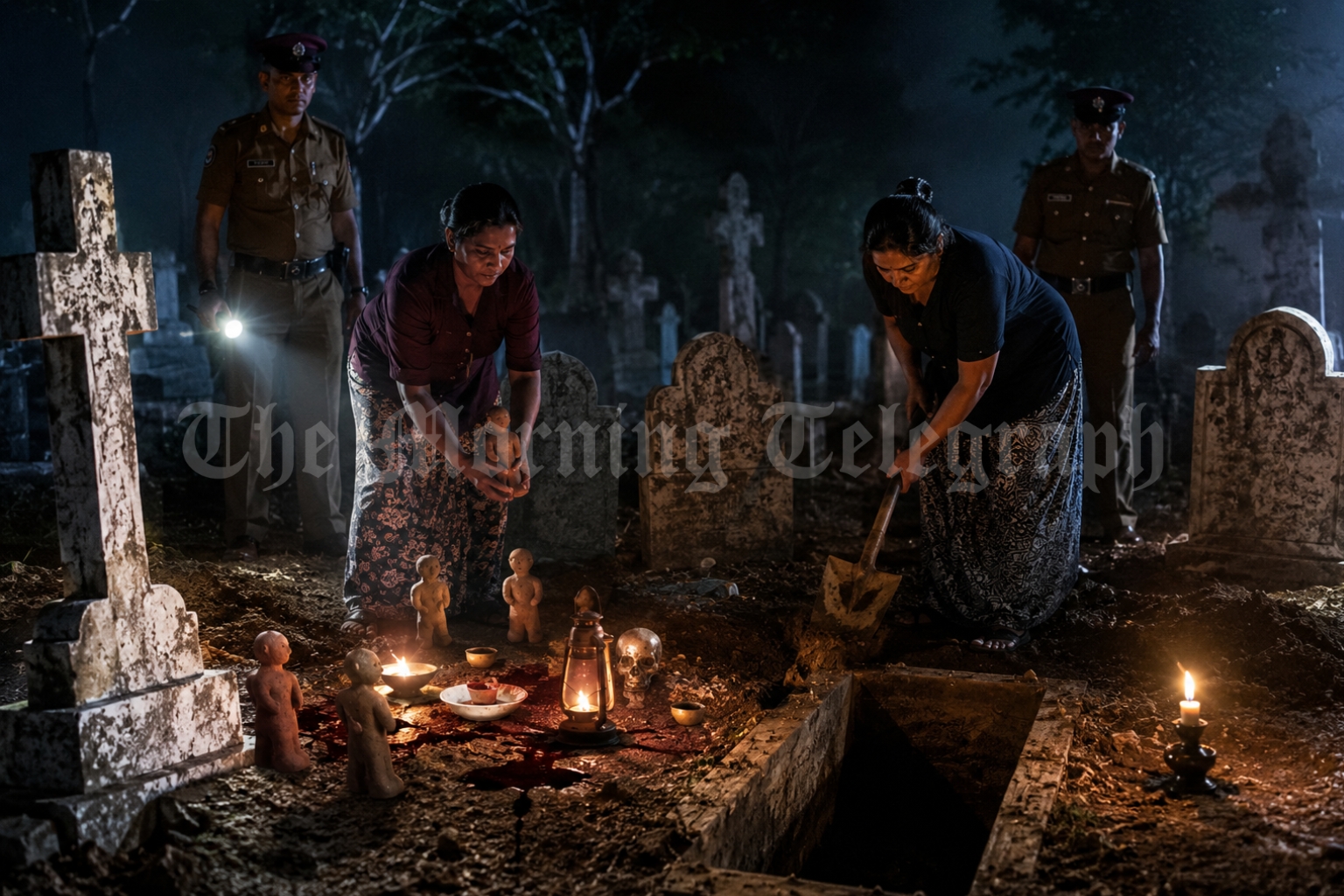
The cemetery, located in the Bakamuna area of the Polonnaruwa district, recently became the scene of a series of macabre night-time activities that have left villagers frightened, angry, and deeply unsettled. What should have remained a quiet place of mourning instead became, according to local accounts, a stage for acts linked to dark paranormal practices and grave desecration.
Under the cover of midnight, the suspects allegedly entered the burial grounds not to honour the dead, but to collect and use objects associated with the graveyard. Clay human figurines had reportedly been placed across cold tombstones, while lamps were lit among the graves, casting eerie shadows over the cemetery. Police also found signs of sacrificial rituals. By morning, historic tombstones had been damaged, and several fresh graves had been violently disturbed, leaving behind a scene of broken earth, fear, and public outrage.

Following urgent complaints from residents, police moved into the cemetery and seized several items, including heavy-duty digging tools and ceremonial objects believed to have been used during the late-night activity. In a revelation that shocked the village, the main suspects arrested were not young men, as many had first assumed, but a 49-year-old woman from Hingurakgoda and a 38-year-old woman from Bakamuna. They are being held under the Cemeteries and Burials Ordinance No. 57 of 1946 and now face serious legal action over the alleged defilement of the dead.
Residents in the area believe the incident is not an isolated act of vandalism. They describe a wider pattern of unexplained spiritual violations that has slowly robbed the village of its sense of safety. Locals now fear that both men and women may be involved in these nocturnal practices, reviving the disturbing image of occult figures who once existed only in folklore, whispered stories, and old village warnings.
The horror is not limited to Sri Lanka. It mirrors a wider global pattern driven by fear, superstition, greed, obsession, and the search for forbidden power. In 2025, in the Khandwa region of Madhya Pradesh, India, panic spread after more than ten graves across two cemeteries were found systematically excavated, with human remains partly dragged into the open. Investigators reportedly ruled out animals and suspected human involvement, pointing to grave robbery linked to supernatural motives.
An even more disturbing case emerged in May 2026 in the Hapur area of Uttar Pradesh. A grieving family was violated when a thief allegedly entered a still-smouldering funeral pyre soon after the cremation of a 16-year-old boy and fled with a fragment of the charred skull. After his arrest, the suspect reportedly confessed that an occultist had told him the bone was needed to bind a woman’s affection to him forever. In 2024, in Prayagraj, a 55-year-old grandfather slaughtered and dismembered his own 17-year-old grandson, telling police that a sorcerer had convinced him a blood sacrifice would elevate his other deceased children to a heavenly state.
When criminologists and psychologists examine the extreme mindset required to break open a coffin or violate a grave, they often identify four deeply disturbing motivations behind such crimes.
The first is necrophilia. Categorised under paraphilia within the DSM-5, this severe psychological condition involves a physical attraction to dead bodies. Those driven by such compulsions may wait until the soil settles over newly buried female corpses before digging into graves in silence to commit violations that most people can barely comprehend.
The second motivation is revenge that refuses to end at death. In cases shaped by hatred, political vendettas, ethnic conflict, or long-running personal hostility, grave desecration becomes a way to attack the memory of someone who can no longer defend themselves. This form of post-mortem violence has been documented in war-torn territories, riot-hit communities, and places where buried resentment survives even after the funeral.
The third driver is tomb raiding. Here, the motive is not ritual, but greed. Thieves enter historic crypts, family burial chambers, and fresh graves to steal gold, silver, jewellery, heirlooms, and cultural objects buried with the dead. From the plundering of Egyptian mummies to the looting of Mayan elite tombs, human history is scarred by those willing to strip the dead for wealth.
The fourth and most frightening motivation is necromancy, the claimed practice of manipulating the dead. Rooted in the ancient Greek words “nekros,” meaning dead, and “manteia,” meaning prophecy, necromancy rests on the belief that departed spirits can be summoned, bound, or forced to reveal the future or act as spiritual weapons. To perform such rituals, occult practitioners often seek physical conduits such as human skulls, severed finger bones, grave clay, and the final clothing worn by the deceased.
This demand for anatomical and burial-related ingredients remains an active fear in many parts of the world. It appears in the extreme corners of Haitian Voodoo, in targeted “Muti” murders across parts of Africa, and in the shadow rituals of “Palo Mayombe” in Latin America. Sri Lanka’s own police history contains rare but unnerving records of individuals entering overgrown graveyards to break ceremonial pottery or bury curses. Under Section 291 of the Penal Code, intentionally causing terror or criminal disruption at a funeral or religious service can carry a one-year prison sentence. Section 292 also outlaws criminal trespass on land reserved for the dead. Unless backed by a lawful forensic or archaeological permit, entering a cemetery with a shovel can place a person inside a serious criminal offence.
The history of this obsession stretches from Asia to Europe. In 1930, Finland was shaken by one of its most infamous criminal horrors after severed human hands, feet, and a head were found submerged in a natural spring at Tattarisuo, near Helsinki. Investigators uncovered a local black magic ring accused of harvesting bodies from the Malmi Cemetery for ritual use. Decades later, in 2012, two Russian Satanists used “Walpurgis Night” as cover to murder a man sleeping in a cemetery. It later emerged that the pair had decapitated another victim in 2010, buried his torso inside a large anthill, and dug him up two years later to use his remains in a complex ritual.
While laws such as Sri Lanka’s Private and Public Cemeteries Ordinance are designed to protect burial grounds through strict penalties, the boundary remains fragile. Driven by psychological delusion, desperate love, vengeance, greed, or the promise of dark power, some continue to believe the graveyard is a doorway where the line between the living and the dead is at its thinnest.
The Bakamuna cemetery case is therefore not merely a strange village mystery. It reflects a darker global undercurrent of antisocial violence linking Sri Lanka to disturbing histories in India, Russia, and Finland. Such acts are direct attacks on community safety, religious respect, and public psychological well-being. If police, local authorities, and community leaders are to restore peace, they must enforce strict vigilance over burial grounds and make it clear that some lines must never be crossed.
#SriLanka #Polonnaruwa #Bakamuna #GraveHunters #CemeteryDesecration #OccultCrime #CrimeNews #SriLankaNews #PoliceInvestigation #CemeteryCrime #BreakingNews #TrueCrime #ReligiousRespect #CommunitySafety #TheMorningTelegraph