By Roy Denish
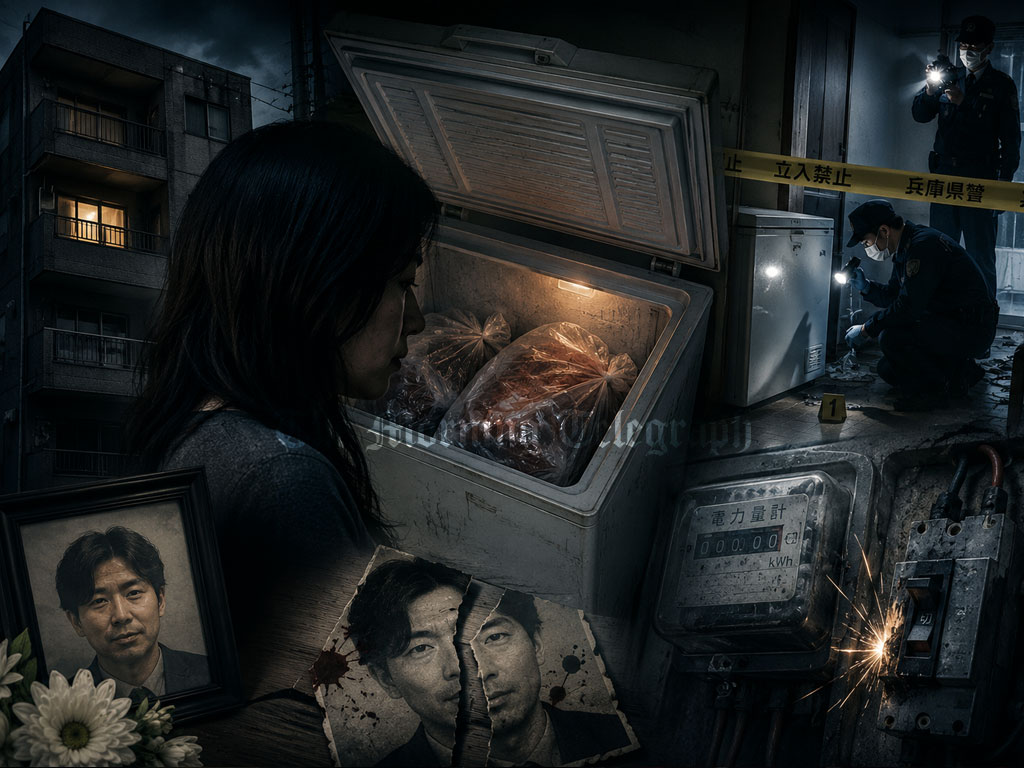
A body cut in half, hidden in a freezer for nearly 15 years, was finally exposed when the electricity was cut and a foul smell led police to the apartment.
Fifteen-Year Secret Hidden Inside Kobe Apartment
For nearly fifteen years, a horrific secret remained locked inside a dark, third-floor apartment in Kobe’s bustling Chuo Ward.
While the world outside passed through a new imperial era, a global pandemic and major economic changes, the severed remains of 42-year-old Yutaka Nishiguchi allegedly remained hidden inside a household chest freezer.
The gruesome discovery has exposed a chilling story of domestic isolation, prolonged deception and a sudden electricity cutoff that finally brought the hidden death to light.

Former Wife Arrested After Gruesome Discovery
On June 22, 2026, Hyogo Prefectural Police arrested 50-year-old Aki Mochizuki on suspicion of abandoning and mutilating the body of Nishiguchi, her former husband.
An 80-member specialised task force is now working to build a formal murder case against her.
Body Allegedly Cut in Half and Frozen
In December 2011, Yutaka Nishiguchi died inside the Kobe apartment he shared with Mochizuki.
Following his death, his body was reportedly cleanly divided at the navel.
The upper and lower sections of his body were wrapped tightly in separate plastic bags and packed into a large chest freezer near the entrance of the apartment.
Divorce Filed One Year After Estimated Death
Rather than fleeing, Mochizuki allegedly began a calculated, multi-layered campaign of deception.
Official records show that she filed for and completed a divorce from Nishiguchi in December 2012, approximately one year after his estimated death.
This created an official paper trail suggesting that Nishiguchi had remained alive and had simply separated from her, potentially preventing relatives from filing a missing-person report.
Empty Apartment Kept Powered for Fourteen Years
Mochizuki later moved into another apartment approximately ten minutes away by car.
She reportedly began living with another man and continued working in Kobe’s Sannomiya nightlife district.
To keep the remains concealed, she allegedly continued paying approximately ¥100,000, or around US$625, each month in rent and utility costs for the empty Chuo Ward apartment.
The payments reportedly continued for fourteen years, ensuring that the freezer remained operational.
Electricity Cutoff Exposes Hidden Remains
The system finally collapsed after Mochizuki stopped paying the apartment’s electricity bills in 2025.
The resulting power cutoff caused the contents of the sealed freezer to thaw rapidly inside the unventilated apartment.
On June 20, 2026, a neighbour noticed a powerful and unmistakable odour coming from Unit 303.
The neighbour alerted the building management, which then contacted police.
When officers entered the locked apartment, they traced the smell to the unplugged chest freezer.
Suspect Surrenders to Police
Following the discovery, Mochizuki initially avoided law enforcement.
She voluntarily surrendered to police on June 22.
Mochizuki reportedly admitted to abandoning and mutilating the body, stating that she had done something terrible and had no excuse.
She also allegedly made statements suggesting to investigators that she had killed Nishiguchi.
Prosecutors Face Statute of Limitations Challenge
The legal strategy being considered by Japanese prosecutors centres on treating the alleged concealment as a continuing offence.
Under Japanese law, the statute of limitations for abandoning a corpse is generally three years.
Because the body was allegedly dismembered and concealed in 2011, a conventional defence could argue that the period for prosecuting the offence had already expired.
Continuing Crime Argument Could Extend Liability
Prosecutors are reportedly seeking to overcome that problem by arguing that Mochizuki was legally married to Nishiguchi at the time of his death and therefore had a civil obligation to arrange a proper burial.
Because the remains were continuously kept inside the freezer, authorities may classify the concealment as an active and ongoing offence that continued until the body was discovered in June 2026.
Japan abolished the statute of limitations for murder in 2010.
Prosecutors could therefore use the corpse-abandonment allegation to keep Mochizuki in custody while investigators build a homicide case, which could carry a maximum penalty of life imprisonment or death.
Frozen Body Preserved Forensic Evidence
Forensic investigators are using specialised pathology techniques to reconstruct a crime scene that is nearly fifteen years old.
The body was reportedly divided at the navel and frozen shortly after death.
Because it remained frozen for approximately thirteen years, decomposition was largely halted, potentially preserving deep tissue structures.
Medical examiners are expected to examine those tissues for signs of trauma, toxins or other evidence that could help determine how Nishiguchi died.
Thaw Released Odour That Alerted Neighbours
The electricity cutoff caused the long-frozen tissue to thaw rapidly.
This process reportedly released volatile organic compounds that produced the smell noticed by neighbours.
During the search of the apartment, forensic officers also allegedly discovered traces of blood inside the rooms.
Investigators believe this could indicate that the dismemberment, and possibly the killing itself, occurred inside the apartment rather than at another location.
Culture of Privacy May Have Helped Conceal Crime
The case has also drawn attention to social conditions within densely populated Japanese cities.
Many urban apartment complexes operate within a strong culture of privacy and non-interference, where neighbours rarely question each other’s movements or personal affairs.
That culture may have allowed an apartment to remain empty but fully powered for fourteen years without neighbours, landlords or utility workers raising serious questions.
Neighbours Describe Suspect as Gentle
Neighbours at Mochizuki’s more recent residence reportedly expressed shock after learning of her arrest.
Some described her to local media as gentle and attractive.
The contrast reflects a recurring feature of Japanese criminal cases in which intense pressure to preserve a respectable public appearance can conceal severe domestic dysfunction.
This social distinction between public appearance and private reality is often associated with the Japanese concept of tatemae.
Murder Investigation Continues
Mochizuki remains in police custody while forensic teams continue examining the apartment and reviewing physical evidence.
Investigators are working to determine the exact cause of Nishiguchi’s death, when the alleged dismemberment occurred and whether the evidence is sufficient to support a formal murder charge.