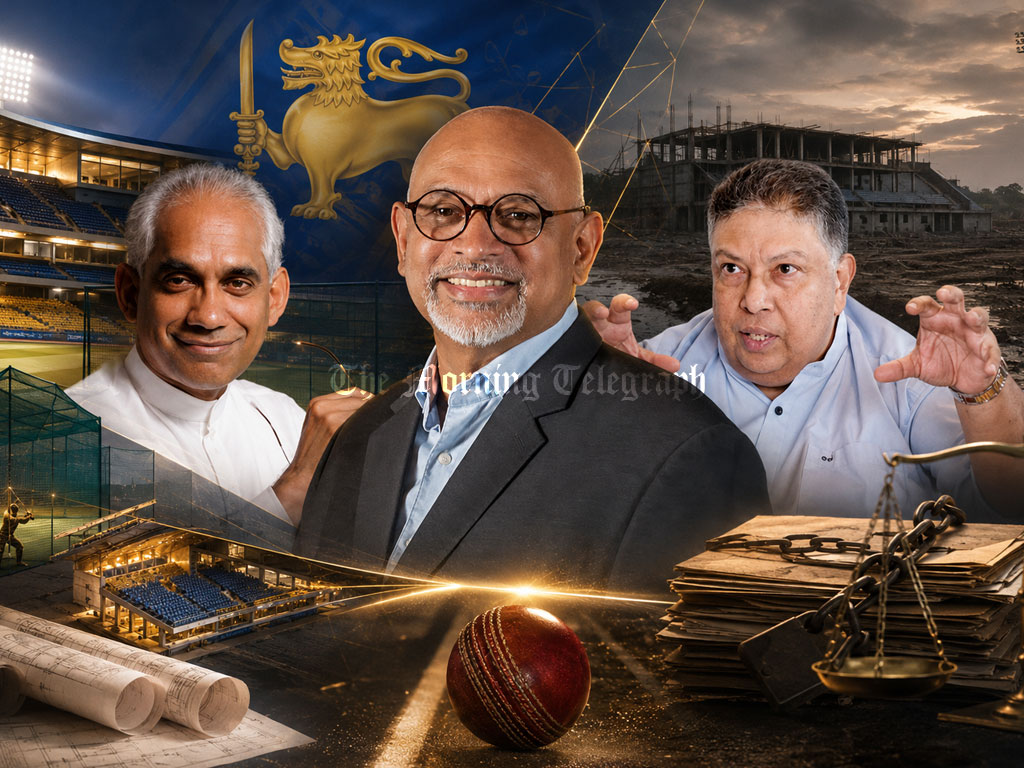
A committee appointed to reform Sri Lanka Cricket now faces uncomfortable questions after a Tamil Union notice revealed plans for SLC-backed development at P. Sara Oval, even as wider national projects and cricketing failures demand urgent attention.
Transformation Committee Faces Its First Real Test
The cricket transformation committee appointed by Minister of Sports Sunil Kumara Gamage arrived with the public image of reformers entering a damaged institution to restore order, discipline and accountability.
It was presented as a body that would correct the sins of a cricket administration long accused of mismanagement, questionable spending and internal politics.
The committee spoke the language of systems, governance and structural change.
Its approach appeared heavily inspired by cricketing models in countries such as Australia, South Africa and Ireland, where centralised structures and controlled decision-making operate within more developed sporting environments.
However, Sri Lanka is not Australia, South Africa or Ireland.
It is a developing cricket nation with different economic realities, different regional needs, different democratic expectations and a deeply complicated club structure.
What works in a wealthy, well-resourced sporting system cannot be blindly imported into Sri Lanka without understanding the fragile ecosystem that keeps local cricket alive.

Reform Vehicle Showing Early Cracks
The early promise of transformation is now beginning to face serious scrutiny.
Instead of producing visible clarity, the reform vehicle appears to be wobbling.
The public is beginning to see that some of the wheels may already be coming loose.
The deeper concern is that the committee which arrived claiming to rescue Sri Lanka Cricket from disorder may itself be walking into another version of the same old problem.
Selective priorities, questionable cricketing decisions, regional neglect and possible benefits to influential club interests are now raising uncomfortable questions.
Test Defeat Exposes Cricketing Confusion
Sri Lanka’s recent innings defeat in the first Test exposed serious concerns about selection, preparation and player management.
The manner of the loss left spectators wondering whether the two teams had batted on entirely different surfaces.
Sri Lanka appeared tactically uncertain and physically underprepared.
One of the most damaging examples was the selection of fast bowler Lahiru Kumara, who managed to bowl only one over before clutching his thigh and leaving the field.
He did not bowl another delivery in the match.
That immediately raised a basic question.
How was an unfit fast bowler selected for a Test match of national importance?
Selection Calls Demand Explanation
The inclusion of Kasun Rajitha also raised questions.
Rajitha had been out of the playing eleven for some time, yet he was brought back while other seamers waiting for opportunities were overlooked.
Sri Lanka cannot build a competitive Test side if selection appears reactive, unclear or disconnected from current form and fitness.
The situation with Kamindu Mendis created another debate.
Historically, Kamindu has produced his best cricket while batting lower down the order.
Yet he was pushed up the order, where he failed badly, making a first-ball duck in one innings and only nine runs from 34 deliveries in another.
Rather than strengthening the batting, the move appeared to expose a player outside his most productive role.
Women’s Cricket Also Under Pressure
The men’s defeat is not the only concern.
Sri Lanka’s women’s cricket team was also knocked out of the ICC Women’s T20 World Cup, leaving captain Chamari Athapaththu to publicly shoulder the emotional weight of failure.
Chamari has carried Sri Lankan women’s cricket for years.
Yet the repeated dependence on one senior figure points to a larger system failure.
A proper transformation committee cannot focus only on boardrooms, constitutions and imported governance theories.
It must also answer why national teams continue to stumble, why player pathways remain inconsistent and why both men’s and women’s cricket appear to lack the depth, planning and support structures needed to compete consistently.
Jaffna Project Left in Limbo
The most glaring concern, however, is not limited to match results.
It concerns cricket development in the North.
The Tamil community in Jaffna has long been deprived of a major cricket stadium and broader sports infrastructure project that could have transformed the region.
Such a project would not merely have developed cricket.
It could have supported tourism, created employment, generated indirect revenue and given young northern cricketers a serious pathway into the national game.
For decades, cricket development has remained heavily concentrated in Colombo and selected urban centres.
A major stadium and real estate-linked sports project in Jaffna could have changed that imbalance.
“No Funds” Claim Raises Questions
The interim cricket transformation committee reportedly maintained that there were insufficient funds to proceed with such an ambitious northern development project.
That explanation has not convinced everyone.
It was previously understood that the former Sri Lanka Cricket Executive Committee had lined up multiple investors to support the broader project.
If that is accurate, then the obvious question is why the project was stalled, slowed or deprioritised.
Was the problem really a lack of funds?
Or was there a lack of will to continue a project associated with the previous administration?
The people of the North deserve a direct answer.
Regional Development Cannot Be Sacrificed
A serious cricket transformation plan must not ignore Jaffna.
Northern cricket cannot be treated as an optional public relations project.
If Sri Lanka Cricket has the ability to support major ground development elsewhere, then it must explain why a transformative project in the North appears to have been pushed aside.
A stadium in Jaffna would have carried sporting, economic and symbolic value.
It would have shown that cricket belongs to the whole island, not merely to Colombo-based institutions and historically powerful clubs.
Tamil Union Letter Changes the Conversation
The debate has now taken a significant turn following a notice circulated by Tamil Union Cricket and Athletic Club to its members.
The notice calls for a Special General Meeting on July 17, 2026, at 7.15 p.m. at the club’s registered premises.
The purpose of the meeting is to consider and approve an agreement between Tamil Union and Sri Lanka Cricket concerning the P. Sara Oval Stadium, also known as the Tamil Union Ground, at Wanathamulla, Welikade, Colombo.
The letter reveals that Tamil Union is seeking member approval for a major agreement giving Sri Lanka Cricket rights to hold, use, develop, manage, operate and maintain the P. Sara Oval.
This is not a minor maintenance arrangement.
It appears to be a long-term ground development and operational agreement carrying significant benefits for the club.
Ten-Year Term With Possible 20-Year Renewal
According to the notice, the proposed agreement contains a primary term of 10 years.
It also includes a possible renewal term of 20 years, subject to Tamil Union obtaining a renewal of the State lease from the relevant authorities.
This means the arrangement could potentially shape the future of P. Sara Oval for up to three decades.
Such a long-term arrangement deserves careful scrutiny, especially when individuals connected to influential cricket clubs are also involved in decision-making spaces within Sri Lanka Cricket.
The question is not whether Tamil Union deserves development.
The question is whether SLC’s development priorities are being applied fairly, transparently and nationally.
What Tamil Union Is Seeking From SLC
The notice clearly sets out the development works expected from Sri Lanka Cricket.
These include the installation of floodlights at the Tamil Union Ground.
They also include the renovation and construction of indoor nets.
The agreement further refers to the expansion of spectator seating capacity, with a minimum guaranteed capacity ranging from 7,500 to 15,000 seats.
In addition, SLC is expected to carry out associated infrastructure development connected to the venue.
In practical terms, Tamil Union is seeking a major upgrade of one of Colombo’s most historic cricket grounds using Sri Lanka Cricket’s involvement and resources.
Floodlights Would Transform P. Sara Oval
The installation of floodlights would be a major advantage.
Floodlights would allow the venue to host day-night cricket, evening matches, televised events and potentially more commercially attractive fixtures.
This would increase the ground’s value and relevance.
It would also strengthen Tamil Union’s position within the domestic and national cricket landscape.
Such an upgrade is not merely cosmetic.
It can reshape the commercial utility of a venue.
If SLC is prepared to support floodlights for P. Sara Oval, it must explain how this fits within the broader national infrastructure plan.
Seating Expansion Adds Commercial Value
The proposed seating expansion is also significant.
A guaranteed spectator capacity of 7,500 to 15,000 seats would turn the venue into a far more capable match-hosting facility.
This would allow larger crowds, more ticketing potential and greater event-day revenue opportunities.
Combined with floodlights and improved indoor facilities, the project could substantially increase the long-term value of the Tamil Union Ground.
Again, the issue is not whether the ground should be improved.
The issue is whether this development is being prioritised while more regionally transformative projects, such as a Jaffna stadium and project in general, are being sidelined.
Heritage Protections Included
The notice also states that SLC must retain and maintain name boards, honour boards and photographs of past presidents and national cricketers who represented Tamil Union.
These heritage items are to be preserved, maintained and updated periodically by the club.
If the main pavilion is demolished and reconstructed, SLC must either retain those items in their original locations or relocate them to a suitable alternative location with Tamil Union’s written agreement.
This shows that Tamil Union is not merely granting development access.
It is ensuring that its legacy, identity and institutional memory remain protected within the proposed arrangement.
Tamil Union Keeps Key Excluded Premises
The notice further states that Tamil Union will continue to hold and manage several excluded premises.
These include the Janashakthi Sports Complex, the Dr. Ranjan Chanmugam Stand, the M. Sathasivam Stand, the parking area adjacent to the swimming pool and one tennis court.
This means the club is not surrendering all control over its property.
It retains important sections while SLC undertakes major development and operational responsibilities over the stadium area.
That creates another important question.
What exact rights does SLC receive in return for funding or undertaking the development works?
Members Asked to Approve Agreement
The resolution asks Tamil Union members to approve and authorise the execution of the agreement between the club and SLC.
It also authorises the club’s trustees and office bearers to negotiate and incorporate additions or amendments before final execution.
The listed amendment specifically refers again to the seating capacity of 7,500 to 15,000.
The notice is signed by Anish Parathalingam, General Secretary of Tamil Union Cricket and Athletic Club, by order of the committee.
The document therefore confirms that a formal internal process is underway within Tamil Union to approve a substantial agreement with Sri Lanka Cricket.
Why This Raises a Governance Question
This development raises a direct governance concern.
If officials connected to Tamil Union are occupying influential seats within Sri Lanka Cricket’s management or administrative structure, then any agreement benefiting Tamil Union must be handled with extreme transparency.
There must be clear declarations of interest.
There must be recusal from decision-making where necessary.
There must be independent approval.
There must be disclosure of the commercial terms.
Anything less would create the appearance that the transformation period is being used to secure advantages for a powerful Colombo club before the committee’s term ends.
The Jaffna Contrast Is Impossible to Ignore
The contrast with the stalled northern cricket project is striking.
On one hand, the public is told that funds are insufficient to proceed with a major Jaffna development that could open cricket and tourism opportunities to an underserved region.
On the other hand, a prominent Colombo club is moving toward an agreement under which SLC would help develop floodlights, indoor nets, seating expansion and infrastructure at P. Sara Oval.
That contrast demands explanation.
Why is one project treated as unaffordable while another appears to be moving through internal approval channels?
What criteria are being used?
Who approved the priorities?
Who stands to benefit?
Transformation Must Not Become Selective Development
Sri Lanka Cricket cannot preach transformation while appearing to favour already established institutions.
Transformation must mean broadening the game.
It must mean supporting neglected regions.
It must mean creating opportunities for players outside traditional power bases.
If SLC resources are being used to improve facilities, the public must know whether the decisions are based on national need or institutional influence.
The perception of selective development can be as damaging as wrongdoing itself.
A Committee Cannot Hide Behind Imported Models
The transformation committee must also recognise that Sri Lankan cricket cannot be rebuilt by copying foreign templates without addressing local realities.
Australia, South Africa and Ireland operate within their own sporting, economic and administrative structures.
Sri Lanka’s cricket system is tied to clubs, schools, regional inequalities, political pressures and uneven infrastructure.
Any reform that ignores those realities will fail.
Worse, it may empower a small group of insiders while claiming to modernise the game.
Key Questions That Must Be Answered
Sri Lanka Cricket and the transformation committee must explain whether the P. Sara Oval agreement has been approved by SLC.
They must disclose the estimated cost of installing floodlights, expanding seating, renovating indoor nets and carrying out associated infrastructure work.
They must clarify whether competitive evaluations were carried out before prioritising this project.
They must state whether any office bearer or committee member connected to Tamil Union participated in discussions or decisions relating to the agreement.
They must explain why the Jaffna stadium project appears to have stalled.
They must also confirm whether investors previously identified for the northern project were consulted before it was dismissed or delayed on funding grounds.
Minister Must Demand Clarity
Minister Sunil Kumara Gamage appointed the transformation committee to restore credibility, not to create a new controversy.
He must now demand clear explanations.
The Minister should require a full list of all SLC-backed infrastructure projects under consideration, their estimated costs, beneficiaries and approval status.
He should also ensure that any agreement involving clubs connected to current cricket administrators is reviewed independently.
This is not about blocking Tamil Union’s development.
It is about ensuring that national cricket resources are not distributed in a manner that creates suspicion or undermines public trust.
Players and Regions Must Come First
Sri Lanka’s recent on-field failures show that the country cannot afford administrative distractions.
The men’s Test team has suffered a humiliating defeat.
The women’s team has been knocked out of a global tournament.
Questions remain about selection, fitness and long-term player development.
At such a moment, the cricket establishment should be focused on rebuilding pathways, improving preparation and expanding the game beyond traditional centres.
Instead, the emergence of the Tamil Union letter has shifted attention back to old questions of club privilege and internal influence.
Reform Must Be Seen to Be Fair
Cricket transformation cannot succeed through speeches, imported systems or selective development agreements.
It must be transparent.
It must be regionally fair.
It must be free of conflicts of interest.
It must convince players, clubs, supporters and neglected regions that the national game is being rebuilt for everyone.
Until Sri Lanka Cricket explains the Tamil Union agreement, the stalled Jaffna project and the priorities of the transformation committee, the public will continue to ask whether cricket reform is truly underway, or whether the same old power game is being played under a new name.