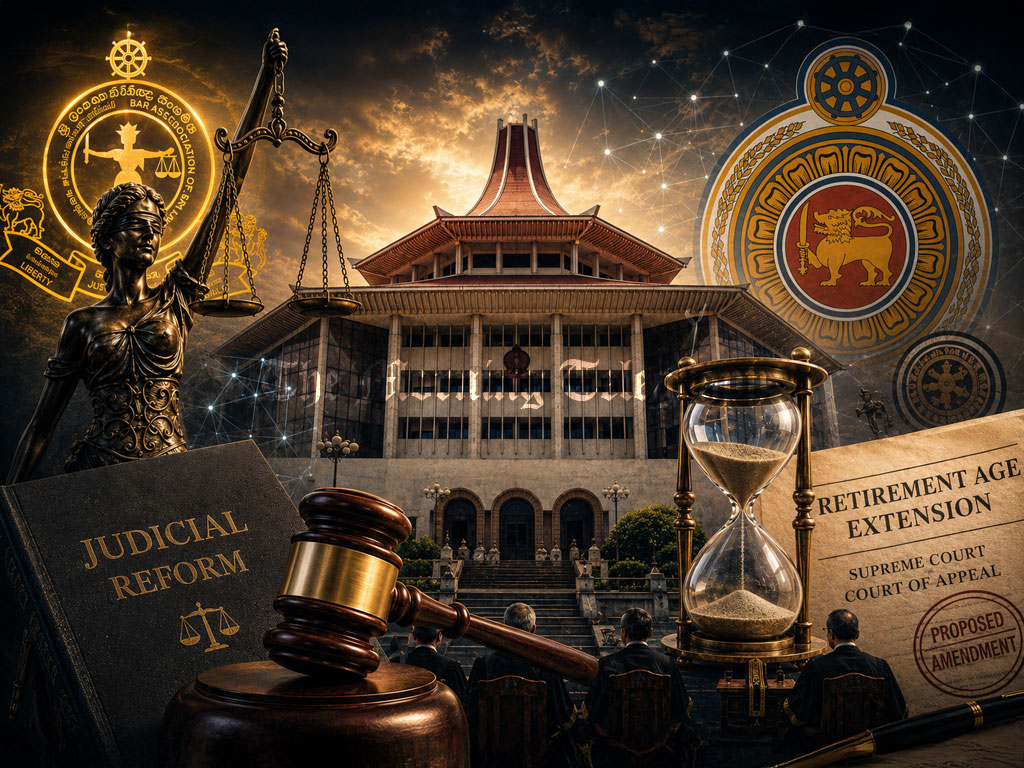
Judge retirement age proposal triggers BASL and international concern as Sri Lanka moves to extend higher court service limits.
Judge retirement age changes for Supreme Court and Court of Appeal judges are moving ahead despite strong objections from legal and political groups.
The government is taking firm steps to implement its decision to raise the retirement age of Supreme Court and Court of Appeal judges by two years, despite protests and warnings from opposition political groups, the Bar Association of Sri Lanka (BASL), and leading international legal organizations.
This sensitive political decision directly affects promotion patterns across the legal system and the independence of the judiciary. It has now become a major topic of domestic and international debate.

New Age Limits Proposed for Higher Courts
If the proposed constitutional or legal amendments are implemented, retirement limits in Sri Lanka’s highest judicial structure will change as follows:
- Supreme Court Judges: Raised from the current retirement age of 65 to 67.
- Court of Appeal Judges: Raised from the current retirement age of 63 to 65.
For comparison, High Court judges currently retire at 61, while District Judges and Magistrates retire at 60.
Three Main Points Behind the Crisis
The political, legal and structural impact of this controversial decision can be examined through three key areas.
1. Government Says It Is Protecting Experience
A senior government spokesperson confirmed to Harideshaya that the main objective is to retain experienced senior judges within the judicial system.
The government argues that when professional judges are about to receive promotions to higher courts, many are already close to retirement. As a result, the system loses valuable intellectual and professional experience. Officials say extending the age limit will allow them to serve the country for another two or three years in higher courts.
2. Critics Warn of Judicial Influence
Critics, however, see the move as a political maneuver that could directly and unduly affect judicial independence.
The Bar Association of Sri Lanka, along with international bodies such as the Commonwealth Lawyers Association and LAWASIA, has officially requested the government to immediately withdraw from the process of raising the retirement age of Supreme Court judges.
They warn that the proposal could lead to unlawful interference in the independence of the benches.
3. New Appointments From Lower Courts
To fill vacancies in the judiciary, the government has proposed a structural “bottom-up system.”
As the first step, it plans to recruit 50 new Magistrates to fill vacancies at the grassroots level in lower courts. Based on that stability, the government then plans to fill vacancies in the higher courts.
Current Vacancies and What Comes Next
While the legal and political process to extend the retirement age continues behind the scenes, filling existing higher court vacancies remains another urgent challenge.
There are currently 4 vacancies in the Supreme Court and 4 vacancies in the Court of Appeal, making a total of 8 vacancies in the higher courts.
Political sources indicate that the government is expected to make a final and decisive decision on filling these existing vacancies within the coming weeks.
How the government proceeds amid international pressure is set to become one of the hottest political and legal issues in the country in the weeks ahead.