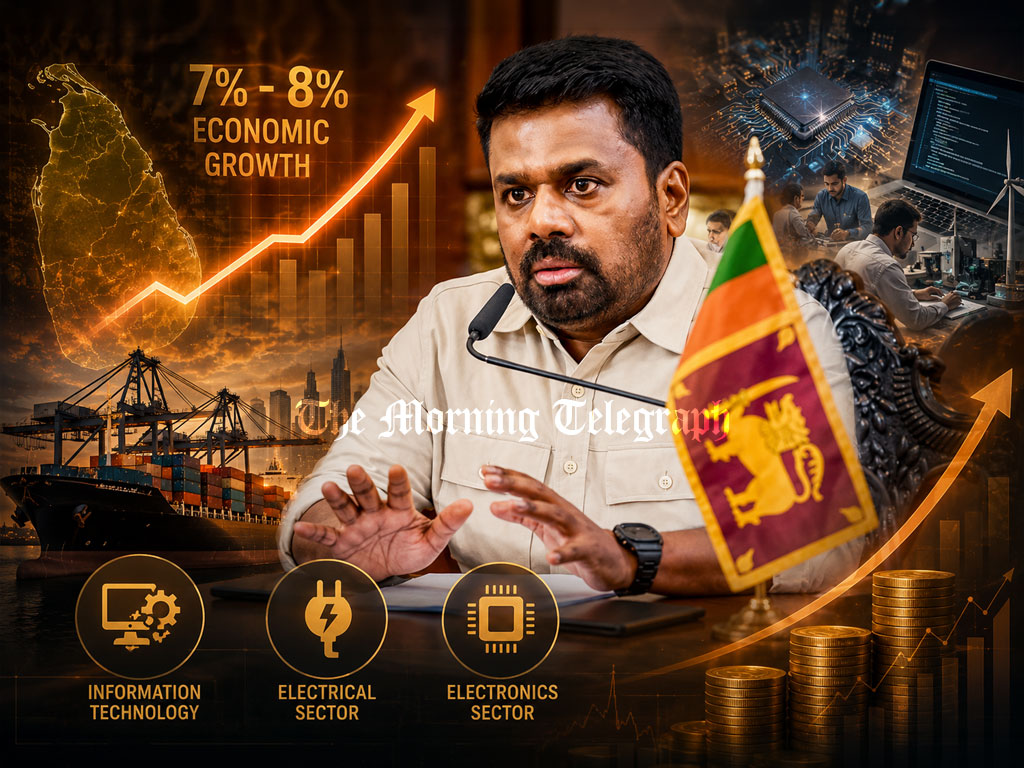
President Anura Kumara Dissanayake says Sri Lanka must lift economic growth to 7%-8% with support from IT, electrical and electronics sectors.
Economic growth in Sri Lanka must be raised from the current 5% level to 7%-8% in the coming years, President Anura Kumara Dissanayake said.
The President said he expects a broad contribution from the information technology, electrical and electronics sectors in achieving that target.

He made these remarks today (01) during a discussion at the Presidential Secretariat with leading association industrialists and investors representing the information technology, electrical and electronics sectors.
The President pointed out that the country’s future can only be secured by strengthening local industrialists.
He invited entrepreneurs to join hands with the government to unlock the country’s true potential and requested them to submit a report as soon as possible outlining their proposals and the current challenges faced by the sector.
President Dissanayake further stated that the government expects to allocate Rs. 2 trillion as capital expenditure next year to accelerate economic growth.
He said the government expects the export sector to contribute as much as possible to meet the dollar demand that will arise from this investment drive.
The meeting also extensively examined the broad contribution that can be obtained from the information technology, electrical and electronics sectors to increase dollar income.
It was revealed that the information technology sector, currently Sri Lanka’s third-largest export income sector, has the potential to earn US$ 5 billion per year in export revenue.
The electrical and electronics sector, which currently earns around US$ 500 million, has the potential to increase its export income to US$ 2 billion.
The discussion also focused on the need to make Sri Lanka a global brand in the information technology, electrical and electronics sectors.
Attention was given to providing facilities and developing infrastructure for Sri Lanka’s high-quality workforce in both sectors.
Industrialists also informed the President about challenges affecting the sector.
These include complexities in importing technical components, obstacles faced by Port City-based companies when dealing with the banking system, and issues in promoting products made by local entrepreneurs within the domestic market.
Attention was also paid to removing these barriers and making necessary amendments to relevant laws and regulations.
The meeting further discussed establishing a special unit representing relevant parties to directly receive industrialists’ issues and proposals and provide swift solutions.
Industrialists were also briefed on programmes already planned by the government to expand facilities in these sectors.