
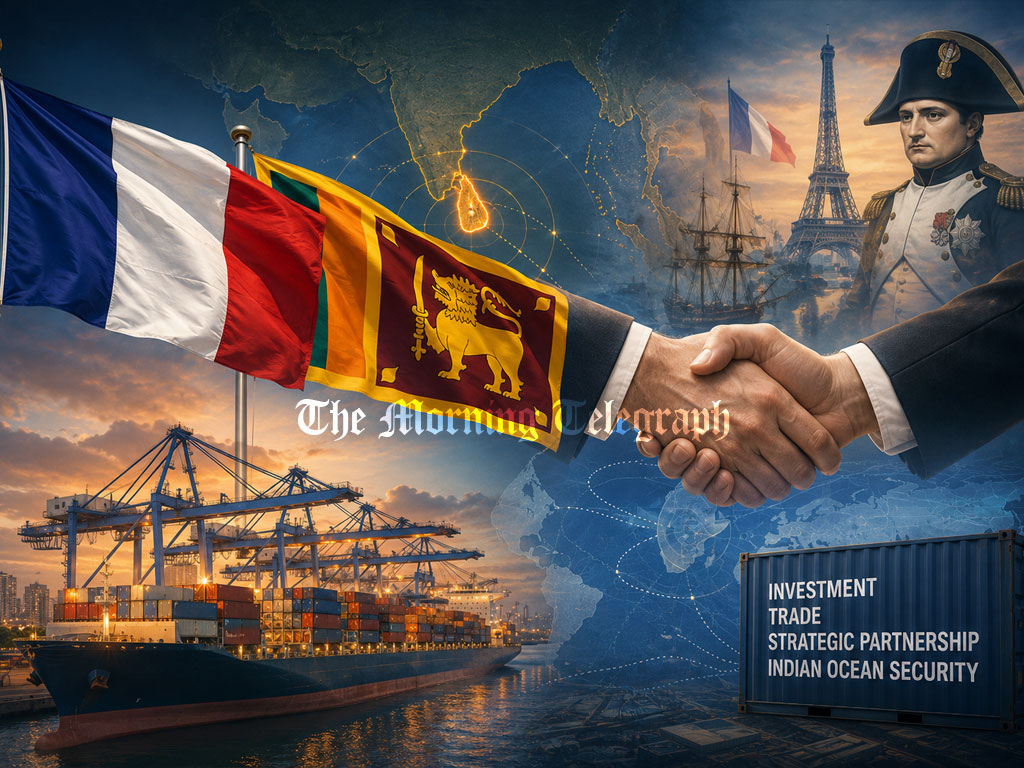
France is deepening its engagement with Sri Lanka through strategic port investments and maritime cooperation, raising new geopolitical questions in the Indian Ocean.
France is steadily expanding its engagement with Sri Lanka, placing the island nation more firmly on the geopolitical map of the Indian Ocean as strategic port investments and maritime cooperation gather momentum.
Sri Lanka’s Ambassador to France, Remi Lambert, is a graduate in history and geography, making him well aware of Napoleon Bonaparte’s famous observation regarding the strategic importance of Trincomalee Harbour. Napoleon is widely credited with stating that whoever controls Trincomalee controls the Indian Ocean. His assessment stemmed from the harbour’s critical role as a major Royal Navy base during the Napoleonic Wars.

Long before the Napoleonic era, the region had already become a focal point of global rivalry. During the American Revolutionary War, the Battle of Trincomalee in 1782 saw French Admiral Bailli de Suffren confront the British Royal Navy. Following the battle, French forces temporarily seized Trincomalee Harbour and transformed it into a vital logistics and supply base supporting their alliance in India.
Today, French President Emmanuel Macron appears to recognize Sri Lanka’s enduring strategic value in the Indian Ocean. Following Sri Lanka’s economic collapse and bankruptcy, Macron played an important diplomatic role in supporting the country’s debt restructuring efforts through the Paris Club, helping pave the way for Sri Lanka to secure its International Monetary Fund agreement.
During that period, then-President Ranil Wickremesinghe was invited to attend France’s Global Financial Summit. Macron also held discussions with Wickremesinghe on bilateral relations and maritime security during a transit stop in Colombo, further highlighting France’s growing interest in Sri Lanka.
The strengthening relationship continued when Rear Admiral Hugues Lainé, Commander of the French Joint Forces in the Indian Ocean, visited Sri Lanka and met with senior defence officials. Those discussions focused on Sri Lanka’s strategic geographical location and the opportunities for deeper maritime and security cooperation in the region.
More recently, while the Commander of the United States Pacific Air Forces was visiting Sri Lanka, Ambassador Lambert met Foreign Minister Vijitha Herath. During the meeting, he conveyed that French investors were eager to participate in development projects connected to the East Container Terminal of the Port of Colombo.
Soon afterwards, Ambassador Lambert held separate discussions with Ports Minister Anura Karunathilaka and the Chairman of the Sri Lanka Ports Authority, accompanied by a delegation representing major French investors.
The delegation was led by the Executive Vice President of CMA-CGM, one of the world’s leading French shipping companies. CMA-CGM currently operates container terminals across 65 major ports worldwide.
During the discussions, the company’s Executive Vice President expressed CMA-CGM’s interest in contributing to the continued development of the Port of Colombo through a joint venture, citing Sri Lanka’s strategic position along major international shipping routes. She also confirmed that the company is already evaluating participation in the second phase of the Colombo Port West Container Terminal project.
Ambassador Lambert further announced that President Anura Kumara Dissanayake is scheduled to visit France on July 16, where he is expected to meet the President of CMA-CGM as part of efforts to strengthen bilateral economic cooperation and explore future investment opportunities.
How France’s increasingly active role within Sri Lanka’s evolving geopolitical landscape will ultimately be viewed by the United States, India and China remains an open question. As global powers continue competing for influence across the Indian Ocean, France’s growing presence could add another significant dimension to the strategic balancing act surrounding Sri Lanka.

What Napoleon said those days is no longer valid I suppose because of the technical advancees in violence and weapon technology
Yes drink only is important because of the free space around it and the size of the harbour weather ect
The writer appears to be well informed. During the separatist war, France was quite active behind the scene with assistance to the GoSL. The number and frequency of naval vessels calling in Colombo is an indication of the interest of both regional and global powers in the Indian Ocean and Sri Lsnka’s location is very strategic