By Roy Denish.
Traffic light labeling is now mandatory for Sri Lanka’s pre-packaged liquid foods, forcing sugar logos on drinks and raising industry concern.
Traffic light labeling is now mandatory on Sri Lanka’s pre-packaged liquid foods after the Ministry of Health and Mass Media finalized its enforcement timeline, ending repeated extensions that had angered food and beverage manufacturers.
The updated timeline came into force through Gazette Extraordinary No. 2494/06, issued on June 23, 2026. The directive amends the original framework under the Food (Colour Coding for Sugar Levels – Liquid) Regulations 2022. Those regulations first appeared in Gazette Extraordinary No. 2319/42 on February 14, 2023, under Section 32 of the Food Act No. 26 of 1980.
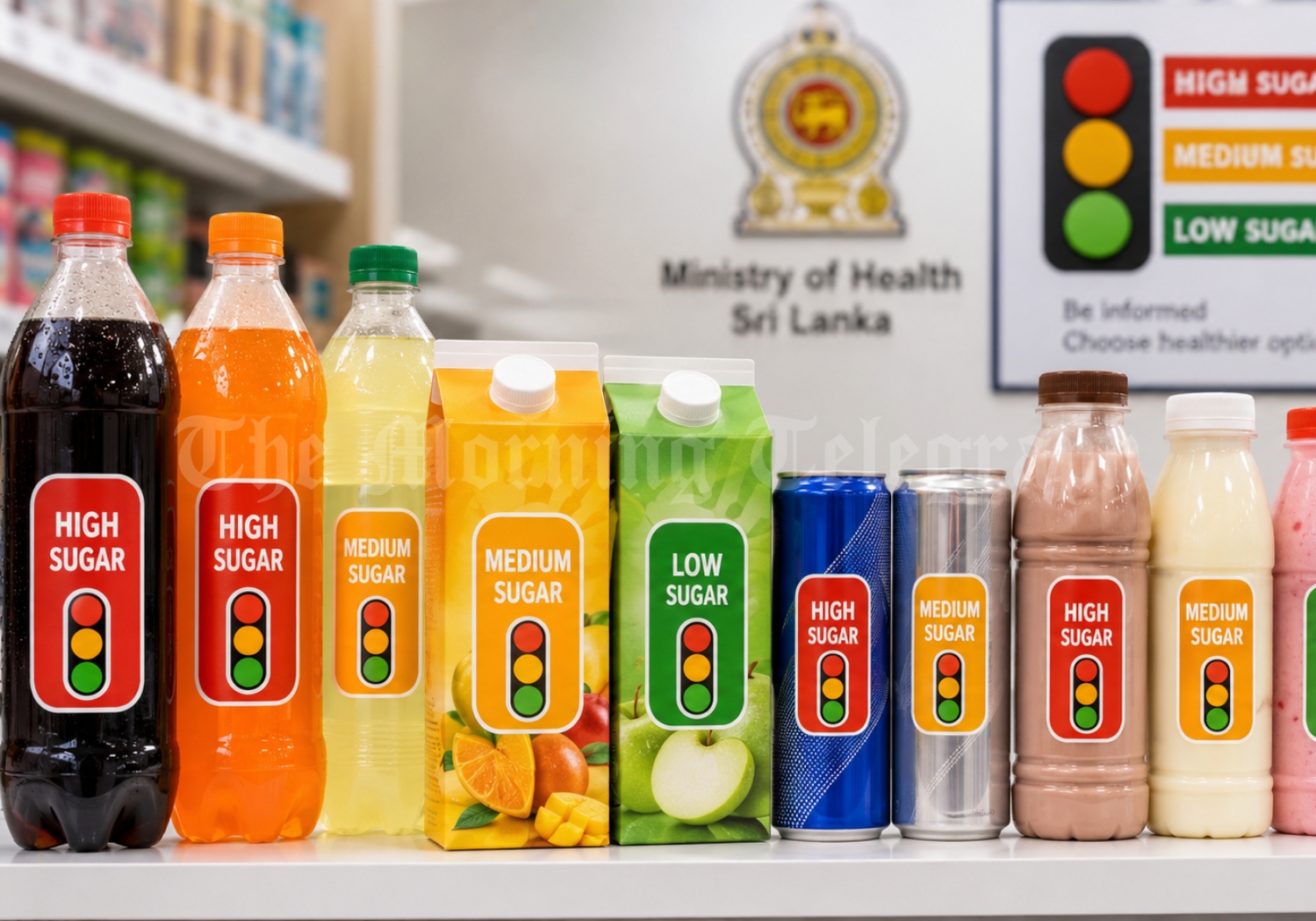
Under the fully enforced law, all pre-packaged beverages and liquid foods must carry a clear front-of-pack logo showing sugar levels. The rule covers a broad list of commercial liquid products. These include carbonated soft drinks, sodas, non-carbonated fruit drinks, fruit nectars, and fruit juices with added sugar.

It also applies to sports drinks, iced teas, energy drinks, cordials, flavored milk products, sweetened milkshakes, and yogurt drinks. Syrups, liquid concentrates, and powdered drink mixes also fall under the law when they become beverages after preparation according to instructions. Sugar content per 100 milliliters determines the color category, while the logo must display bold white lettering in Sinhala, Tamil, and English.
Traffic Light Labeling Sets Sugar Limits
The color system divides liquid foods into three health categories. A red logo marks high sugar content. It applies to any product with more than 8.0 grams of sugar per 100 milliliters.
An amber logo signals medium sugar content. This category covers products containing 2.5 grams to 8.0 grams of sugar per 100 milliliters. A green logo identifies low sugar content and applies to products with less than 2.5 grams of sugar per 100 milliliters.
However, several liquid products remain outside the mandatory traffic light labeling rules. The mandate does not cover products with less than 0.5 grams of total sugar per 100 milliliters. Standardized packaged drinking water, bottled drinking water, and natural mineral water are also exempt.
The law further excludes standardized dairy products without added sugar. These include pasteurized milk, sterilized milk, UHT milk, low-fat milk, and skimmed milk. Unsweetened black tea, green tea, ground coffee, spices, spice mixes, food additives, and flavoring substances also do not need the labels.
Beverage Industry Warns Of Rising Costs
The final rollout has sharpened tensions between public health authorities and commercial manufacturers. Industry representatives argue that the mandatory logos create heavy financial and logistical pressure on a sector already facing a difficult economic climate.
Manufacturers say companies must redesign packaging to make room for the tri-lingual, color-coded logos. As a result, domestic production costs have risen. At the same time, a separate excise duty linked to sugar content has placed companies under a double financial burden. They now face both taxation and forced capital spending.
For importers, the regulation creates another problem. Import firms must manually attach customized, compliant stickers to every incoming container before products can legally move into retail distribution. That process raises overhead costs and slows product availability.
The main commercial complaint remains the expected hit to revenue. Market data indicates that Sri Lankan consumers respond strongly to the visual warning signals on traffic light labels. A bold red logo can act as an instant deterrent. As a result, manufacturers fear a steep fall in demand for high-margin carbonated soft drinks and juices.
The Ministry of Health, however, defends the measure as a critical intervention against rising non-communicable diseases. Beverage companies argue instead that the regulatory approach punishes the industry too aggressively and gives manufacturers too little transitional support.