By Roy Denish.
The same official ordered senior police officers to round up minorities in Colombo and send them to a notorious detention camp in the Southern Province.
COLOMBO, Sri Lanka — A hidden chapter of Sri Lanka’s bloody civil war has emerged through a detailed whistleblower account exposing how top officials, including a senior defence official, allegedly ordered the assassination of a senior law enforcement officer to silence a high-profile human rights investigation.
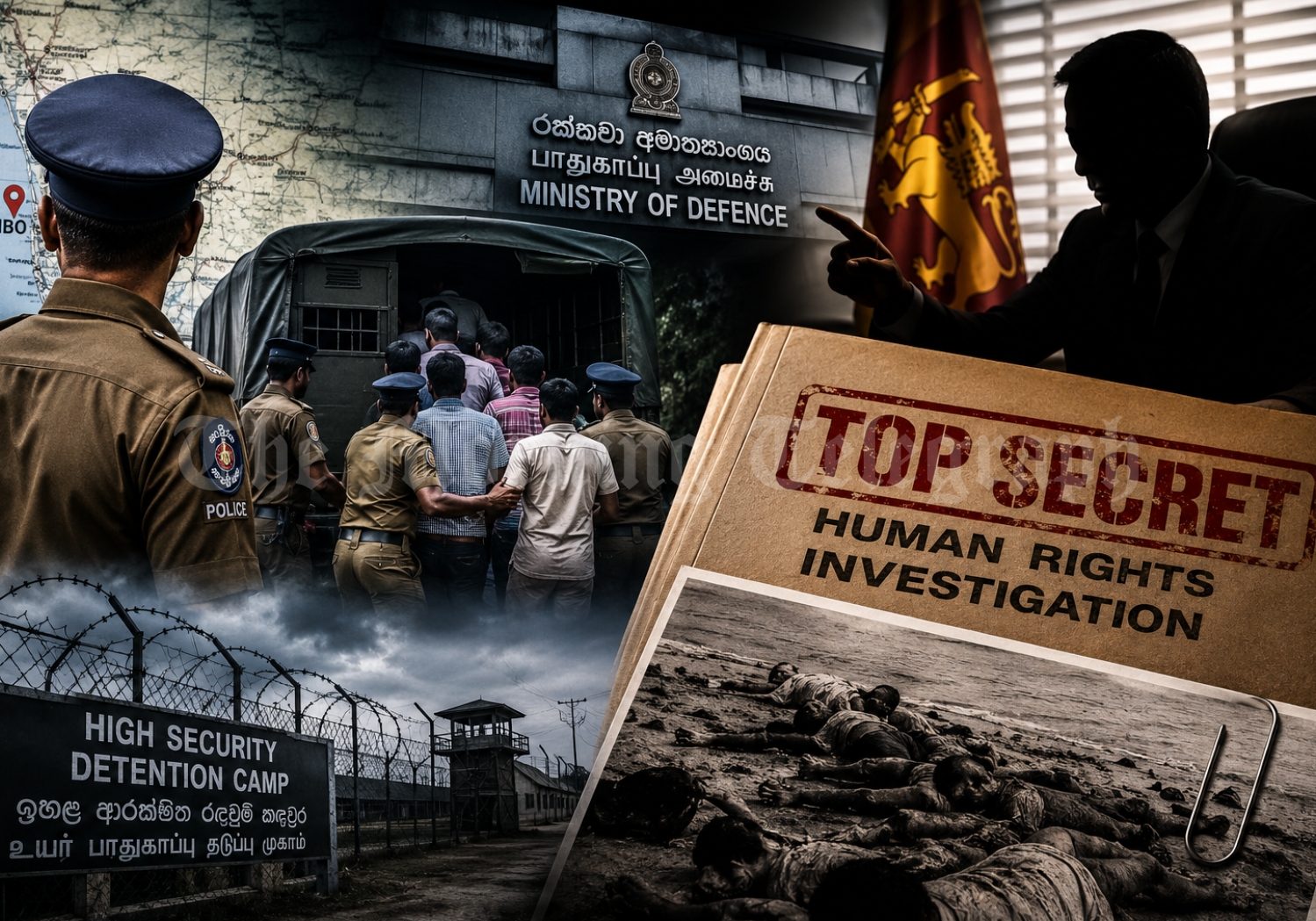
The chilling revelation builds upon a pattern of targeted state actions directed by the defence official, who, immediately after assuming duties, ordered senior police officers to systematically round up unemployed and homeless minorities from the capital and have them arbitrarily detained at a notorious detention camp.

Against this backdrop of systemic state repression, a retired Deputy Inspector General of Police and veteran investigator has detailed a systematic state-sponsored campaign to compromise a presidential commission of inquiry.
The 2007 commission was mandated to investigate 16 of the war’s most notorious atrocities, including the beachside execution of five minority students in a northeastern port city and the massacre of 17 local aid workers working for a French non-governmental organization.
As head of the commission’s victims and witnesses assistance and protection unit, the retired officer became the gatekeeper of testimonies that threatened to incriminate state security forces.
The account exposes deep state complicity, judicial interference, and a targeted death squad deployment directed from the highest corridors of power.
The campaign to neutralize the human rights probe began at its inception.
In May 2007, when the commission requested the Inspector General of Police to nominate the DIG, who could speak Tamil, to head the investigation due to his 40-year career, including two decades in the Criminal Investigation Department and a law degree, the police chief refused to nominate him.
The police chief falsely cited the officer’s impending December 2007 retirement, claiming the commission might continue after 2008.
He nominated two other DIGs.
One DIG was three months older than the said DIG.
The other, a Tamil officer, bluntly refused, saying he would be targeted.
The DIG bypassed the blockade, secured the appointment directly through the commission, and staffed the protection unit with trusted police boxers and long-time field colleagues to ensure operational integrity.
By late August 2007, as the unit head prepared to fly to Australia for specialized witness assistance and protection training, a Deputy Solicitor General, who was acting as the unit’s adviser, was also due to go.
The Presidential Secretariat issued a sudden directive.
The order barred any public servant with less than two years of remaining service from utilizing government funds for overseas training.
Since not having this training would hinder his progress, the DIG said he would finance his two-week trip himself.
Parallel institutional conflicts over human rights directives unfolded within the law enforcement framework during this period.
In 2007, the state human rights apparatus expanded when the Secretary of Foreign Affairs requested the police legal division to conduct comprehensive lectures for police station officers-in-charge regarding human rights violations.
The educational initiative, coordinated alongside an Additional Solicitor General who later became the Attorney General, targeted high-level personnel across multiple divisions, including divisional superintendents, assistant superintendents, and heads of crime branches.
Lectures focused heavily on conducting criminal interrogations without resorting to physical assault, alongside broader presentations on the legal implications of human rights violations.
During a session break for a major urban division, a high-ranking field officer disclosed to the legal team, under absolute confidence, details of a prior briefing led by the head of the ministry.
According to the disclosure, the defence official explicitly ordered that if any minority individual was found within the capital without a registered residence or formal employment, that person was to be immediately arrested and transferred directly to a high-security detention facility.
When a senior retired law enforcement official raised concerns during that briefing regarding potential human rights violations, the defence official reportedly aggressively reprimanded and dismissed the officer.
The disclosure sparked immediate internal bureaucratic friction when it was reported the following day at a high-level foreign affairs meeting.
A member of the official bar assisting the Udalagamuwa Commission immediately intervened, stating that a foreign affairs meeting was an inappropriate forum for the disclosure and insisting the matter be handled directly through the Inspector General of Police.
Despite the pushback, the head of the legal division formally documented the incident, submitting an official dispatch to the Inspector General of Police, with copies distributed to the Secretary of Foreign Affairs, the Additional Solicitor General, and the commission’s legal counsel.
While foreign ministry leadership privately commended the integrity of the formal report, the state-appointed commission counsel contacted the legal division to verify the authenticity of the written filing, signaling deep administrative anxiety over the documentation of the mass detention directive.
Operating under strict need-to-know protocols, the unit head and his deputy, an attorney and school principal, personally conducted high-risk relocations of vulnerable victims and witnesses.
Seeking to shield them from state surveillance, the unit head coordinated with foreign embassies to smuggle key witnesses out of the country and hid others locally within dense, ethnically integrated communities.
He intentionally excluded his own police drivers from these operations to protect them from departmental retaliation, transfers, or forced interrogations.
By mid-September 2008, the protection unit’s success triggered a lethal response from the defence establishment.
The unit head received intelligence from a vetted security source who had previously accurately warned of a high-profile political assassination.
The source revealed that during a closed-door, top-level meeting of the military and police command, the same member of the official bar assisting the Udalagamuwa Commission had actively compromised the unit.
The state-appointed counsel informed the panel that the unit head was holding witnesses incommunicado and coaching them to provide testimony inimical to the interests of the state.
Upon receiving this briefing, the top defence official chairing the meeting, identified as the head of the ministry, explicitly assigned a specialized unit of the state security forces to eliminate the protection unit head.
On September 15, 2008, the unit head submitted a formal resignation letter to the Udalagamuwa Commission chairman.
To mask the immediate threat, the letter cited financial constraints and an unreleased state pension.
Privately, however, the unit head verbally informed the commissioners that a state hit squad was actively targeting his life.
The commission chairman instructed him to cease attending public commission proceedings, confine his movements strictly to the internal offices, and remain in the post until a replacement could be secured.
An ex-policeman who was a close relative of a sitting cabinet minister subsequently confirmed the active nature of the assassination order.
Believing the threat would subside once the ministry observed his withdrawal from active proceedings, the unit head fortified his residence, which was located down a dead-end street containing only five houses.
He ordered his remaining staff to conduct routine counter-reconnaissance along his daily transit routes.
The surveillance escalated significantly in the early hours of October 2, 2008.
At 1:15 a.m., neighbors alerted the unit head after a pack of local dogs began barking aggressively down the lane.
Residents who stepped outside witnessed two unidentified men standing directly beside the unit head’s personal vehicle, and the men turned and walked away casually once observed.
A neighborhood youth subsequently reported seeing the same individuals, including a fair-skinned man, casing the vehicle at midnight on two separate occasions that same week.
Suspicious motorcyclists were also documented repeatedly entering and exiting the dead-end street.
Convinced that resigning would not stop the assassination plot, the unit head officially withdrew his resignation on October 4, 2008, concluding that maintaining an official link to the commission was his only viable shield.
On October 9, 2008, the commission chairman intervened directly, sending an urgent dispatch to the Inspector General of Police.
The commission chairman explicitly linked the death threats to the unit head’s official duties in protecting witnesses who had been terrorized to prevent them from testifying against state forces.
The commission demanded immediate, adequate physical protection for the unit head and ordered an emergency investigation by the Criminal Investigation Department.
The police department systematically ignored the judicial order.
No protection details were deployed, no witnesses were questioned regarding the death squad surveillance, and an Assistant Superintendent of Police merely recorded a standard statement before closing the matter.
Instead, the police department escalated bureaucratic pressure, denying the release of the unit head’s legally owed retirement pension and demanding that he immediately surrender his official service pistol.
This occurred despite an explicit written directive from the commission chairman on June 12, 2008, authorizing the unit head to retain his firearm for self-defense due to the verified threats against his life, a privilege standardly afforded to retiring high-ranking police officers.
With domestic legal and security structures entirely compromised, the unit head met secretly with top diplomats from two foreign missions in the capital to brief them on the active state plot.
When asked by a foreign diplomat if the information should be directly confronted with the ministry, the unit head agreed, stating that the top official must know the international community was watching and that this killing could not be portrayed as an unsolved crime by unknown actors.
The human rights commission was abruptly terminated in April 2009 by the country’s president, just as the military finalized its total victory in the civil war.
By allowing the commission’s mandate to expire, the administration effectively dismantled the witness protection unit, halted the human rights investigations into the remaining nine atrocities, and left the remaining protected witnesses entirely exposed to state reprisal.