
Plantation investment schemes face scrutiny over CSN’s reported comeback, extraordinary vanilla claims and alleged media acquisition strategy.
Plantation investment schemes are facing fresh scrutiny following reports that CSN television is preparing to return under a network linked to rapidly expanding agricultural investments.
The channel attracted major controversy in the past and continues to face various legal cases. Therefore, the reported comeback has raised questions that extend far beyond ordinary media investment.
The central allegation is that a suspicious and unregulated financial network is orchestrating the operation. This network has reportedly expanded rapidly across Sri Lanka while promoting what it describes as “Plantation Investments.”

The Reported CSN Comeback
According to reports, an entity called Business Media International has acquired the channel under a 20-year long-term lease arrangement.
Business Media International is reportedly affiliated with a business network known as Agro Ventures.
The company has allegedly agreed to pay the owner of CSN a massive Rs. 23.8 million each month. That figure is equivalent to Rs. 2 crore and 38 lakh.
Recent reports have also revealed further details about the television channel’s attempted return.
CSN had remained closed for years while facing several controversial legal cases. However, reports indicate that it has already conducted test transmissions for nearly six months.
An earlier report claimed that a former head of a state media institution, with links to the current government, was serving as the channel’s Chief Operating Officer.
However, according to the latest information received by us, Nilupa Ranawcera currently holds the COO position.
Ranawcera previously served as Chief Engineer at the company that owns the Swarnavahini television channel.
The former state media chief mentioned in the earlier report allegedly holds a more senior position at CSN. According to the latest information, that individual serves as the channel’s CCO.
These developments make it essential to examine who is financing the channel and why a plantation-linked business network would commit such vast sums to broadcasting.
Plantation Investment Schemes and Asset Growth
The business model promoted by these companies appears sophisticated.
They claim to cultivate “Vanilla Planifolia,” often marketed as “green gold.” They also claim that they will plant four million vanilla vines by 2030.
According to their projections, those vines will eventually produce 16 million kilograms of vanilla.
The businesses say investors receive legal security because land ownership is transferred through the Matale Land Registrar’s Office. They market the investment as “Fully Asset-Backed.”
However, they also promise returns of approximately 120% after five years.
Such returns appear highly inconsistent with general business principles. They also conflict sharply with available local and international production and export data.
The operators of these plantation investment schemes reportedly boast of earning billions of rupees through their vanilla projects.
Yet an examination of national export statistics raises serious mathematical questions about those projections.
In 2024, Sri Lanka exported only 5,262 kilograms of vanilla in total. The entire country earned approximately US$1,066,230, or around US$1.07 million, from those exports.
Even in the previous year, total export earnings did not exceed US$1,406,160, or approximately US$1.41 million.
When the 2024 revenue is converted at the current exchange rate, the figure amounts to roughly Rs. 320 million to Rs. 350 million. That equals approximately Rs. 32 crore to Rs. 35 crore.
The most striking contradiction involves the company’s forecast of harvesting 16 million kilograms by 2030.
Sri Lanka currently exports approximately 5,262 kilograms annually. Therefore, the company claims it will produce a harvest around 3,040 times larger than the country’s present total exports.
The global figures make the claim even more difficult to accept.
Total annual vanilla production worldwide stands at approximately 8,000 metric tons, or eight million kilograms.
Therefore, one Sri Lankan company is effectively claiming that it will produce 16 million kilograms. That would be twice the current annual production of the entire world.
Such a projection appears to lack a credible mathematical, agricultural or economic foundation.
Sri Lanka’s total annual vanilla export income remains around Rs. 35 crore. Against that reality, promises to distribute billions of rupees in profits require urgent scrutiny.
The figures raise the allegation that these operators may not be engaged in physical cultivation on the scale advertised. Instead, critics argue that they are selling the public a mathematically impossible vision.
Further questions surround claims that the company accumulated financial assets worth Rs. 60 billion within four years of its establishment in 2022.
That growth raises serious concerns about the network’s financial transparency.
Reports also claim that individuals who were ordinary insurance agents in the Thalawathugoda area several years ago have since become millionaires living in luxury Colombo apartments.
Why Would Plantation Businesses Buy Media?
This brings the discussion back to the central question.
Why would alleged pyramid or Ponzi-style operators spend billions of rupees to acquire media channels?
Several possible reasons require consideration.
A Ponzi or pyramid-type operation depends on a steady daily flow of money from new investors. Without continuous recruitment, the structure cannot survive.
For that reason, operators need to create an image of legitimacy, stability and public trust.
Ownership or control of a mainstream media channel could provide that image. It could make an unregulated business appear more established and credible to ordinary investors.
Media influence could also become valuable when the Central Bank or other authorities warn the public about suspicious investment operations.
A company that controls its own broadcasting platform could suppress damaging reports. It could also promote favourable narratives and repeatedly defend its activities before a mass audience.
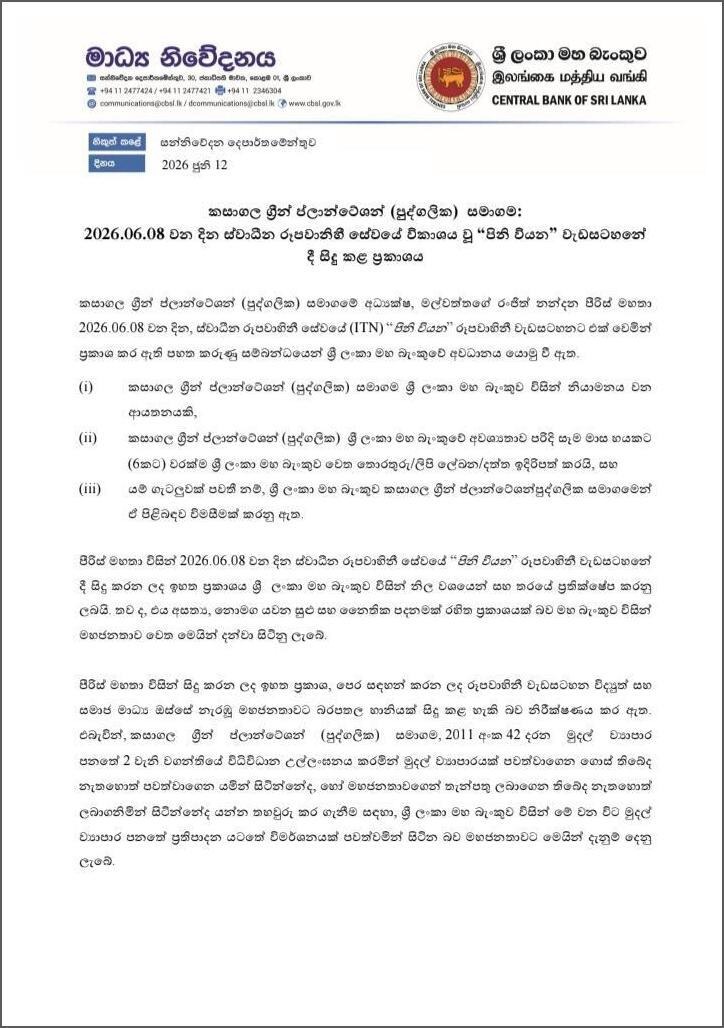
Reports claim that Kasagala Plantations came under strict Central Bank scrutiny after promoting itself through paid programmes on national media.
The company reportedly attempted to acquire two other radio channels. However, those efforts allegedly failed because of legal issues linked to existing cases involving the channels.
If accurate, those attempts would further strengthen concerns about a deliberate campaign to secure media influence.
Special Attention
Plantation business networks are spreading rapidly across Sri Lanka. However, the country continues to struggle with imports of rice, potatoes, onions and even vegetables.
Against that background, media organisations accepting money for advertisements and sponsored programmes carry a serious responsibility.
They should independently establish whether these businesses conduct physical cultivation at anything close to the scale they advertise.
Accepting paid content without examining such claims could expose the public to significant financial risk.
CSN’s Past and the Central Bank Warning
The history of CSN is itself controversial.
The channel launched in 2011 after allegedly obtaining the frequencies and Pay TV rights of Prime TV, which belonged to ITN.
Critics alleged that political influence enabled the transfer without transparency or a competitive tender process.
CSN has consequently faced controversy since its inception.
Today, concerns have emerged that the same channel could become a media instrument for unregulated financial networks.
Central Bank Governor Dr. Nandalal Weerasinghe recently issued a clear warning about high-return agricultural and plantation investments.
“Such high-return projects and institutions operating under the guise of agricultural and plantation sector investments are NOT regulated by the Central Bank of Sri Lanka. These are mostly likely to be illegal deposit-taking schemes. Therefore, we strongly urge the public to refrain from investing money in such unsafe projects.”
Sri Lanka has already witnessed devastating financial frauds linked to names such as Sakvithi and Kotalawala. The losses suffered by their victims remain a painful national memory.
Therefore, the public must treat promises of rapid wealth with extreme caution, especially when the Central Bank has issued direct warnings.
The reported effort to spend billions on media institutions should not automatically be viewed as public service.
It may instead represent an attempt to legitimise undisclosed wealth, build a respectable public face and attract more money from unsuspecting investors.
The questions surrounding CSN’s reported return, extraordinary vanilla projections and rapid asset growth demand independent regulatory scrutiny. They also demand greater responsibility from media organisations that profit from promoting plantation investment schemes to the public.