Sri Lanka 2027 budget targets depend on stronger revenue, strict spending controls and steady growth under the IMF-backed reform programme.
The Sri Lanka 2027 budget strategy outlines an ambitious route towards fiscal stability, but its success depends on revenue, spending restraint and economic growth remaining closely aligned.
The Government’s Fiscal Strategy Statement (FSS) for 2027 sets out a medium-term plan under the IMF-backed reform programme. However, the figures also reveal a narrow margin for error as authorities attempt to manage competing economic pressures.
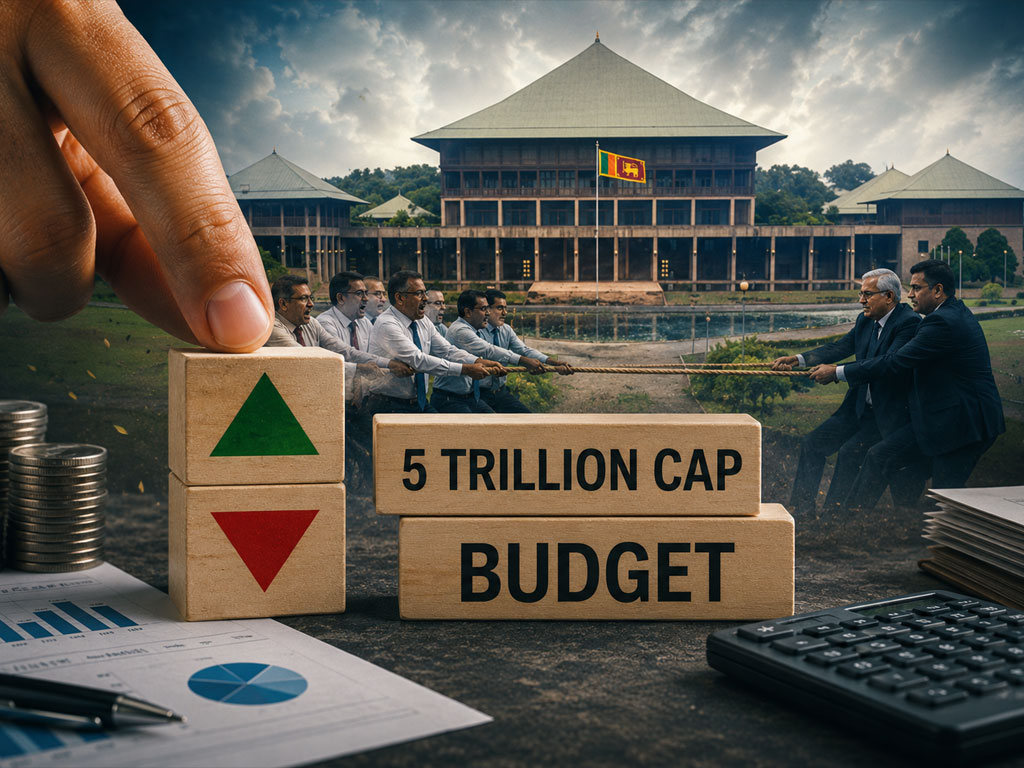
At the centre of the plan is a statutory primary expenditure ceiling of Rs. 5.064 trillion. This equals 12.9% of gross domestic product and will serve as the Government’s main fiscal anchor.
Officials intend to maintain the ceiling until 2031. Meanwhile, the Government plans to reduce the overall Budget deficit from an estimated 5.6% of GDP in 2026 to 4.5% in 2027.
The deficit should then narrow gradually to 3.5% of GDP by 2031.

Sri Lanka 2027 Budget Depends on Steady Revenue
The strategy requires several major assumptions to work at the same time.
Revenue and grants are projected to remain at 15.5% of GDP throughout the five-year period. At the same time, primary expenditure must stay below 13% of GDP.
Meeting both targets every year will require stronger tax collection and continued discipline over Government spending.
One of the main challenges involves protecting recent revenue gains. The FSS projects tax revenue at 14.2% of GDP and non-tax revenue at 1.2%.
However, weaker economic activity could reduce collections. Falling consumer demand or lower business profits could also place pressure on revenue.
Sri Lanka’s recent revenue improvements have largely followed tax reforms introduced during the economic recovery. Yet maintaining those gains may become harder as the economy returns to more normal conditions.
The Government must therefore improve compliance and collection without creating new pressures that could weaken consumption, investment or business activity.
Spending Controls Could Become Politically Difficult
Managing expenditure will present another major test.
The Government plans to reduce total expenditure from 20% of GDP in 2027 to 19% by 2031. At the same time, it intends to maintain public investment at 4.4% of GDP.
As a result, recurrent expenditure will remain under strict control. This includes public-sector salaries, subsidies and the daily operating costs of Government institutions.
Analysts warn that such restraint could become politically difficult.
Pressure may grow for salary increases across the public sector. The Government could also face demands for wider welfare assistance or additional financial support for State-owned enterprises.
Any major spending overrun would place the primary expenditure ceiling under pressure. It could also disrupt the Government’s deficit-reduction programme.
Maintaining public investment while restricting recurrent expenses will require careful prioritisation. Otherwise, the Government could face pressure to cut development projects or seek additional revenue.
Growth Forecasts Carry Significant Fiscal Weight
The fiscal framework also relies heavily on economic growth assumptions.
The Government forecasts real GDP growth of 4.2% in 2027. Growth is then expected to moderate to around 4% during the following years.
Nominal GDP growth is projected to remain at 9% annually.
Stronger growth would make the Government’s debt and deficit targets easier to achieve. A larger economy would increase revenue and reduce debt and deficit figures when measured as percentages of GDP.
However, weaker growth would create the opposite outcome.
Lower economic activity would reduce tax collections. It would also push fiscal ratios higher relative to the size of the economy.
Therefore, even if the Government controls expenditure, a slowdown could still make the headline targets harder to achieve.
Primary Surplus Must Continue for Several Years
The Government is targeting a primary surplus of 2.6% of GDP from 2027 onwards. This follows an estimated primary surplus of 2.1% in 2026.
Sri Lanka recorded a primary surplus of 5.4% in 2025. That result showed that substantial fiscal consolidation was possible.
However, maintaining large primary surpluses over several consecutive years has historically proved more difficult.
Fiscal pressures can return through wage demands, welfare requirements, debt-related costs or support for struggling public enterprises.
The Government must therefore ensure that the surplus does not depend only on temporary revenue increases or postponed expenditure.
Ultimately, the Sri Lanka 2027 budget strategy represents far more than a list of financial targets.
Its success will depend on whether economic growth, revenue mobilisation and expenditure discipline remain aligned throughout the medium term.
Any significant weakness in one of those areas could force difficult policy changes. It could also test the Government’s commitment to deficit reduction and long-term debt sustainability.