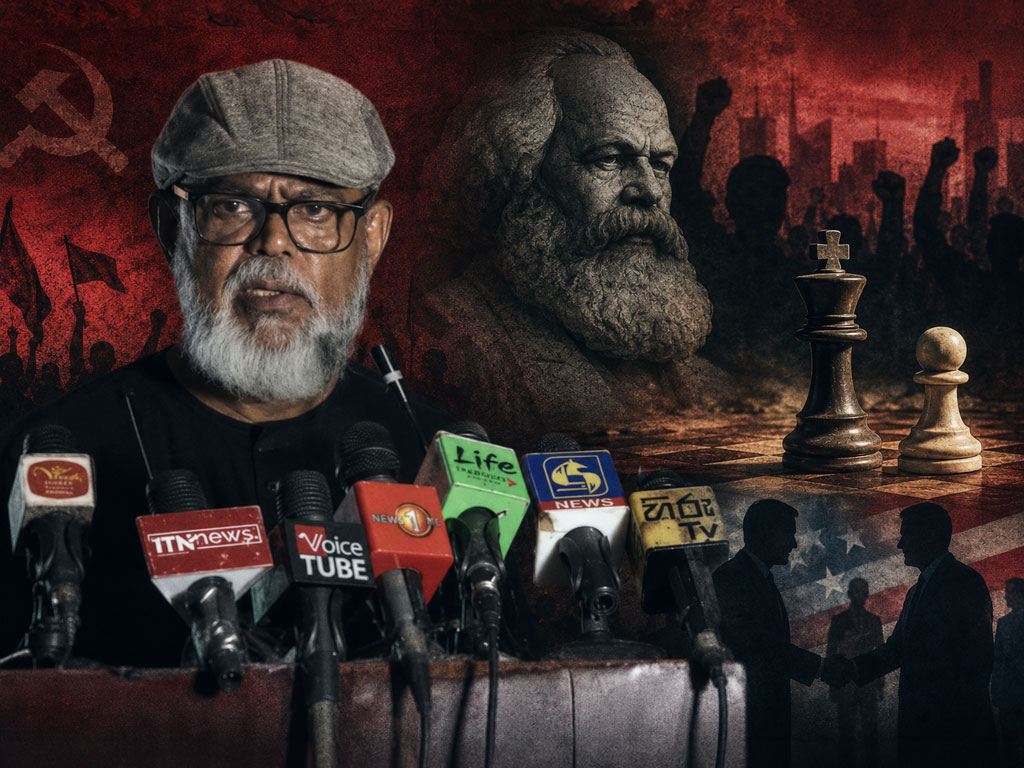
Sri Lankan Left movement leaders were absorbed by liberal capitalism and coalition politics, veteran journalist Gnanaseera Kothigoda argues.
The Sri Lankan Left movement lost its ideological direction after senior leaders embraced liberal capitalism, coalition politics and personal opportunism, veteran journalist Gnanaseera Koththigoda has argued.
Breaking more than 15 years of silence away from political platforms and public media, Koththigoda delivered a sharp analysis of what he described as the theoretical collapse of Sri Lanka’s Left.
He said a new Marxist party was now necessary to challenge the entire political and economic system. Such a movement, he argued, must resist what he described as an American imperialist liberal-left project operating through environmental, human rights and LGBTQ+ organisations.
Koththigoda formerly served as President of the Sri Lanka Union of Professional Journalists. He was also a Political Bureau member of the New Socialist Party, known as the NSSP, and previously worked for the BBC Sinhala Service.
He made the remarks during the launch of his autobiographical book, The Beginning, Middle, and End of the New Socialist Party and Me.
The event took place on July 7 at the Auditorium of the National Library and Documentation Services Board in Colombo.
The book draws on Koththigoda’s 24 years of experience in political and labour struggles. It also covers his period in political asylum in Switzerland.

Labour Activism Led Koththigoda Into Politics
Koththigoda entered politics while working at the Wellawatte Textile Mill after moving to Colombo from a rural background.
His early political involvement developed through campaigns against the mill’s closure under the country’s open-economic policies.
During that struggle, he met Vasudeva Nanayakkara and Sirithunga Jayasuriya. He later joined the New Socialist Party and became deeply involved in Left politics.
Looking back, Koththigoda identified several causes behind the decline of the Sri Lankan Left movement.
He argued that trade unionism gradually replaced the wider political objectives of the party. At the same time, personal ambition and opportunism weakened ideological discipline.
Koththigoda said the crisis intensified when sections of the Left entered coalition politics with the government of Chandrika Bandaranaike Kumaratunga in 1994.
According to his analysis, those alliances trapped Left leaders inside a system they had previously promised to challenge. Instead of transforming the state, he said, many became part of its existing political structure.
He described that shift as a decisive moment in the weakening of revolutionary politics.
Koththigoda Blames Weak Marxist Education
Koththigoda argued that strong Marxist education is essential for any Left party seeking political power.
Without such theoretical training, he said, party members became vulnerable to the values promoted by the capitalist system and liberal ideology.
He claimed that several Left leaders were eventually swept away by that ideological current.
Koththigoda also addressed the controversial question of authority within revolutionary political movements.
He referred to Lenin’s position that a revolutionary party requires “iron discipline” and authority to achieve political power.
However, he distinguished that form of authority from the authoritarian rule practised by capitalist governments.
According to Koththigoda, the real issue is how party leaders use their authority. Leaders must not use power to protect their own positions or personal survival, he argued.
Instead, they should use it to develop cadres from below and build the organisational strength required for a successful revolution.
He said a disciplined party must prioritise political education, grassroots leadership and collective goals over individual privilege.
New Party Needed to Challenge the Entire System
Koththigoda also discussed the global political changes that followed the collapse of the Soviet Union.
He argued that American imperialism adopted new methods to spread its influence internationally after the Soviet bloc disappeared.
According to his analysis, organisations linked to human rights, environmental activism and LGBTQ+ issues have helped introduce liberal-left ideas into societies.
Koththigoda claimed that these projects may appear progressive while ultimately protecting the existing capitalist system.
He described them as system-preserving initiatives because they focus on reforming limited sections of society rather than replacing the wider economic and political structure.
In his view, liberalism changes individual parts of the system while leaving its foundations untouched.
Koththigoda therefore called for a new political party rooted in what he described as genuine Marxism.
Such a movement must aim to uproot and transform the entire system rather than make small adjustments within it, he said.
He argued that the need for such a party extends beyond Sri Lanka. A strong international Left movement has become necessary across the world, he maintained.
Koththigoda’s intervention marks his return to public political debate after more than a decade away from the spotlight.
His analysis presents the decline of the Sri Lankan Left movement as the result of weak political education, coalition opportunism, trade-union limitations and the growing influence of liberal capitalism.
He concluded that only a disciplined, ideologically trained and system-changing Marxist movement could rebuild the political Left and restore its original revolutionary purpose.
🔴 රනිල් තරම් අධිකාරීවාදියෙක් නෑ? | මාක්ස්වාදීන් කළ යුත්තේ දේ – කොත්තිගොඩ වසර 15කට පසු කියයි
Topic: Leftist ideology, authoritarianism, and the future of Marxism in Sri Lanka
Channel: Voice Tube (748K subscribers)
Published: July 8, 2026
Source: Voice Tube (YouTube) • This is an embedded preview. Click play to watch on this page if your browser supports iframes.